

Last updated: October 2026 · This is my own experience. What you make depends on what you sell and where you live.
Have things you no longer use, but no room to keep them? Selling locally can help you clear the space without arranging postage for every item. The questions are usually where to list, how to price and how to handle collection safely.
I’ll show you what we sold, how our clear-out worked and the steps you can follow with your own belongings. Start with one item you can photograph, describe honestly and have ready for collection.
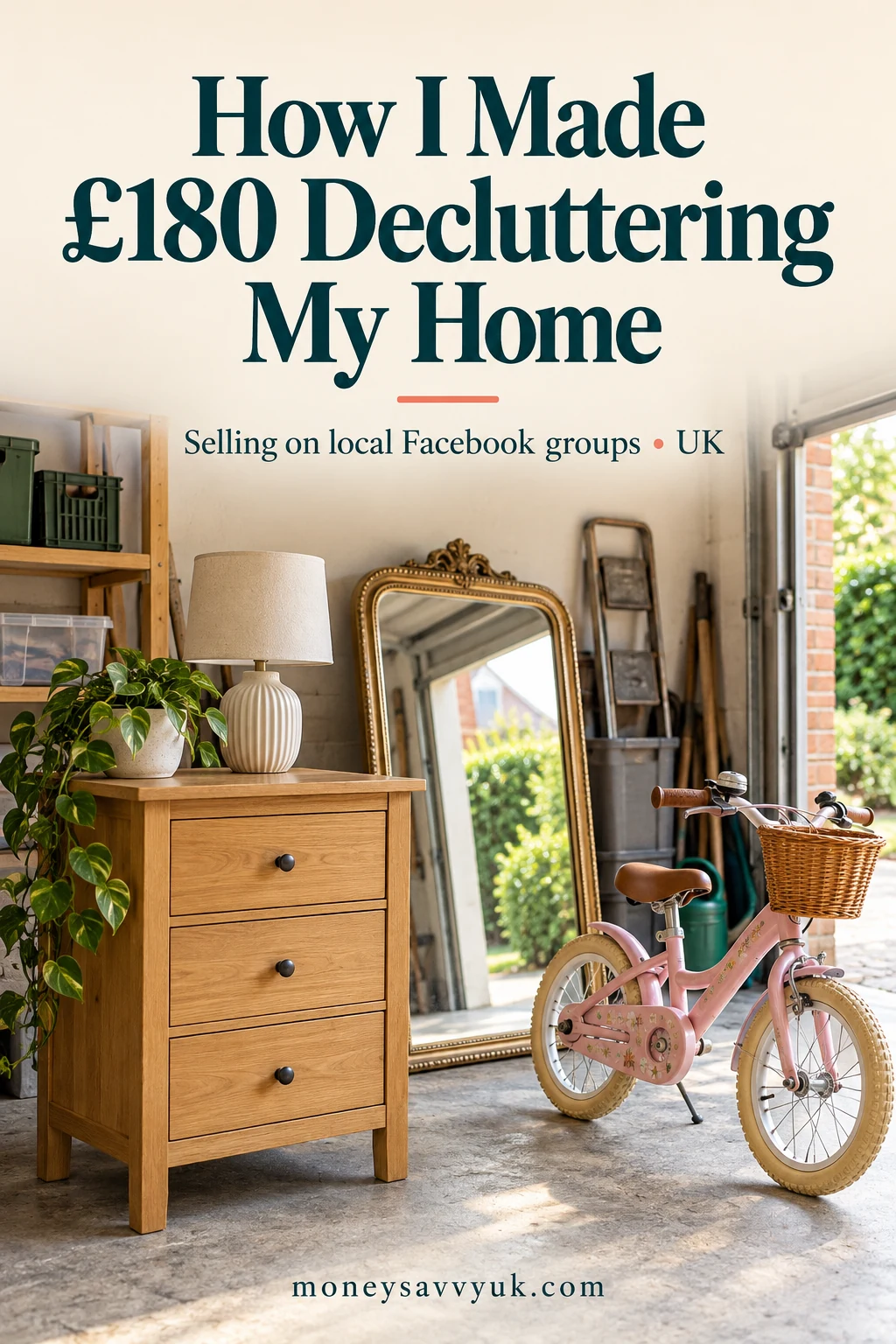
Like a lot of families, we’d been putting everything we weren’t using into the garage. Then one day I went into the garage and started selling the things we weren’t using on local Facebook groups. We made £180 in a week. We sold things like our son’s bike (he’d outgrown it), a mirror and bedside cabinets. Buyers collected from our home, and we always asked them to test the item before they paid. They were happy with what they bought, and we were happy too. It wasn’t a get-rich-quick plan. It was simply clearing out cupboards, taking a few photos and letting someone nearby give our old things a new home. And I ended up with a tidier house and £180 in my pocket.
If you’ve got a garage, loft or spare room full of “I might need that one day”, here’s exactly how to turn it into cash, step by step: what to sell, how to price it, how to write a listing that sells, and how to stay safe.
To plan the next step, try my Side hustle tax calculator.
Free printable: the Clear Out, Cash In toolkit
A 30-day clear-out plan, a what-to-sell list, a listing template, message scripts and safety checklists, from my book Good Salary, Extra Cash.
Why I sell locally on Facebook
- It’s free for local sales. Facebook doesn’t charge a fee when you arrange the payment and collection yourself.
- No posting. Buyers collect, so it’s perfect for big or awkward things like furniture, prams and toys.
- Lots of local buyers. Most areas have busy buy-and-sell groups, as well as Marketplace.
- It’s quick. Some things sell the same day.
For clothes and smaller items you can post, Vinted can be better. Here’s my guide on how to sell on Vinted UK.
Step 1: Declutter one room at a time
Start with the place where unused things pile up. For us, that was the garage. Then don’t try to do the whole house in a day. That’s how decluttering ends with everything in a pile in the hallway. Pick one room or one cupboard, and sort everything into four piles:
- Keep: you use it or love it
- Sell: in good condition and someone would pay for it
- Donate: still useful, but not worth the effort to sell
- Recycle or bin: broken or worn out
My tip: time it around the school holidays
We made our £180 in a single week. My tip is to do your clear-out during or just before the school holidays. Parents are at home looking after the children, so they’re happy to pop round and collect during the daytime, and it’s when lots of parents are looking for things like bikes, toys and garden furniture. It’s also a natural time to sort out what the kids have outgrown.
What sells well on Facebook?
- Furniture: bookcases, chests of drawers, tables, desks, garden furniture
- Baby and kids’ things: prams, cots, high chairs, toys, outgrown bikes
- Home and kitchen: small appliances, lamps, mirrors, storage
- Garden and DIY: tools, lawnmowers, plant pots
- Hobby and fitness kit: exercise bikes, weights, craft supplies
- Seasonal items: Christmas decorations in autumn, paddling pools in spring
Use the season to choose what to sort first: garden furniture before warmer weather or festive decorations ahead of Christmas, for example. This is a planning suggestion, not verified sales-ranking data or a promise of a faster sale.
For baby items, be extra careful with safety. Car seats are best not sold second-hand, because hidden accident damage can’t be seen. Always check for product recalls before selling anything for children.
Give some things away for free
Not everything has to be sold. We gave some things away for free, like a sofa and a garden dining table, because we needed the space. They were in good condition, so someone nearby got something useful, and it saved us hiring a van or paying for a trip to the tip. Bulky furniture can be expensive and awkward to get rid of, so “free to collect” can be the cheapest option of all.
If you give things away, post them as free on Marketplace or your local group, say that the buyer must collect, and give measurements so people know it’ll fit. Facebook’s local groups and apps like Freecycle and Olio are great for this.
Step 2: Take clear, honest photos
- Use daylight near a window. It makes everything look better.
- Clean the item first and clear the background.
- Take 4 to 6 photos: the front, back, sides, any labels or brand names, and close-ups of any marks.
- Show any damage. It saves wasted trips and awkward conversations at the door.
Step 3: Price it to sell
Price from what similar things are selling for locally, not what you paid. Search Marketplace and your local groups for the same item and see what’s listed, and what’s gone quickly.
- Want it gone fast? Price a little below similar listings.
- Happy to wait? Price in the middle and allow a little room to negotiate.
- Not selling after a week? Drop the price, or relist with better photos.
Be ready for “Is this still available?” and “Would you take £X?” messages. Decide your lowest price before you list, so you can answer quickly.
Step 4: Write a listing that answers every question
A good listing saves you lots of messages. Include:
- What it is, including the brand and model if you know it
- Condition, honestly
- Measurements for furniture (people need to know if it fits in the car and the house)
- Collection area (just the town or area, not your full address)
- Whether it needs taking apart, and if you’ll help carry it
- Payment: cash on collection, or bank transfer before collection
Here’s an example listing:
Example: “White 5-shelf bookcase, good condition, a few small marks on one side (see photo 4). H 180cm × W 80cm × D 30cm. Collection from [area]. Already flat-packed. £[price], cash on collection.”
Step 5: Use Marketplace and local groups
Facebook lets you sell on Marketplace and in buy-and-sell groups. I’d use both:
- Marketplace reaches lots of people in your area.
- Local groups (search your town’s name plus “buy and sell” or “selling”) often have keen local buyers. Read each group’s rules first: some only allow certain items or certain days.
Check Meta’s current Commerce Policies for the exact item. An ordinary household item still needs to meet the relevant eligibility and safety rules.
Step 6: Sell safely
- Keep messages on Facebook where you can, so there’s a record.
- Watch for scams. Common ones include fake “payment sent” emails, buyers asking you to click a link to “receive” money, buyers who want to send a courier and overpay, and requests for codes sent to your phone. If anything feels odd, don’t go ahead.
- Get paid before the item goes. Cash on collection, or check the bank transfer has actually arrived in your banking app.
- For small items, meet in a busy public place.
- For big items collected from home, have someone else in, and put the item in a porch or garage if you can. That’s how we sold ours: buyers came to the garage.
- Let buyers inspect the item before paying. We asked our buyers to check or test items where appropriate. This helps them understand the condition, although it cannot guarantee that a dispute will never arise or remove any applicable rights.
Do you pay tax on selling your old things?
Usually not. GOV.UK says there’s no new tax on selling things online. If you’re decluttering and selling your own unwanted possessions, you probably won’t owe tax.
Some online platforms must report seller information to HMRC under digital-platform rules. Do not assume every Facebook advert or locally arranged sale follows the same reporting process as a marketplace checkout. Reporting rules are separate from whether you owe tax. See HMRC’s explanation; keep your own sales records regardless.
It’s different if you buy things to resell or make things to sell for profit. That can count as trading. If that income is more than £1,000 a year before expenses, you may need to register for Self Assessment. My side hustle tax and £1,000 trading allowance guide explains more.
What to do with the money
It’s so tempting to spend it, but decluttering money is perfect for:
- Starting your emergency fund: here’s my guide to your first £1,000
- Christmas savings in a sinking fund
- Paying off a small debt
And the best part: you won’t fill the space back up if you’re mindful about what you buy next.
Facebook Marketplace UK: questions before your first sale
Updated 23 October 2026. My £180 clear-out came from selling our own belongings through local Facebook groups. Marketplace and buy-and-sell groups are related ways to find buyers, but their settings and rules are not identical. Here are practical answers for both, without treating my result as a typical income.
1. How do I sell on Facebook Marketplace for beginners?
Start with one permitted item you own and can describe honestly. Prepare the item, take clear photographs and check what comparable local listings are asking. Those asking prices are a reference point, not proof of completed sales.
- Open Marketplace through Facebook and look for the option to create a listing.
- Choose the appropriate listing type and category offered.
- Add your own photographs of the actual item, including any faults.
- Enter the price, condition, approximate collection area and useful details such as dimensions.
- State what is included, how collection will work and the payment arrangement.
- Review the listing and any audience or group-sharing options before publishing.
- Reply to genuine enquiries, agree a collection time and verify payment before handing the item over.
- Update the listing after the item is sold so other people do not make unnecessary enquiries.
Button names can vary. Use the current Facebook selling guidance and the controls in your account. My decluttering guide can help you choose the first few items.
2. How do I sell on Facebook Marketplace locally?
Set the correct approximate location and make collection expectations clear. A buyer needs to know whether the item will fit in their vehicle, whether it is upstairs and whether it needs dismantling. For furniture, add height, width and depth.
For example: “Small oak-effect desk, 100 cm wide, some marks shown in the photos. Collection from [area]; buyer needs to transport it.” Use your real measurements rather than copying this example. Share a precise pickup address only when needed for an agreed collection, rather than putting it in the public description.
You can also share an eligible listing with relevant local groups where permitted. Read each group’s rules and keep availability consistent across every listing.
3. What are the downsides of selling on Facebook Marketplace?
Common difficulties include unanswered enquiries, people who do not turn up, repeated low offers and the time needed to arrange collection. You may also encounter fake payment messages or buyers trying to move you into a suspicious courier arrangement.
Agree a time window and ask the buyer to confirm before travelling. Set your minimum price before negotiating. Do not hold an item indefinitely just because someone has asked whether it is available. For a bulky item, weigh the likely proceeds against the inconvenience of repeated collections.
Local handovers should not be treated as if they automatically have the same order tracking or platform protection as an eligible checkout purchase elsewhere. If you prefer a more structured order process, compare my eBay guide and Vinted guide, including their conditions and limitations.
4. What is the safest way to sell on Facebook Marketplace?
No arrangement removes every risk. Reduce it by keeping a written record, checking the item with the buyer and refusing pressure to hand it over before payment is verified.
- Use a busy public meeting place for suitable portable items and consider taking another adult.
- For necessary home collections, arrange a convenient time with another adult present where possible and limit access to your home.
- Keep personal documents, addresses and valuables out of listing photographs.
- Do not share banking passwords, card security details or one-time codes.
- Reject requests to pay courier insurance or an account-upgrade fee to receive money.
- Pause or cancel if the buyer becomes threatening or changes the arrangement in a way that concerns you.
Police Scotland’s marketplace guidance advises sellers to watch for fake confirmations, overpayments and unexpected charges. A long-standing profile is a useful clue, not proof that the person contacting you is trustworthy.
5. What is the safest way to accept payment on Facebook Marketplace?
For a local handover, agree the payment method beforehand and verify it yourself. Cash avoids reliance on a payment screenshot, but count it and consider counterfeit and personal-safety risks. If accepting a bank transfer, open your own banking app independently and confirm receipt before the item leaves.
Do not rely on the buyer’s phone screen, an email, a text or a promise that a transfer will arrive later. MoneyHelper warns about fake banking apps and payment confirmations. You should not need to send money to “release” a buyer’s payment. If an unexpected overpayment appears, contact your bank rather than forwarding money to an account the buyer names.
Buyer and seller protection varies by payment service and transaction type. Do not describe any method as guaranteed or irreversible.
6. What sells quickly on Facebook Marketplace?
There is no guaranteed fast-selling category. A correctly priced item that someone nearby needs and can collect easily has fewer obstacles than an unclear listing with missing measurements.
In our own clear-out, we sold an outgrown bike, a mirror and bedside cabinets. Those are examples from our household, not evidence of what is selling fastest across the UK. Photograph usable belongings you already have before spending money on stock.
To improve a listing, show condition clearly, give accurate dimensions and offer realistic collection windows. A lower price can make an item more attractive, but it cannot create local demand that is not there.
7. What are the easiest items to flip on Facebook Marketplace?
There is no risk-free flip. If you buy specifically to resell, choose items you can assess, store and transport competently. Avoid purchases where hidden damage, authenticity questions or repair costs could exceed the sale value.
Illustration: buying something for £15 and selling it for £35 leaves a £20 difference. If cleaning, supplies and travel cost £8, the remaining profit is £12 before tax and your time. The sale is not guaranteed, and unsold stock ties up money.
Buying to resell can be trading. Check applicable platform rules, consumer obligations and the UK trading allowance rules before treating it as a business.
8. What is the most popular thing sold on Facebook Marketplace?
I do not have verified live UK Marketplace category-sales data, so I would not label one item “the most popular”. Lists claiming that furniture or electronics always sell best may not reflect demand in your area.
Search locally for the type of item you own. Compare condition, dimensions, collection distance and price. Plenty of competing listings can mean supply is high; it does not prove those items are selling. Use that information to decide whether your listing offers something useful at a sensible total cost.
9. What should I not sell on Facebook Marketplace?
Do not list prohibited, counterfeit, recalled or unsafe goods. Check Meta’s current Commerce Policies for the exact product rather than assuming that a similar listing makes it allowed.
Be especially careful with products where safety or authenticity is difficult to establish. A disclaimer does not make an unsafe item suitable to sell. If a product has been recalled, follow the recall instructions. For a genuine product-safety check, use the UK product safety alerts and recalls service.
Do not relist a removed item under a misleading name to evade a restriction.
10. What is the easiest thing to resell?
For a beginner, the simplest learning project is usually an eligible item you already own, understand and can hand over without complicated packing or repairs. “Easy to list” and “easy to sell profitably” are different things.
Choose a low-complication item with a clear description and known condition. Start by finding a buyer for that, then assess the work involved. You can learn about photographs, negotiation and collection without taking the extra financial risk of purchasing stock.
11. What are people buying on Facebook Marketplace right now?
Demand changes with local needs, season and price, and public listings do not provide a dependable live sales ranking. Use current local searches to understand competing offers rather than treating a national trend list as proof of buyers.
Seasonal timing can help you choose what to sort first: garden items ahead of warmer weather, for example, or unwanted festive decorations before Christmas. Those are planning suggestions. Condition, collection convenience and an appropriate price still matter.
12. Is it hard to sell on Facebook Marketplace?
Creating a basic listing is often straightforward; finding a genuine buyer and completing a convenient handover can take more effort. Budget time for photographs, answering questions and dealing with missed appointments.
Make your first test small. List a few manageable items and record proceeds, costs and time. If the effort outweighs the return, consider bundling, donating or another marketplace. Our £180 week was a personal result, not an amount every household should expect.
13. How much is the fee to sell on Facebook Marketplace in the UK?
For a basic local listing where you arrange collection and payment directly, there is generally no Marketplace listing or sales commission. That is different from paid advertising, boosted listings or separate business-commerce services.
You may still incur transport, packaging, payment-service or other costs. Review any charge shown before accepting a paid option; do not apply a fee schedule from another country or a different Meta product to your UK local sale.
You do not need to pay for a boost just to test a few local listings. Improve the description and photographs before spending money on promotion.
14. How do I advertise on Facebook Marketplace locally for free?
Create a standard listing and share it to suitable local buy-and-sell groups if the sharing option and group rules allow it. Include a clear price and collection area so the listing reaches people who can realistically buy.
Use your own photographs and relevant item details. Avoid unrelated keywords, duplicate spam or a misleading £0 price for an item that is actually for sale. A standard listing is different from a paid advertising campaign; check before pressing a boost or promotion button.
15. How do I sell without my Facebook friends seeing?
Check your listing’s current audience controls. If a “Hide from friends” option is offered, read its explanation before using it. Do not assume the option exists for every account, category or group post.
Treat Marketplace listings as potentially discoverable. A privacy control should not be treated as a confidentiality guarantee, particularly if links or screenshots are shared. Avoid publishing anything you need to keep secret from people you know. Check group-sharing destinations separately, and remove unnecessary personal details from photographs and text.
16. Can I sell from a business Page or as a business?
Meta describes Marketplace, buy-and-sell groups and Pages as different selling routes. A business Page or Shop is not automatically the same as a personal Marketplace listing. Available business features depend on eligibility, location and the current commerce setup.
Check what Meta offers for your actual account before following a tutorial. Do not assume that switching to a Page creates Marketplace access or that a personal profile removes your responsibilities as a trader. If buying or making goods to sell, keep business records, check relevant customer obligations and follow my sole-trader registration guide where appropriate.
For qualifying original digital products, my Etsy beginner guide explains another route. Product eligibility differs between platforms.
17. Can I sell on Facebook Marketplace without an account?
Do not confuse viewing a public listing with having permission and tools to sell. For the normal personal Marketplace selling flow, expect to sign in to an eligible Facebook account. Access and any alternative browsing experience can vary by location and rollout.
If you only want to browse, a public link may show limited information or request sign-in. It does not provide a reliable guest-selling route. Do not pay someone promising to bypass account eligibility or use someone else’s identity. If your account cannot list, check the official Help Centre and the explanation shown in your account.
For alternatives to local collection, use my UK selling-platform comparison and question hub. It links to the full Etsy, Vinted, eBay and TikTok guides.
Our Facebook clear-out was about passing on things we no longer needed. I also sell my own digital work through my KGDesignedCo Etsy shop and MoneySavvyUK Payhip shop, and publish my books on Amazon. You’re welcome to browse them if creating something to sell interests you as a separate, longer-term project.
Sources for these Marketplace answers
Reviewed 23 October 2026: Meta: ways to sell on Facebook; Meta Commerce Policies; MoneyHelper: fake Marketplace payment messages; Police Scotland: marketplace fraud; GOV.UK: product safety recalls. Meta menu labels and eligibility can vary; follow your current account settings.
Selling on Facebook: FAQs (UK)
Does Facebook Marketplace charge fees in the UK?
There is no listing or selling fee for local sales where you arrange payment and collection yourself. Facebook’s built-in delivery and checkout are not currently offered for UK Marketplace sales. Paid listing boosts and separately arranged delivery can cost extra.
How do I find local selling groups?
Search Facebook Groups for your town or area plus “buy and sell”, “selling” or “for sale”, and ask to join. Read the rules before posting.
What’s the safest way to get paid?
Cash on collection, or a bank transfer you’ve checked has arrived in your account before the buyer takes the item. Never click payment links sent by buyers.
Do I have to pay tax on things I sell on Facebook?
Not usually, if you’re selling your own unwanted things. If you buy or make things to sell for profit and earn over £1,000 a year, you may need to tell HMRC.
Your first local listing can be a small one
- I decluttered my home and made £180 selling on local Facebook groups.
- Declutter one room at a time into keep, sell, donate and recycle.
- Take clear photos, price from local listings and answer every question in the listing.
- Use Marketplace and local groups, and get paid before the item leaves.
- Selling your own things usually isn’t taxed.
What’s the first thing you’re going to sell? Tell me in the comments.
Sources
- GOV.UK: Information for online sellers (checked 9 October 2026)
- Facebook: Selling on Marketplace
This is my personal experience, not a promise of any earnings. Check Facebook’s current rules and fees before selling.
Related guides and tools
- Vinted tax explained
- Vinted shipping and parcel sizes
- Vinted seller safety
- Side hustle tax calculator
- Start a practical money makeover
Make your next money step easier
Start with my free 7-Day Financial Reset Kit.