

Disclosure: I use Hostinger for MoneySavvyUK. Hostinger links in this guide are ordinary editorial links. My own paid planners are mentioned below.
Last updated: 12 October 2026. Programme and advertising-network requirements can change.
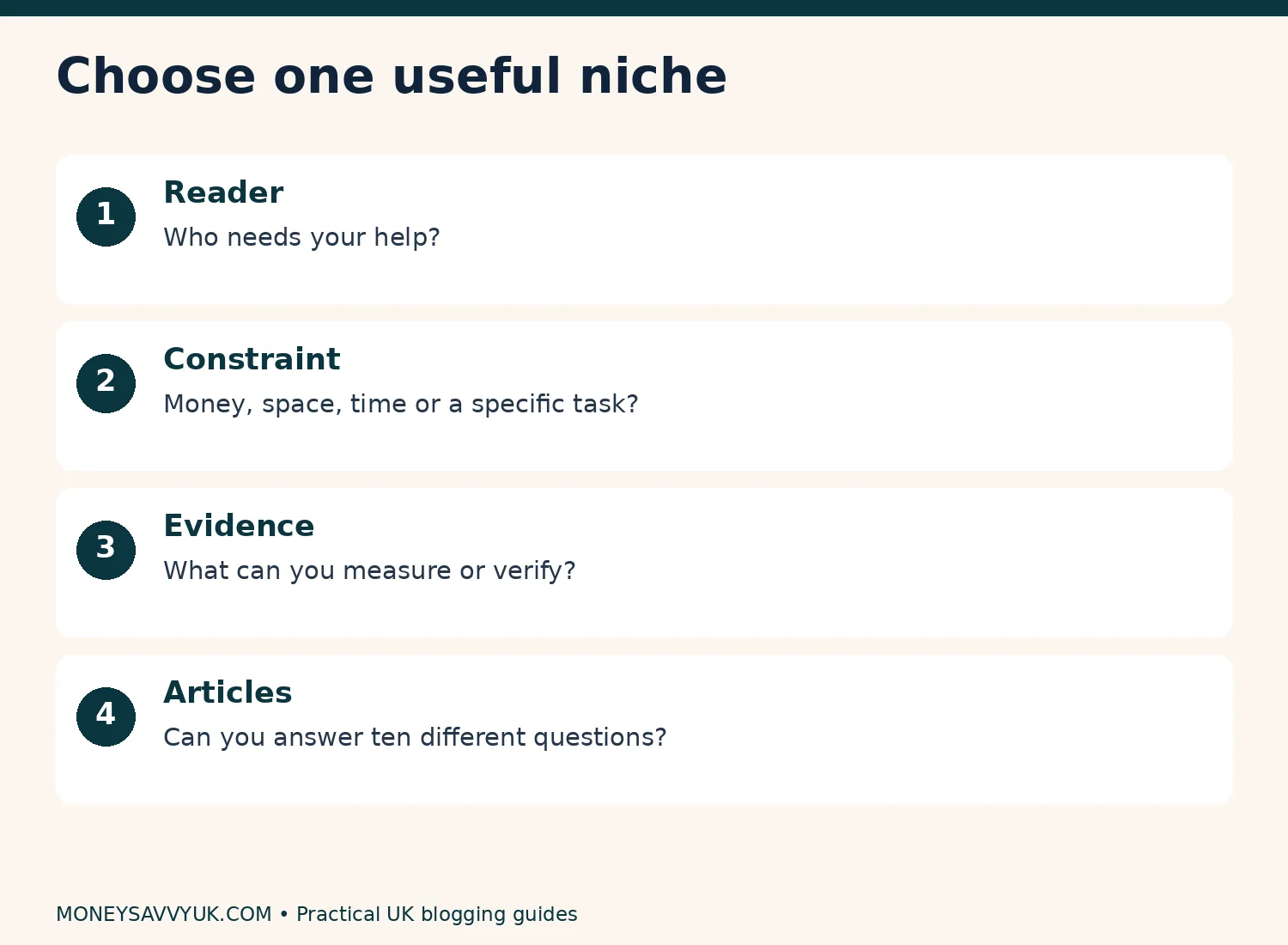
Looking for Amazon affiliate niches for Pinterest UK readers will find useful? Begin with a problem you can explain well, then check whether relevant products and real reader interest support the idea.
I use Amazon Associates on MoneySavvyUK, but these are niche ideas to investigate, not a ranking of proven income opportunities. A beautiful pin doesn’t guarantee a sale.
This guide gives you 50 specific starting points, a validation method and a practical blog-to-Pinterest workflow. If you need a website first, follow how to start a blog UK.

Quick answers for new UK bloggers
Which Amazon affiliate niches should I consider for a UK Pinterest blog?
Consider specific problems that suit useful visual content: small-kitchen storage, rental-friendly organisation, compact desks, family paperwork, craft supplies or budget gardening. Choose a subject you can explain with evidence and relevant products. These are ideas to investigate, not proven profitable niches; validate UK reader demand and competition before committing.
- Small-kitchen storage and awkward cupboard layouts.
- Rental-friendly home organisation.
- Compact desks and cable storage.
- Family paperwork and useful budget binders.
- Craft storage and beginner hobby equipment.
- Small-space gardening and practical plant-care tools.
How do I choose a blog niche that could earn money?
Choose a niche by checking the reader’s problem, your ability to produce original answers, relevant product availability and evidence of demand. Review search results and Pinterest suggestions, then plan ten distinct articles. Consider programme eligibility and realistic income maths. A visually attractive topic or an AI keyword list does not establish profitability.
Can I apply to Amazon Associates with only Pinterest?
Amazon’s current UK application guidance does not list Pinterest among its accepted social networks for an application. A useful route is to build an original website and use Pinterest to bring readers to it. Check Amazon’s current application and link-placement rules, and keep your declared sites and traffic sources accurate.
50 Amazon affiliate niches for Pinterest UK readers
1. Measure small kitchen cupboards
Help readers choose storage by usable width, depth and shelf height. Publish a measuring checklist before recommending organisers. Your useful evidence is whether an item fits around hinges and pipes, not whether its catalogue photograph looks lovely. Start with small-kitchen organisation ideas.
2. Organise a rented kitchen
Focus on changes that don’t require drilling or permanent alterations. Compare freestanding racks, removable storage and using existing shelves differently. Explain landlord restrictions, load limits and surfaces that adhesives may damage. Don’t call an installation rental-safe without checking the actual method.
3. Use awkward under-sink space
Readers need to work around pipes, cleaning bottles and access for maintenance. Show a measured plan with safe access left clear. Compare adjustable shelving and containers rather than pretending one pull-out unit fits every cupboard. This lends itself to a practical annotated photograph.
4. Store food without wasting it
Explore when decanting is useful and when keeping original packaging makes more sense. Include labels, dates, allergen information and container dimensions. A pantry aesthetic shouldn’t hide important instructions or encourage buying unnecessary jars. Your counterpoint can be just as useful as the shopping list.
5. Arrange a tiny utility area
Cover drying racks, baskets, hooks and folding routines in limited space. Explain clearances and ventilation rather than filling every corner. Test whether a collapsible item actually stores where the reader needs it. An honest before-and-after can show both improvements and remaining limitations.
6. Store shoes in narrow hallways
Compare depth, capacity and access for different household sizes. Include a walkway measurement and alternatives using existing furniture. Don’t recommend stacking unstable units or obstructing exits. The reader wants an easier school morning, not simply another cabinet to assemble.
7. Keep a small desk usable
Focus on cable management, document storage and room for everyday tasks. Show where the keyboard, notebook and mug actually fit. Be careful with ergonomic claims; explain adjustments without promising treatment for pain. Our budget desk guide offers related inspiration.
8. Store craft supplies compactly
Compare compartments by the materials people own: paper sizes, brushes, threads or cutting tools. Include child-safe storage where relevant and test whether drawers open fully. Readers can use a supply inventory before spending. Avoid suggesting they buy containers before knowing what needs storing.
9. Organise a family paperwork station
Cover bills, school letters and documents with different retention needs. Show a simple sorting system and affordable folders without sharing private records. Link to reputable retention guidance when discussing important paperwork. A useful printable index can complement the article rather than replace it.
10. Style shelves with fewer purchases
Teach spacing, grouping and using objects readers already own. Include a no-shopping version alongside optional additions. Photograph realistic shelves rather than implying a generated room is your home. This can appeal to readers who want a calmer space without a complete makeover.
11. Fit nursery storage into a box room
Focus on room measurements and adult access, with safety taking priority over styling. Cover clothes organisation and storage placement without presenting sleep advice as personal expertise. Use authoritative safety sources for anything near a baby’s sleeping area. Our baby essentials guide provides context.
12. Organise changing supplies
Compare portable caddies by compartments, cleaning and stability. Explain keeping supplies accessible to adults and unsuitable items away from children. Don’t create a setup that encourages leaving a baby unattended. A practical article can show what to omit as well as what to include.
13. Rotate children’s books
Help families organise a small book collection with accessible storage and a rotation system. Include library borrowing and second-hand choices, not just new purchases. Check furniture stability and fixing requirements. Photograph a real arrangement without displaying children’s names or private family details.
14. Plan primary-school supplies
Compare lunch containers, labels and bag sizes against actual school requirements. Explain what can be reused before adding a shopping list. Avoid unsupported claims that one product improves attainment. This niche has seasonal questions, so plan updates before the back-to-school rush.
15. Store outdoor play equipment
Cover wet shoes, garden toys and sports gear in a small home. Test cleaning and drying routines as well as storage capacity. Avoid storing damp equipment in sealed boxes without considering the consequences. Include a low-cost setup using items already in the household.
16. Pack for days out with children
Show a packing system by trip length and transport method. Compare bag access, weight and washable compartments. Keep child safety and weather preparation separate from product promotion. Related inspiration includes our free half-term activities guide.
17. Organise children’s art materials
Help parents choose storage and surfaces suitable for the child’s age and supervision. Explain cleanup and material labels rather than saying every craft item is harmless. Test a few manageable activities. A compact setup may be more useful than a cupboard full of supplies.
18. Manage family swimming bags
Compare wet compartments, towel sizes and easy-to-find small items. Include a checklist for removing damp kit after the trip. Don’t make untested waterproof claims. A real packing photograph and measured bag dimensions can answer questions a retailer description leaves open.
19. Simplify birthday-party equipment
Focus on reusable decorations, serving equipment and storage between events. Show the difference between a small gathering and a bigger venue party. Include borrowing options. Our children’s birthday freebies guide can complement a budget-focused plan.
20. Choose practical family gifts
Organise ideas by the recipient’s interests and space rather than a generic “best gifts” list. Explain suitability, cleaning and storage. Don’t pretend you own every item. Seasonal gift content should include useful alternatives if a product becomes unavailable.
21. Build a returning-to-work wardrobe
Focus on outfits for a defined dress code and climate. Show how existing pieces combine before recommending additions. Explain sizing variability and return checks without making body-shaming claims. Real outfit photographs add value when they are your own and accurately labelled.
22. Plan rainy school-run clothing
Compare layering, pockets and practicality for walking or cycling. Distinguish advertised water resistance from waterproof performance you’ve personally tested. Include care instructions and fit considerations. A UK-weather constraint makes this more specific than a broad fashion blog.
23. Pack a small travel wardrobe
Build a packing list around trip duration, laundry access and baggage dimensions. Check current airline rules separately. Compare packing cubes by actual size, not just number of pieces. Our Ryanair fees guide helps with the travel-cost side.
24. Store accessories neatly
Help readers organise jewellery, scarves and belts using existing drawers. Compare materials and cleaning requirements. Avoid claiming that inexpensive jewellery is hypoallergenic without evidence. A simple layout plan can answer more than a glamorous flat lay alone.
25. Maintain clothes for longer
Cover garment care tools, storage and repair basics with fabric-specific instructions. Check manufacturers’ care labels before demonstrating a method. Include when a tool is unnecessary or unsuitable. The money-saving angle is keeping useful clothes in circulation rather than adding another fashion haul.
26. Organise lunch preparation
Compare containers by capacity, cleaning and the meals people actually prepare. Verify microwave, freezer and dishwasher claims from the manufacturer. Include food-safety guidance when discussing storage. A practical portion or size comparison is more helpful than promising a container transforms someone’s diet.
27. Make packed drinks easier
Test leak resistance, opening mechanisms and washing access for bottles or flasks. State the conditions of your test and distinguish personal observations from specifications. Avoid unsupported claims about children’s development or medical benefits. Explain replacement-part availability where verified.
28. Store baking equipment
Cover tins, trays and tools in small cupboards. Compare nesting dimensions and access for frequent use. Show a beginner collection rather than recommending every accessory. A labelled photograph can demonstrate why a particular setup suits a small UK kitchen.
29. Choose air-fryer accessories carefully
Match accessories to the exact appliance’s dimensions and manufacturer guidance. Discuss airflow and safe use without claiming that every liner is compatible. Don’t present generated food photographs as results of your own cooking. An incompatibility explanation can be valuable original content.
30. Set up a tea-and-coffee corner
Focus on counter space, spill management and storing what a household uses. Include a simple version without buying an appliance. Compare racks by dimensions and stability. Avoid energy-cost claims unless you show the assumptions and the source of the electricity rate.
31. Start balcony gardening
Discuss container size, drainage, sunlight and rental restrictions before products. Check structural and placement considerations for heavy planters. Use reliable gardening guidance for plant needs. Don’t assume every balcony can safely support the same arrangement merely because a photograph looks attractive.
32. Organise indoor plant care
Compare practical watering tools, trays and storage for a small collection. Explain plant-specific needs and pet toxicity with reliable sources. A moisture meter isn’t a substitute for understanding the plant. Document what you observed without promising a tool keeps every plant alive.
33. Store garden tools safely
Help readers manage a shed or compact outdoor store with safe access. Consider sharp tools, chemicals, locks and damp. Explain fixing requirements and weight limits. Show a measured layout instead of recommending the largest rack available.
34. Prepare a small picnic kit
Plan for transport, cleaning and food storage. Compare cool-bag capacity and carry comfort under stated conditions. Include a no-new-purchases packing list. Avoid suggesting that appearance proves insulation performance or safe food temperatures.
35. Pack for UK camping
Choose a narrow audience such as families travelling by small car. Cover packing volume, setup and wet-weather storage. Verify safety guidance for heaters, cooking and ventilation. Don’t call equipment essential for every camper; trip conditions determine what is appropriate.
36. Organise dog-walking supplies
Focus on storage, washing and convenient access to everyday items. Check sizing and suitability for the individual dog. Avoid veterinary or behavioural promises attached to accessories. Test practicality on a real walk only if you’ve genuinely done it.
37. Protect a car from muddy gear
Compare washable covers, boot storage and drying routines by vehicle dimensions. Distinguish protective accessories from equipment needed for safe animal transport. Read manufacturer and authoritative safety guidance. A cover that looks tidy may still interfere with another function.
38. Store pet food neatly
Discuss suitable storage, cleaning and preserving product instructions. Include dimensions and access, and check manufacturer guidance on decanting. Don’t turn a storage article into nutrition advice. Readers need to know whether a container suits their packaging and household.
39. Create a beginner painting kit
Focus on a defined medium such as watercolour. Compare a small set of tools by the tasks a beginner wants to try. Include cleaning and storage. Show actual sample work if you have it, without implying equipment alone produces professional results.
40. Organise journalling supplies
Compare paper sizes, pen storage and a simple weekly routine. Include a low-cost option using an existing notebook. Don’t promise stationery treats anxiety or changes income. A useful template and realistic demonstration can support optional product recommendations.
41. Build a simple home reading corner
Cover lighting placement, storage and comfort within a small room. Check safe electrical use and avoid medical claims about eyesight. Include a setup made from existing furniture. Help the reader decide what problem a new item would actually solve.
42. Set up budget video calls
Compare lighting, background organisation and microphone placement for ordinary home use. Use recorded test conditions if evaluating sound. Don’t imply you have reviewed equipment you only researched. This niche can connect to practical work-from-home job checks.
43. Store chargers and cables
Help readers label, sort and access cables without unsafe electrical practices. Distinguish storage from power distribution. Check product safety and compatibility before recommending chargers. A visual organisation guide shouldn’t encourage using damaged cables because they fit the colour scheme.
44. Plan a low-cost seasonal display
Use reusable pieces and a small storage footprint. Show how the same items work across seasons. Keep candles and electrical decorations within safe-use guidance. Our budget Halloween guide is an example of a clear spending constraint.
45. Organise wrapping supplies
Compare rolls, bags and ribbon storage by the space available. Include reuse and recycling considerations with accurate local guidance. A compact wrapping station can make a helpful seasonal article without requiring readers to buy a completely new set of supplies.
46. Build a useful budget binder
Focus on a reader’s actual tracking needs rather than decorative supplies. Demonstrate sections with fictional data. Include a free paper alternative and optional accessories. Our budget binder supplies guide and budget calculators offer related resources.
47. Store travel toiletries
Compare washable bags, refillable containers and packing volume. Check current airport security rules rather than repeating an old liquid allowance everywhere. Include cleaning and labelling. Avoid describing containers as universally airline-approved without verifying the applicable route and restrictions.
48. Organise hobby collections
Choose a specific collection, such as board-game pieces or sewing patterns. Compare protection, access and labelling. Don’t make unsupported archival-storage claims. A clearly photographed system and an inventory template can be useful even without an affiliate purchase.
49. Prepare a guest sleeping space
Focus on occasional visitors in a small home. Compare storage requirements and setup effort for relevant equipment. Be accurate about capacity, cleaning and manufacturer limits. Don’t equate a catalogue comfort claim with your own overnight test.
50. Make household resets manageable
Build short checklists for a defined problem: clearing a desk, sorting a cupboard or preparing school bags. Recommend tools only after explaining the routine. This can connect naturally to our subscription audit and other practical money-saving resources.
Choose a niche with five evidence checks
Score each idea from zero to two on five questions: can you explain the problem, see real reader questions, obtain useful evidence, find appropriate products and write at least ten distinct articles? The maximum is ten. This is a planning tool, not a prediction of earnings.
For example, a renter who has measured several small cupboards may be better placed to explain storage fit than to review baby sleep products. Existing experience reduces the evidence-gathering burden, but it doesn’t remove the need to verify safety and specifications.
Check Google results and Pinterest suggestions yourself. Note whether the intent is inspiration, a comparison, a tutorial or a purchase. AI can brainstorm variants but cannot establish low competition or search volume by declaring it. Read our Pinterest SEO guide for more on topic language.
Don’t buy fifty products to launch fifty niches. Pick one audience, write a focused plan and create useful material with evidence you can afford to obtain. Keep business spending separate from your household essentials using the 50/30/20 budgeting guide.
Build the website before applying to Amazon
Amazon’s UK guidance says a useful rule of thumb is at least ten original posts. It also requires public, recent, substantive content and reviews the sites you list. Four rushed product lists aren’t a reliable shortcut to acceptance.
After sign-up, Amazon reviews your application once you have at least three qualifying sales within the first 180 days. Personal orders don’t qualify. Approval isn’t guaranteed, and you shouldn’t organise purchases by yourself or close contacts to manufacture eligibility.
Apply through Amazon Associates UK, list your actual website and complete the requested details accurately. Read the Operating Agreement and keep your site list current. Pinterest isn’t on the UK guidance’s accepted social-network list for applications, so don’t assume a Pinterest-only profile qualifies.
Use official link tools, such as SiteStripe where available, with your own approved tracking ID. This guide explains the process; it doesn’t supply an ID for your future website. Our UK blogging rules guide explains disclosures and record keeping.
Create a Pinterest route that serves the reader
Use a free Pinterest business account for business activity and analytics. Add a clear profile description and a few boards matching your actual articles. Follow Pinterest’s current website-claiming instructions; claiming connects your content and profile, not a guarantee of traffic or verification status beyond that feature.
For a straightforward content strategy, send the pin to a relevant article on your own website. The article should solve the advertised problem and offer appropriate choices. Don’t make a blanket claim that all direct affiliate links are banned; permitted use depends on platform and programme rules.
Create three distinct vertical designs for one article, with readable text and a clear promise. A common standard is a 2:3 layout. Use original or appropriately licensed imagery. A generated room can illustrate an idea but mustn’t be presented as your own renovation or product test.
Write the pin title and description for people. Name the problem and what the article contains. Don’t claim you transformed your home if you didn’t. Use descriptive alt text for accessibility and write a separate promotional description; alt text isn’t a secret substitute for Pinterest metadata.
Our making-money-on-Pinterest guide and Pinterest affiliate guide cover wider strategy. Start with a schedule you can sustain rather than a supposed mandatory daily pin quota.
Write one helpful commercial article
Use this structure: upfront ad disclosure where applicable, the reader’s constraint, your selection method, options with reasons, limitations, alternatives, FAQs and sources. Include “don’t buy this if…” where that is the honest conclusion.
For a cupboard-storage comparison, show internal measurements, door-clearance needs, the listed dimensions of each option and what you actually tested. If you researched specifications but didn’t handle the product, say so. A measurement worksheet can add more value than a copied star rating.
Use Amazon’s required identification statement and clear ad labels. Add sponsored link attributes. Don’t use generic link-cloaking tools or copy Amazon reviews, ratings and images outside the programme’s permitted mechanisms. Use “Check today’s price on Amazon (ad)” rather than manually maintaining volatile prices without the required approved approach.
Don’t imply every item in a shopper’s later basket earns a commission. Eligibility, tracking sessions, exclusions, returns and programme rules determine what is payable. A cookie-window slogan isn’t a substitute for reading the current commission terms.
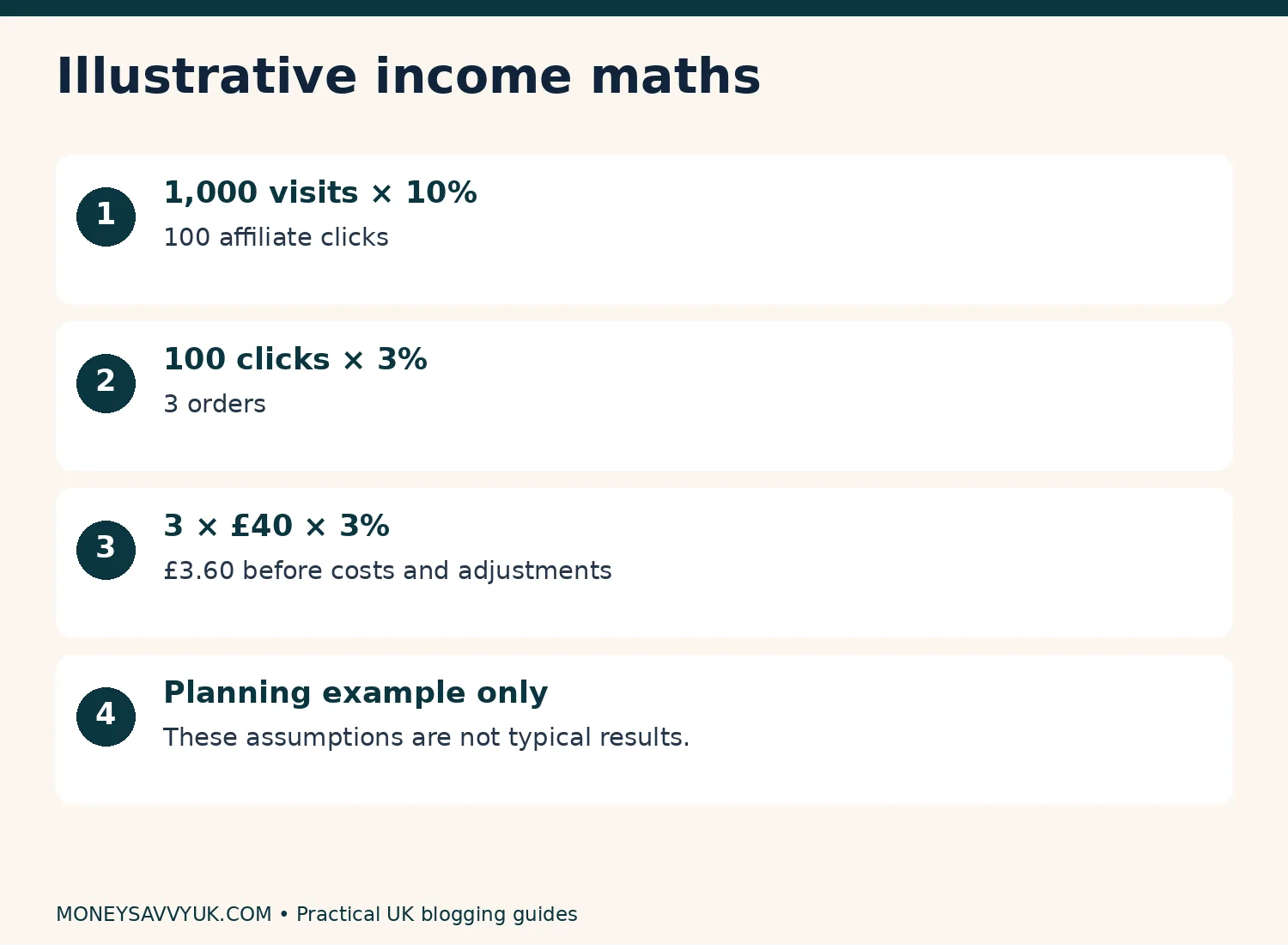
These figures illustrate a calculation, rather than typical or promised earnings.
Understand income maths before setting targets
Here is a deliberately simplified planning example, not a typical result: 1,000 article visits × 10% affiliate click rate = 100 clicks. If 3% of those clicks convert, that’s three orders. At £40 eligible revenue per order and a hypothetical 3% commission, that is £3.60 before costs and adjustments.
Changing any assumption changes the result. Category rates vary, clicks can buy nothing and returned orders may not remain payable. Use your actual confirmed reports once available. Never map a fixed number of pageviews to guaranteed monthly income.
Display advertising is another route, with separate acceptance rules. Current official guidance checked for this article describes Journey’s starting requirement as over 1,000 sessions; Mediavine’s main offering uses an annual ad-revenue threshold of $5,000 plus other standards. Raptive currently starts at 25,000 monthly pageviews with additional conditions. These replace older blanket 50,000-session and 100,000-pageview claims.
A session is a visit; pageviews count pages viewed, so one visit can generate several pageviews. Neither metric is itself profit. Check Mediavine requirements, Journey guidance and Raptive requirements before applying.
What I’d do first with one month available
Choose one niche, validate ten questions and finish the site foundation. Draft helpful non-commercial articles as well as comparisons. Then create pins for the articles that fulfil their promise and review outbound clicks, useful engagement and confirmed income.
Use a simple record: article, pin design, publication date, impressions, outbound clicks and relevant website action. An appealing design with no clicks needs a different investigation from an article receiving clicks but no affiliate engagement. Make one change at a time.
AI prompt: “Using this published article and these verified facts, suggest three accurate pin titles and descriptions in British English. Do not invent prices, personal experience, income claims, keyword volume or deadlines. Keep the promise consistent with the destination. Flag any commercial content needing an ad label.”
Track earnings and costs from the first payment. Our side-hustle tax guide explains the shared trading allowance. The free Financial Reset Kit can help keep household priorities visible while you test the business idea.
Pin this guide for later.

Amazon affiliate niches for Pinterest UK: FAQs
Which Amazon affiliate niche is most profitable?
There isn’t a dependable universal winner. Profit depends on reader
demand, useful evidence, product suitability, traffic, conversion,
current commission terms and your costs. Choose a niche you can
substantiate and test it with actual results. These fifty ideas are
starting points for research, not verified earnings rankings.How many articles do I need to apply to Amazon UK?
Amazon gives at least ten original posts as a useful rule of thumb,
alongside public, recent and substantive content requirements. Approval
isn’t automatic. Its application review follows at least three
qualifying sales within the first 180 days; personal orders don’t
qualify. Check the current guidance and keep declared websites
accurate.Can I apply using only a Pinterest account?
Pinterest is not on Amazon UK’s current accepted social-network list
in its application guidance. A public website with suitable original
content is the route covered here. Use Pinterest to direct readers to
your articles, and check current platform and programme terms before
placing direct affiliate links anywhere.Do I need to buy every product I mention?
No, but be honest about your evidence. A researched comparison should
identify its published sources and distinguish specifications from
first-hand tests. Never claim personal use you haven’t had, copy reviews
as your own or present generated imagery as a product test. Original
measurements and decision tools can add useful value.How quickly can Pinterest produce affiliate income?
There is no guaranteed timetable. Pins can receive impressions
without clicks, and clicks can produce no qualifying purchases. Build
accurate articles, test a manageable pin routine and assess actual
reports. Don’t plan household spending around predicted affiliate
earnings or treat a viral pin as a sustainable business model.
Amazon affiliate niches for Pinterest UK: summary
- Choose one reader and a specific constraint.
- Validate questions and gather evidence before recommending products.
- Build substantive original content before applying to programmes.
- Send accurate pins to useful articles and disclose commercial content.
- Review actual results, costs and current programme rules.
Which problem could you explain better than a generic shopping list?
Sources and further reading
- Amazon UK application review
- Amazon UK programme policies
- Pinterest website claiming
- Pinterest pin creation
- Mediavine requirements
- Raptive eligibility
I’m not a financial adviser. This is general information; see the financial disclaimer.
About Dr Kalpana Govindaraasan
Dr Kalpana Govindaraasan is a UK mum, PhD materials chemist and former secondary science teacher who runs MoneySavvyUK. She shares practical ways to manage money and investigate income ideas, using official sources and clearly labelled examples.