
Last updated: 27 October 2026.
Looking for Christmas on a budget UK ideas that help you organise the whole season? Start with the part you need today: booking the food shop, choosing presents or working out what you can comfortably spend.
I would make Christmas fit the household budget before filling a shopping list. A smaller celebration can still include the food, people and traditions you care about.
I’m Dr Kalpana Govindaraasan, a PhD scientist and UK mum. Use this page as a starting point. Each guide below tackles a specific task, so you can take one useful step without having to organise everything at once.
Christmas on a budget UK: start here
If you have already bought part of the food shop or a few presents, start by recording those purchases. Include them in the total rather than treating them as separate from the plan. Knowing what is already paid for makes the remaining budget easier to manage.
1. Set your Christmas spending limit
List the money you can put towards Christmas after essential bills and everyday spending. Include food, gifts, travel, school events, postage and activities. Decide what you can spend in each area before browsing offers.
If the total is too high, choose what to reduce now. Agreeing a smaller gift budget early is easier than trying to find the money after buying presents. You do not need to match another household’s celebration.
Start with a practical household budget, my free money calculators and what to do when spending exceeds income.
2. Organise the Christmas food delivery
Some supermarkets already have Christmas booking windows open; others have published upcoming dates. Check the service and your postcode, then finish checkout and keep the confirmation.
- Compare supermarket Christmas delivery slots: booking windows, services and the checks before ordering.
- Tesco Christmas delivery slots: November opening dates, eligible plans and basket deadlines.
- Asda Christmas delivery slots: booking steps, Food to Order and ordinary grocery amendments.
Do not pay for priority access until you have checked that your exact plan and joining date qualify. A delivery subscription should fit the way you actually shop.
More detailed guides: Morrisons Christmas delivery slots and Tesco Christmas Savers after the 2026 deadline.
Shopping with Sainsbury’s? Read the Sainsbury’s Christmas delivery booking guide for release dates, basket rules and alternatives when slots are full.
Also compare Waitrose Christmas delivery slots and Iceland Christmas delivery slots, including prepared-food deadlines and the rolling booking window.
For in-store Christmas shopping, see Aldi Christmas offers and official range dates and Farmfoods vouchers and shopping checks. Farmfoods confirms that it does not offer home delivery or Click & Collect.
Also see Lidl Christmas offers, leaflets and regional checks, including the distinction between GB promotions and the Northern Ireland savings card.
3. Build the food list around meals
Write down who is eating with you and which meals you are providing. Check the cupboards and freezer before buying another packet “just in case”. Think about storage, use-by dates and what can realistically be prepared.
A shorter menu with food your household enjoys is often more useful than several extra dishes that create work and leftovers. Keep dietary requirements clear before choosing a centrepiece or accepting substitutions.
Use the grocery savings calculator, my family shopping guide, the grocery bill checklist and the supermarket downshift challenge.
4. Choose gifts by the person
Set a limit per person and choose around their interests, age and what they already own. A discount is useful only if it helps you buy something suitable within the limit.
The Christmas gift ideas by age guide links to the individual age groups. For smaller gifts, try teen stocking fillers, Secret Santa ideas or cosy gifts for homebodies.
Some linked gift guides contain affiliate links, disclosed on those pages. You can use the ideas as a starting point and compare the product, delivery and returns terms before buying.
5. Use sales with a shortlist
Keep a list of the products you actually intend to buy and compare their normal prices. Record the total delivered cost, including any collection journey that would be needed.
Check Christmas toy sale dates for retailer events and how to spot misleading Black Friday deals for price-checking steps. An event advertised as “up to” a large reduction will not reduce every item by that amount.
Before ordering a gift, check whether the recipient can exchange it and whether any Christmas returns extension covers that particular product. Keep the receipt and order confirmation together.
6. Check offers before budgeting them
New-customer codes, loyalty rewards and Christmas savings bonuses can have different terms. Identify the promotion first, then check eligibility, expiry, exclusions and whether the benefit actually appears at checkout.
The Asda £30-off-£60 voucher status guide explains the reported pause. Do not include an unconfirmed voucher in the money you have available to spend.
For the wider principles, see supermarket loyalty apps and Christmas savings clubs and what to check.
7. Leave room for low-cost activities
Choose a few things the household would enjoy rather than filling every weekend. A local walk, making decorations with supplies you already own, or a film evening at home can be part of the celebration.
The free Christmas films guide explains viewing options. Check access requirements and current availability before promising a particular film. If a free trial is involved, record when charging would begin.
For days out, check current opening times, transport, parking and booking requirements. “Free entry” does not always mean the whole outing is free once food and travel are included.
8. Keep extra income realistic
If you want temporary work to help with seasonal costs, look at Christmas jobs in the UK. Check the employer, hours, travel requirements and when wages would arrive before relying on the money.
For things you no longer need, selling on Vinted and selling on eBay offer practical starting steps. An unsold listing is not money available to spend.
Make your Christmas budget concrete
A spending limit becomes easier to use when every planned purchase has somewhere to go. The worksheet below is an example of a planning method, not a recommended amount for every family. Your own essentials, income and commitments come first. You can use a notebook, spreadsheet or the free calculators linked above; there is no need to buy a new planner before starting.
9. Turn the total into named pots
Write the amount you can safely spend after regular bills, ordinary food and other essential commitments. Include only money already available or income you can reasonably rely on. Keep money needed before your next payday separate. Do not count a credit limit, an unsold item or a possible cashback payment as Christmas savings.
Split the Christmas amount into food, gifts, travel, activities and small extras. Small extras can include wrapping, postage, school events and batteries. Give each category a maximum, even if that maximum is zero. This prevents a collection of little purchases from consuming the money you intended to keep for the food shop.
For an illustrative £300 plan, someone might allocate £100 to additional festive food, £120 to gifts, £40 to travel, £20 to activities and £20 to wrapping, postage and other extras. Those amounts add to £300. They are invented examples for the calculation, not typical UK household costs or a suggestion that £300 is affordable for your circumstances.
Keep ordinary food spending separate from the additional festive food pot. If your usual weekly food bill is already covered in the household budget, adding it again to the Christmas total would double count it. Conversely, if you have not allowed for that week’s everyday meals anywhere, a Christmas dinner budget alone will not cover the full food shop.
10. Make the gift list before the sale list
Give each recipient a line with their name, your limit, an idea, the actual amount paid and whether the gift is complete. Include delivery and any necessary accessories in the amount paid. If you are sharing a present with another person, agree who is buying and how the contribution will work before either of you orders.
A simple hypothetical example shows why this matters. Suppose three gifts have limits of £15 each. Your planned total is £45. If two suitable gifts cost £12 each, you do not have to increase the third gift to use the remaining money. Spending £39 rather than £45 leaves £6 available for another priority; a budget is a ceiling, not a target you must reach.
For a multibuy, check that all the products already have a recipient. An additional £10 item bought only to unlock a promotion can still leave you paying more than buying the two gifts you needed. Use the Boots basket examples and toy-sale guide to compare actual totals, then return to your own list before checking out.
If the gift budget does not work, reduce the number of purchases or agree a smaller exchange. A shared activity, something homemade using supplies you already own, or an agreed second-hand present may suit some recipients. Check what is appropriate for the person and avoid presenting a lower-cost choice as something they have to accept without discussion.
11. Put the food menu beside the calendar
Write the meals you are actually providing and the number of people for each one. Include breakfasts and other everyday meals around Christmas if guests are staying. Start with food already available at home and add only the missing ingredients. Plan a manageable menu for the cooking space and time you have.
Now put the supermarket booking, special-food deadline and ordinary grocery deadline beside the menu. If a prepared item cannot be edited after a particular date, settle the relevant part of the menu before that deadline. Leave room to check ingredients and dietary suitability rather than making that decision during a rushed final checkout.
Keep a short alternative for important items. For instance, decide whether a different vegetable, dessert or main would be acceptable if your first choice is unavailable. Do not buy several full alternatives in advance merely because something might go wrong. A flexible menu should simplify the food shop rather than multiply it.
After you know the basket, check the total including delivery and any other applicable charge. A voucher changes the calculation only when it is valid for your account and order. Treat the paused Asda offer as unavailable for a new claim unless official new information establishes otherwise.
12. Agree the traditions worth keeping
Ask the household which parts of Christmas they most look forward to. Choose a small number you can organise within the spending limit. It might be a particular meal, seeing family, decorating together or a film evening. Write those priorities down before filling weekends with tickets and extra shopping trips.
For an outing, consider the whole cost: travel, parking, food and anything you would be expected to buy there. A free event can still require spending you have not allowed for. Check the practical arrangements before promising an activity, particularly when it depends on a booking or a specific date.
Agree expectations early with other adults where you can. If you are reducing presents or sharing the cost of a meal, make the arrangement clear while there is still time to plan. You do not need to explain every detail of your finances to set a comfortable limit.
13. Review what is left, not just what you saved
Once a week while you are preparing, add the actual amounts paid and the purchases still planned. Compare their combined total with the original limit. A shop advertising a saving has not improved your position if it persuaded you to add products that were not in the plan.
If one category runs over, choose deliberately what will change elsewhere. Do not quietly borrow from the money set aside for rent, mortgage payments, energy or ordinary food. Where the wider household budget is already under pressure, use the money-help guide linked in the FAQs before committing to extra festive spending.
After Christmas, keep a short note of what worked, what was unused and which deadlines were easy to forget. This is more useful for next year’s plan than judging the celebration by how much you spent. You can carry forward the traditions you enjoyed while changing the purchases that did not earn their place.
Use a final page in the notebook for things you decided against buying. That can be a useful reminder when a new promotion appears: the fact that a product is now reduced does not change the reason it was unsuitable or unnecessary. If something genuinely useful becomes affordable, compare it with the amount still available rather than with its advertised original price. Keep receipts for the purchases you do make, and write down where gifts are stored so a forgotten item does not lead to buying a second present.
What I’d do first
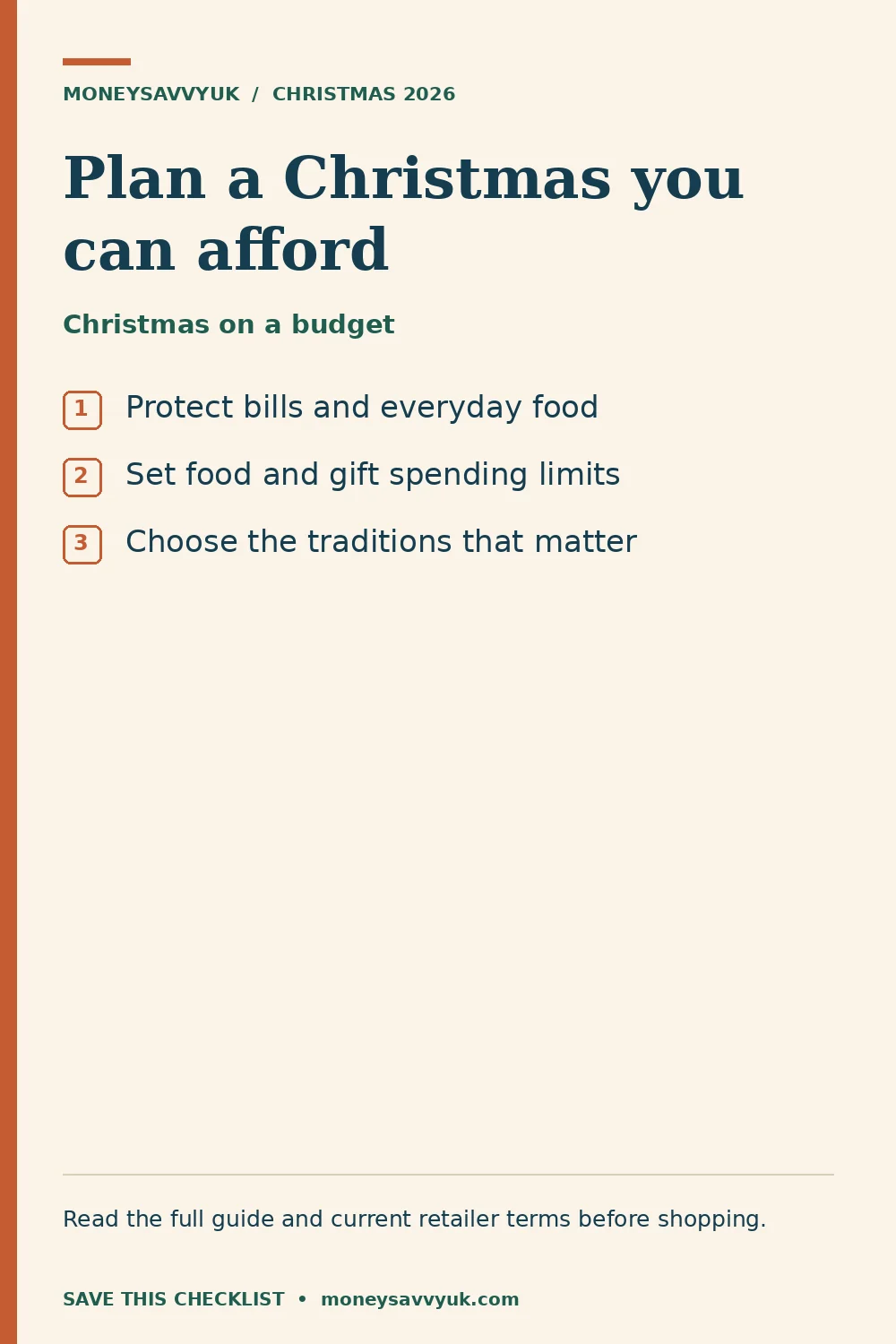
I would set the overall limit, organise the food booking if needed and write a short gift list. Then I would decide which traditions matter most and remove purchases that do not support them.
- Protect bills and everyday food.
- Set food and gift spending limits.
- Choose the traditions that matter.
Christmas on a budget: FAQs
How can I make Christmas cheaper without losing everything I enjoy?
Choose the parts that matter most and give them space in the budget first. Reduce the rest: fewer gifts, a shorter menu or fewer paid outings. Agree limits with other people early so the plan feels clear rather than becoming a last-minute disappointment.
Should I book Christmas food delivery before finishing my menu?
You can often reserve an order and amend it later, subject to the retailer’s process. Complete checkout, keep the confirmation and record both special pre-order and regular grocery deadlines. Check the booking guide for your retailer rather than assuming every supermarket works the same way.
Should I wait for Black Friday to buy every gift?
Not necessarily. Compare the actual product price, availability, delivery and returns terms. If you find a suitable gift within your budget, a later sale label alone does not establish that waiting will be cheaper. Use a shortlist and avoid buying extras just to qualify for an offer.
Where should I start if there is very little money for Christmas?
Protect essential bills and food first. Agree a smaller celebration and avoid committing to purchases based on money you do not yet have. The free money help guide gives starting points for support when the wider household budget is under pressure.
Christmas on a budget UK: summary
- Protect bills and everyday food.
- Set food and gift spending limits.
- Choose the traditions that matter.
Set a limit, organise the food booking, choose gifts deliberately and keep offers separate from confirmed money. Return to the guide you need as the season moves on. Which part of Christmas would you most like to make simpler this year?
Sources and checks
Retailer booking claims are sourced in the individual supermarket guides. This hub organises MoneySavvyUK’s existing Christmas, shopping and budgeting content. A link to an older article does not mean every offer on that page has been rechecked today; always check its visible update date and retailer terms.
About the author: Dr Kalpana Govindaraasan is the PhD scientist, former science teacher and UK mum behind MoneySavvyUK. She has lived in the UK since 2008 and shares researched household money guides. She is not a financial adviser. Read the financial disclaimer.