

Updated 19 October 2026 · 2026/27 rules · General information, not financial advice.
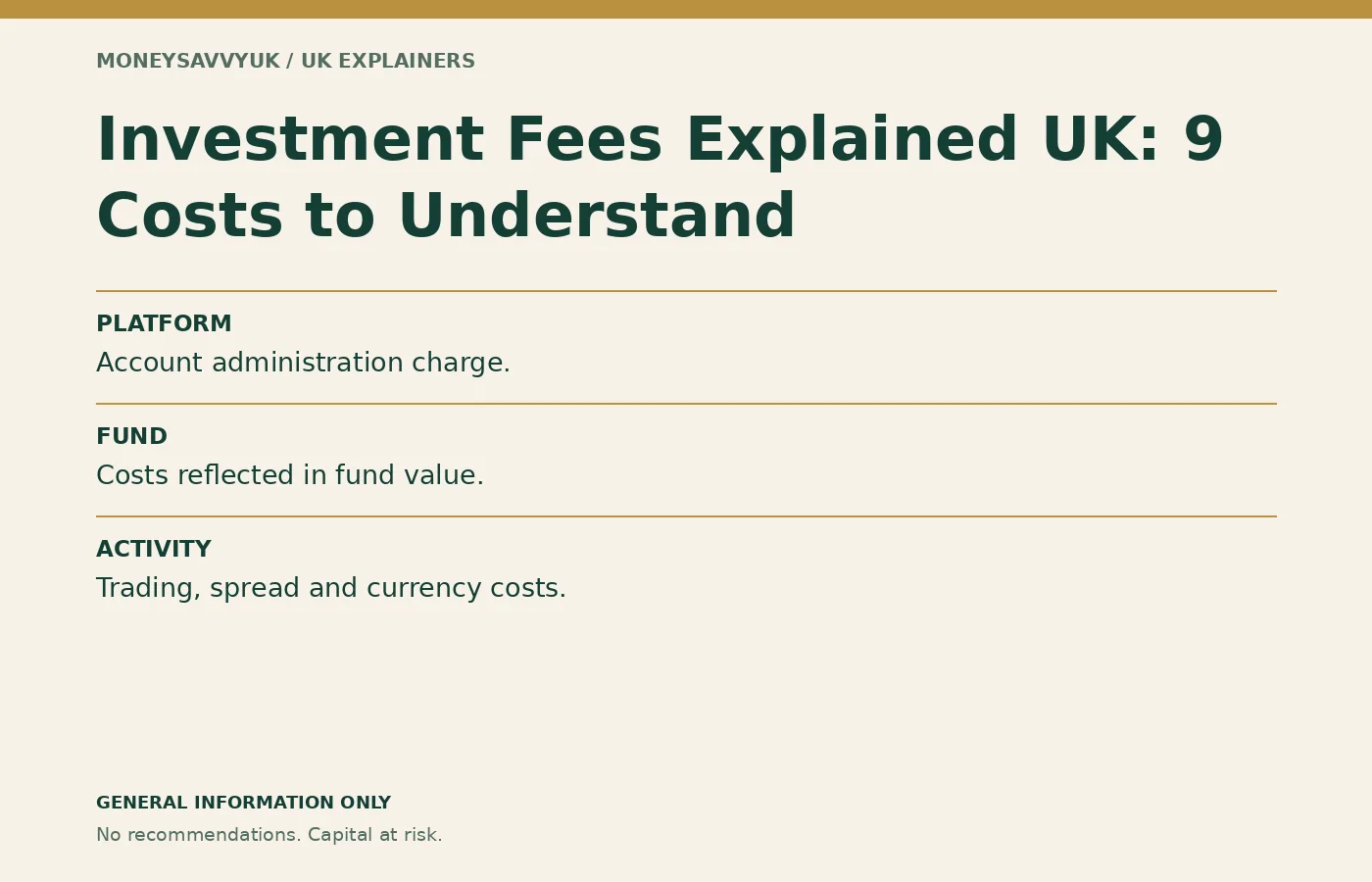
Investment fees explained UK: if the platform charges one fee and the fund charges another, do you pay both? Often yes—they pay for different parts of the service.
I’m Kalpana, a PhD scientist, former teacher and mum. This guide turns a charge sheet into a simple calculation, with the assumptions beside every example.
I’m not a financial adviser. This is general information, not a recommendation to buy, sell or hold investments. Capital is at risk: investments can fall and you may get back less than you put in.
investment fees explained UK: your questions, step by step
1. Why are there platform fees and fund fees?
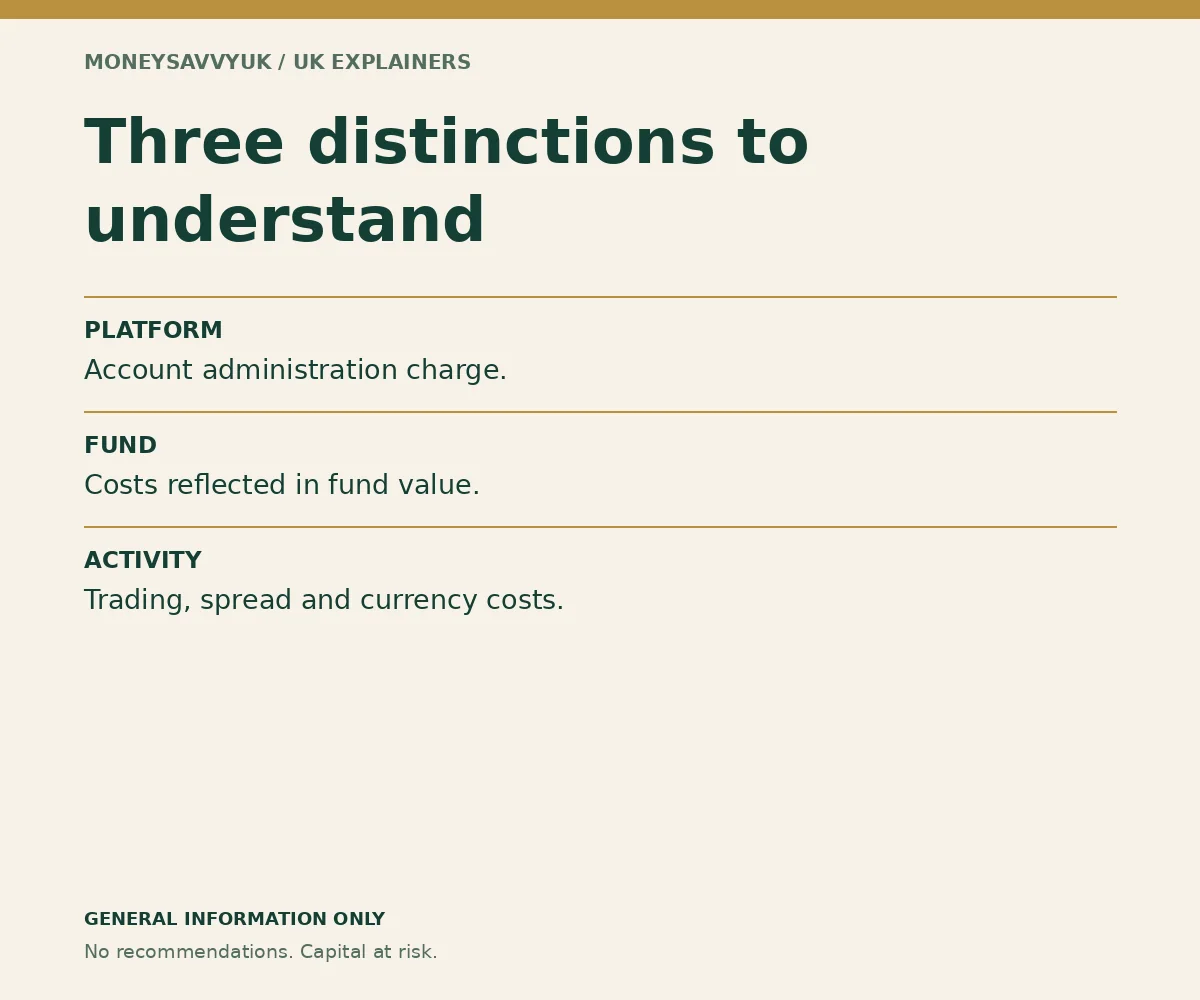
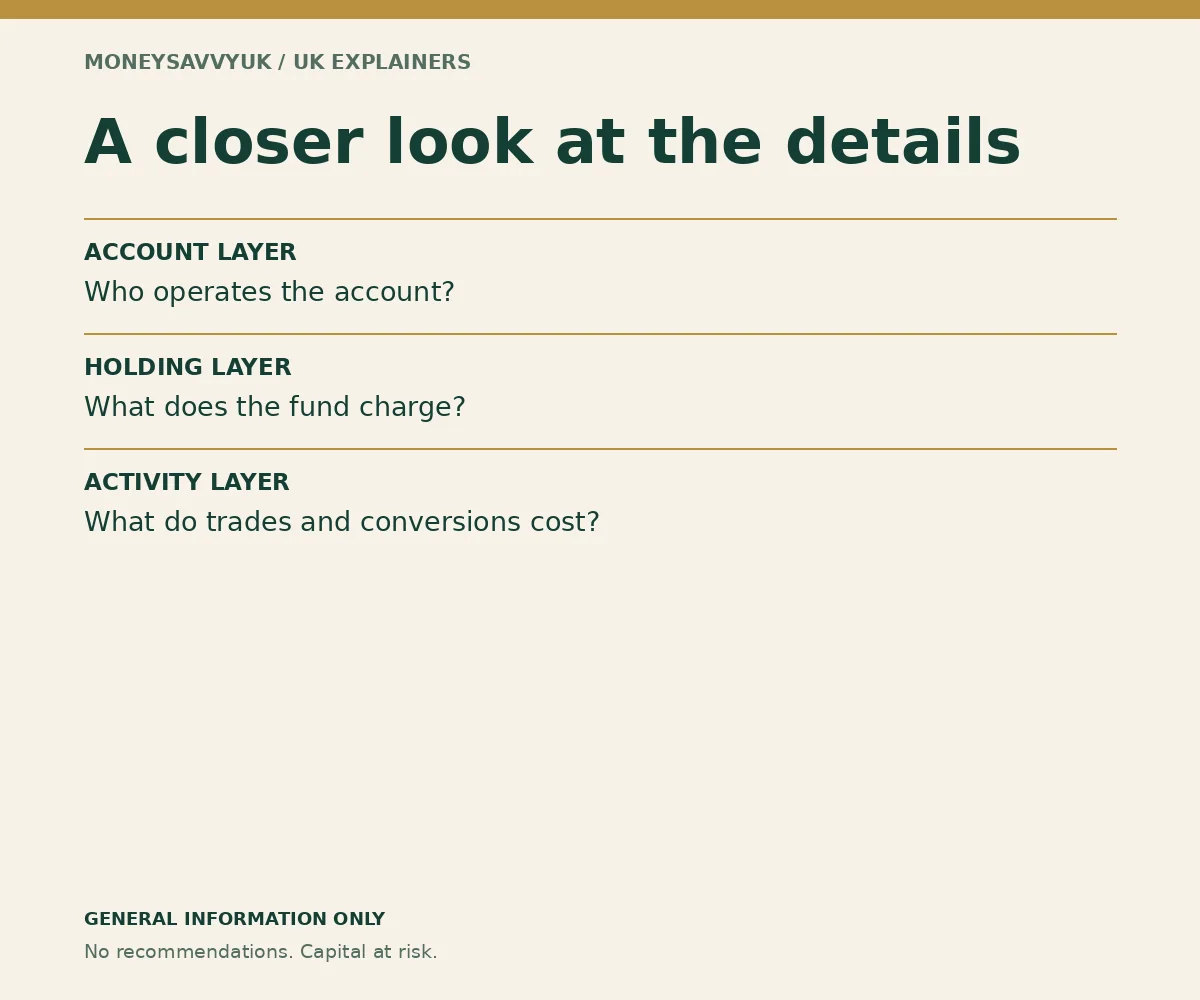
The platform operates the account. The fund manager operates the investment held inside it. Those are different jobs, so both can create a charge.
For example, an investment ISA could contain one fund. The ISA provider may charge for holding the account, while the fund has its own ongoing costs. A bank statement may show the first charge but not a separate payment for the second.
Fund costs are often reflected in the fund value. Not seeing money leave a bank account does not establish that the expense is zero. MoneyHelper: investment types and charges explains investment costs generally.
The ISA beginner guide separates account, platform and investment. The fund walkthrough shows where costs appear on an information page.
2. What numbers do I write down first?
A cost calculation needs a scenario. Without it, two advertised totals may describe different customer activity.
A simple worksheet has these inputs:
| Input | Hypothetical example |
|---|---|
| Invested balance | £2,000, unchanged for a year |
| Account fee | 0.25% annually, no minimum or cap |
| Fund charge | 0.20% annually on the same balance |
| Trading | No additional purchases or sales |
| Other charges | Excluded from this first simplified calculation |
This is a teaching example, not a real provider quote. A real account can have changing balances, cash treated differently from investments, caps, minimum fees and different billing dates. Those details belong in the assumptions rather than being silently ignored.
3. How do I calculate a percentage fee?
Divide the percentage by 100, then multiply by the balance to which it applies. For the example above, 0.25% is 0.0025.
| Layer | Calculation | Simplified annual cost |
|---|---|---|
| Account | £2,000 × 0.0025 | £5 |
| Fund | £2,000 × 0.0020 | £4 |
| Combined layers | £5 + £4 | £9 |
That £9 excludes transaction costs and other charges. It assumes the full balance is present throughout the year, with neither fee capped nor subject to a minimum. If the balance changes, the actual charge can change.
The beginner’s result is not “this account costs £9 for everybody”. It is “these two fee layers produce £9 under these exact assumptions”. That makes the calculation reproducible.
4. What if the charge is a fixed amount?
Use the cash amount directly for the stated period. To see how large it is relative to a balance, divide the fee by that balance and multiply by 100.
A hypothetical £36 yearly account fee on £1,200 is £36 ÷ £1,200 × 100 = 3%. The same fee on £12,000 is 0.3%. This ratio is not the investment return.
For someone paying in monthly, the final balance was not present all year. Using that final balance alone can make a fixed fee look proportionately smaller than it was during earlier months.
Minimum charges can override a percentage, while caps can limit one layer without limiting the others. The small-contribution guide works through that issue, and the provider comparison applies it to dated published terms.
5. What could a purchase or sale cost?
Some services charge each time an investment is bought or sold. A hypothetical £2 fee on a £50 purchase equals 4% of the amount being purchased. Twelve such charges would total £24.
A spread is different: it is the gap between the price available to buy and the price available to sell. It can affect the transaction even where commission is zero.
Currency conversion is another possible layer. A hypothetical 0.15% conversion charge on £1,000 is £1.50, where the full trade value is subject to that charge. A later conversion can create another charge under the tariff.
A fund traded in pounds can still hold overseas investments with exchange-rate exposure. That risk differs from paying a conversion fee. The account comparison explains why an investment return is different from cash interest.
6. Are payment and transfer fees included?
They may be separate. A service can accept bank transfers free while charging for another funding method. A free threshold may be cumulative rather than renewed each year.
The payment-method line on the worksheet records what method is being used and whether any threshold has already been used. A quote for one method does not answer the cost of another.
For transfers, both the old and new provider’s terms matter. A receiving service charging nothing does not establish that the outgoing service charges nothing. Unsupported holdings may require sales, which can introduce further costs.
A provider-led ISA transfer is also different from personally withdrawing and redepositing. The ISA rules guide explains that process. Costs and allowance rules need separate lines rather than one blended assumption.
7. How do fees affect a return calculation?
A fee can reduce the money left invested. A simple zero-growth example shows this without pretending to predict markets.
Start with a hypothetical £1,000, no new payments, no investment growth and a 1% charge taken at each year end. After year one, £1,000 × 0.99 = £990. After year two, £990 × 0.99 = £980.10.
This example has no other charges and deliberately assumes no growth. Actual charges may be taken differently. It demonstrates the mechanism, not the likely future value of a real account.
There is also a double-counting trap. If a published fund return already subtracts certain fund expenses, subtracting those same expenses again understates that historical return. The return label and cost disclosure explain what has already been deducted.
8. How do I compare two totals fairly?
Use the same balance, period, payment method, trading pattern and currency assumptions. Then list every included layer and every exclusion. Only then do the totals describe comparable scenarios.
A fictional account with one purchase a year is being used differently from an account making frequent overseas trades. Their bills can differ even at the same provider and opening balance.
Costs also do not describe everything about suitability. A cheap service can hold an investment that loses money. The losses and protection guide explains that distinction.
The emergency fund calculator and calculator directory cover separate household calculations. The purpose of this worksheet is to understand costs accurately—not to choose the lowest number and assume it answers every other question.
What I’d do first
I’d calculate one unchanged-balance example first, then add payments and transactions only when the first calculation is clear. Each number would carry its source or an explicit hypothetical label. That makes a confusing tariff something a beginner can check line by line.
investment fees explained UK: FAQs
Do I pay the platform fee and the fund fee?
They are separate cost layers and both may apply. The platform operates the account; the fund incurs its own expenses. The relevant disclosures explain the charge basis. An example must include the applicable layers without subtracting the same expense twice from a return already reported after costs.
Why is there no fund-fee bank payment?
Fund expenses are often reflected within the fund value rather than collected through a separate debit from your bank. They can still reduce what investors retain. The fund’s current cost document explains the categories and how the figures are presented.
Are fees charged when investments fall?
Many fees pay for operating the service or investment rather than rewarding a profit, so they can apply during losses too. The tariff determines the charge. A percentage fee may fall with the balance but can still reduce the amount remaining.
Does a smaller fee guarantee a better result?
No. Results also depend on holdings, market changes, income, payments and withdrawals. A fair cost comparison uses consistent assumptions, but it does not establish which investment will perform better or which service is personally suitable.
investment fees explained UK: summary
- Write down the balance and activity first.
- Calculate the separate cost layers.
- Check minimums, caps and payment methods.
- Compare like-for-like scenarios and avoid double-counting.
Sources
Rules and provider figures checked on 19 October 2026. Worked examples are calculations with the assumptions shown; they are not forecasts. Tax treatment depends on individual circumstances and can change.
- MoneyHelper: investment types and charges
- Vanguard UK: current fees
- Trading 212: Stocks ISA terms and fees
Reader-question research
This public pension-account question illustrates the same two-fee confusion. The worked examples here explain the fee layers without importing pension rules into an ISA article.
Public discussion: Confused about SIPP charges – platform fee AND funds charges?. Used to identify the question, not as authority for current figures or personal recommendations.
Written by Kalpana, founder of MoneySavvyUK: PhD scientist, former secondary science teacher and mum, in the UK since 2008. I’m not a financial adviser. See the financial disclaimer.