

Updated 19 October 2026 · 2026/27 rules · General information, not financial advice.
Can you lose money in a stocks and shares ISA? Yes. The ISA does not stop investments falling in value or guarantee that you will get back the amount paid in.
I’m Kalpana, a PhD scientist, former teacher and mum. This guide starts with the problem a beginner actually sees—a lower balance—and separates the possible reasons, without telling you to buy, hold or sell.
I’m not a financial adviser. This is general information, not a recommendation to buy, sell or hold investments. Capital is at risk: investments can fall and you may get back less than you put in.
can you lose money in a stocks and shares ISA: your questions, step by step
1. My balance is lower—what am I comparing?
First distinguish contributions from current value. Contributions are money paid in. Current value combines the cash and holdings currently shown in the account.
For a fictional account with £1,000 paid in, no withdrawals and no separate income payments, a total value of £920 is £80 below contributions. The account’s records can show how price changes and charges contributed to that difference.
A daily percentage displayed in an app may compare today with yesterday, rather than compare the balance with all contributions. The label beside the number matters.
The main beginner guide explains the cash balance, investments and order history. A missing bank payment requires a different check from a price fall in a holding that is already present.
2. Could charges explain part of the fall?
Yes. Account charges, fund expenses and transaction costs can reduce the amount left invested. They can apply even where the investment made no gain.
For a simplified example, an unchanged £1,000 investment with no income and a £10 charge would leave £990 if the charge were taken from that balance. That example isolates a fee; real statements can contain several movements.
A practical reading sequence is contributions, withdrawals, income, charges and investment-value changes. It does not require guessing the cause from the final balance alone.
The fees walkthrough shows the calculation layers. The small-payment guide explains why a fixed charge can be significant compared with a small balance.
3. How does a market loss work?
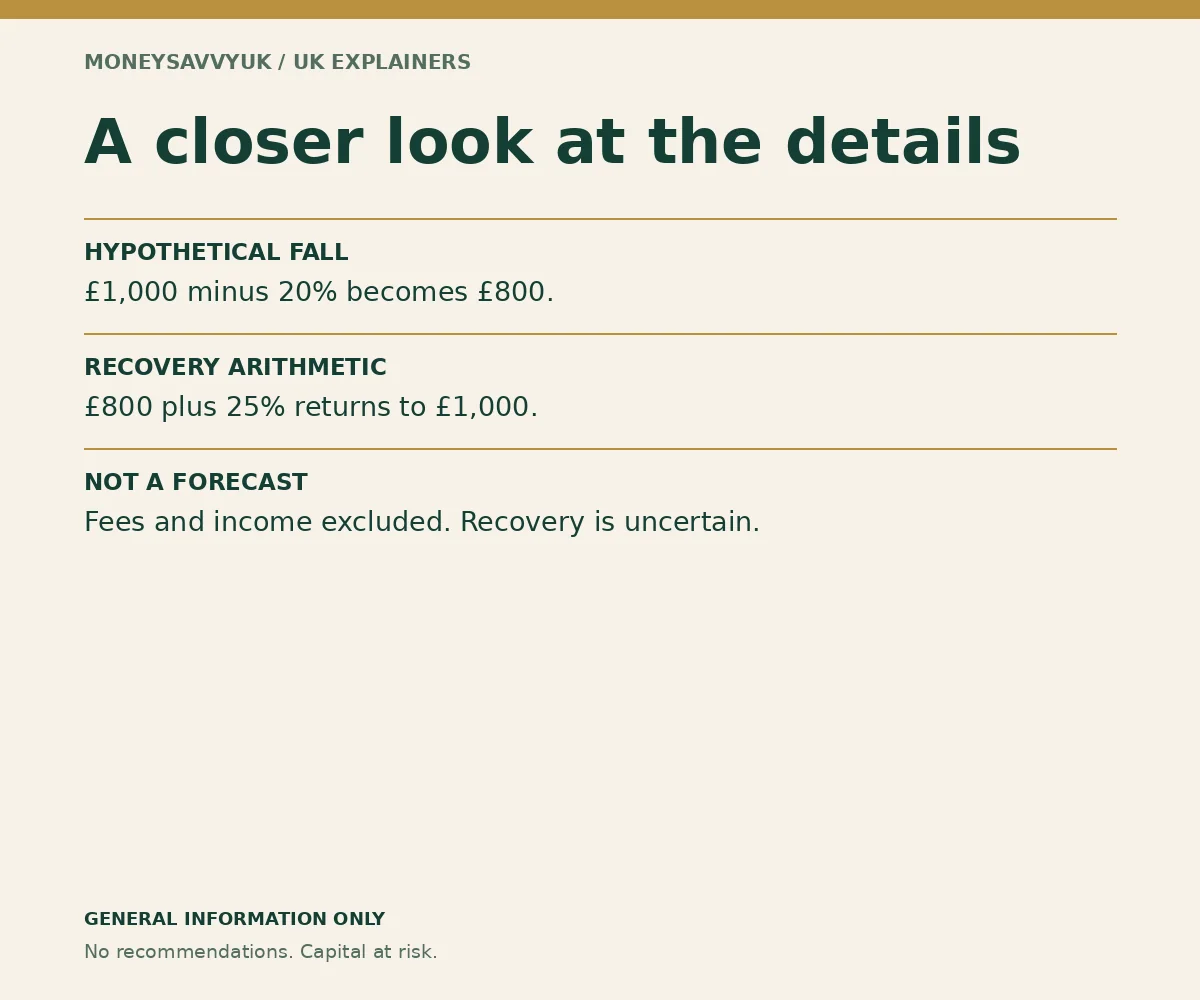
If a holding worth £1,000 falls by 20%, its value becomes £800 before other changes. That is a £200 fall. It does not mean the account is missing £200 of cash that can simply be located elsewhere.
To return from £800 to £1,000 requires a 25% increase: £200 divided by £800. A 20% rise from £800 would reach £960, not £1,000.
| Illustrative movement | Calculation | Value |
|---|---|---|
| Starting holding | — | £1,000 |
| 20% fall | £1,000 × 0.80 | £800 |
| 20% rise from the lower value | £800 × 1.20 | £960 |
| 25% rise from the lower value | £800 × 1.25 | £1,000 |
These are arithmetic examples, not a prediction of a fall or recovery. They exclude costs and income. Equal percentages in opposite directions do not cancel when they use different starting values.
4. Is it only a loss if I sell?
No. An unsold holding can still be worth less than its purchase cost. Unrealised means the holding has not been sold; it does not mean the lower current value is imaginary.
Selling turns the holding into proceeds under the dealing and settlement rules. The overall result can also include income and charges. A price comparison alone can omit those parts.
A holding may recover, decline further or, in some circumstances, become worthless. There is no automatic recovery date. A long time horizon does not create a guarantee.
This article explains the statement rather than prescribing a response. It does not tell a reader to sell in a fall, keep holding or buy more. Those are investment decisions requiring circumstances this general guide does not assess.
5. Why did a diversified fund fall too?
A fund holding many companies can still decline when share markets fall together. Diversification spreads dependence on particular holdings; it does not eliminate common market risks. See FCA: diversification.
For example, a fund can hold businesses from several countries that are all affected by the same broad economic shock. Having many names in the holdings list does not promise that some must rise enough to offset every loss.
Country weights, sectors, company sizes and asset types describe different aspects of exposure. A global share fund remains a share investment even when it contains many companies.
The global fund walkthrough shows where these details appear in the factsheet. The cash-versus-investment comparison explains why the behaviour differs from a cash deposit.
6. Will FSCS pay back a market loss?
No. FSCS says it does not accept claims for ordinary poor investment performance. A share or fund losing value does not become compensable because it is held in an ISA.
Its investment protection can cover eligible claims up to £85,000 per eligible person, per firm, subject to the conditions for the relevant failure. See FSCS: investment protection and exclusions.
The limit is not a guarantee that the first £85,000 of any investment is safe. Nor does it mean everything above that amount automatically disappears when a platform fails. There must be an actual eligible claim under the scheme’s rules.
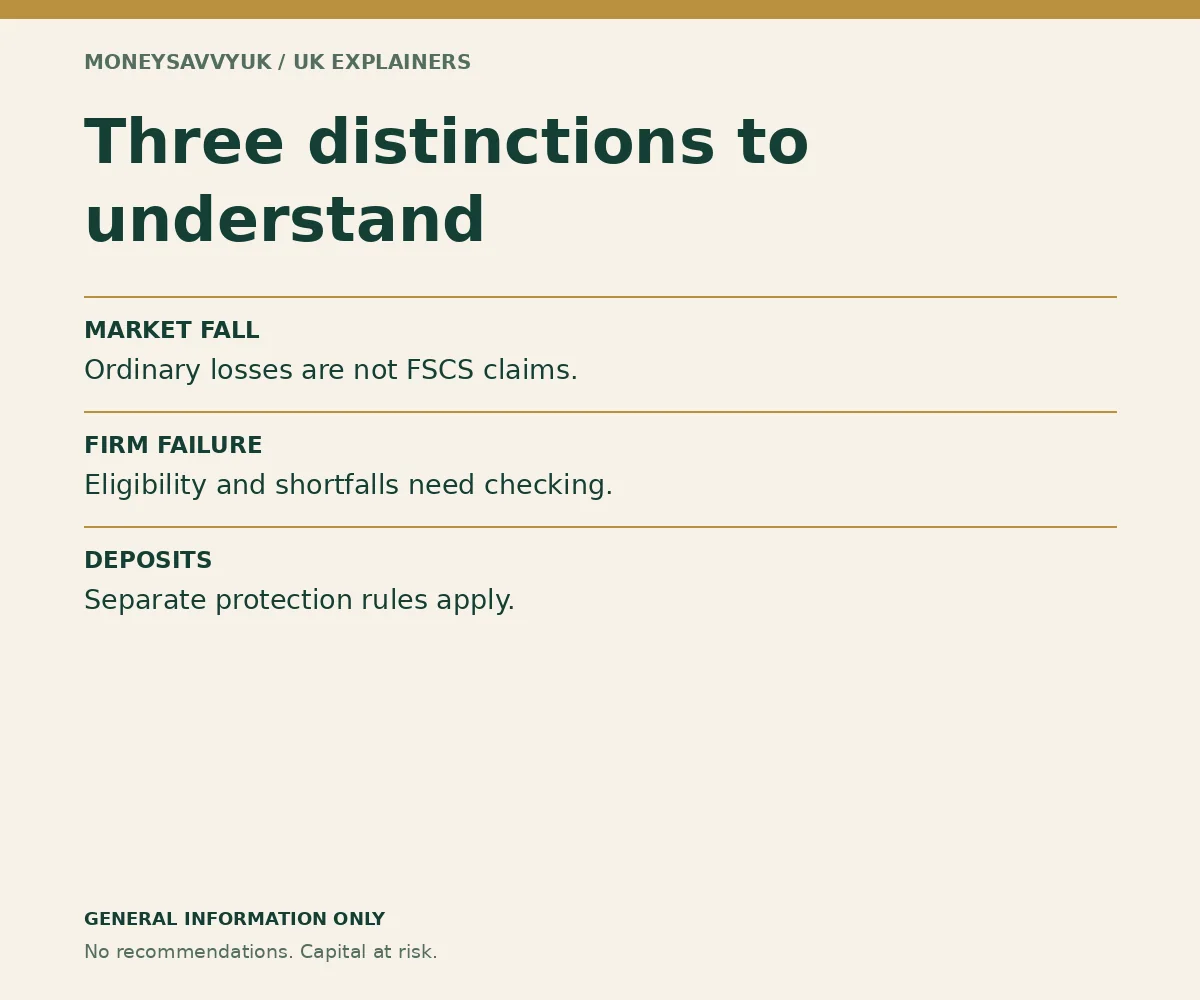
For a beginner, the useful split is “price movement in my holding” versus “a relevant failed firm and an eligible claim”. These are different events, even if both can affect someone’s finances.
7. What if the platform itself fails?
A platform is the service holding and administering the account. Its failure is different from a company share or fund falling in the market.
Client-asset arrangements can separate customer investments from a firm’s own assets, subject to the structure and rules. Failure can still involve access delays, administration and possible shortfalls. The actual notice and legal arrangements determine what happens.
This is why a displayed balance alone does not establish the compensation amount. The relevant questions include who the legal provider is, how the assets are held, whether assets can be returned and whether an eligible shortfall exists.
The provider comparison explains account and service distinctions. It does not certify either business as incapable of failure. The FCA’s FCA: Financial Services Register provides official permissions and contact information, separate from a general brand claim.
8. Is cash protection the same thing?
No. Eligible bank deposits have a separate FSCS limit, currently £120,000 per eligible person, per authorised firm. Brands sharing an authorisation can share that limit. See FSCS: deposit protection.
Uninvested cash held through an investment service needs its actual arrangements checked. A cash-like investment is not automatically a bank deposit. An ISA label or pound sign on the screen does not establish the protection category.
For money needed unexpectedly, the emergency fund calculator explains cash-cover calculations. The ISA overview explains account rules, and the calculator directory covers separate planning tools.
If an account message describes a missing payment, failed order, withdrawal delay or firm failure, the relevant provider process supplies the next factual information. Those problems should not all be labelled a stock-market loss.
What I’d do first
I’d first identify exactly what changed on the statement: a payment, a charge, a holding’s price or an account-access message. Then I would use the matching explanation above. That avoids treating every lower balance as the same problem and does not make a buy, hold or sell decision for the reader.
can you lose money in a stocks and shares ISA: FAQs
Does the ISA guarantee my original deposit?
No. The investments inside a Stocks and Shares ISA can lose value. The ISA changes tax treatment rather than guaranteeing capital. The amount recoverable from a holding depends on its value and the costs and conditions of selling or withdrawing.
Will FSCS reimburse a falling fund?
No. Ordinary poor investment performance is excluded. FSCS investment protection concerns eligible claims involving relevant failed firms and other conditions. A market fall is different from an eligible shortfall following a firm’s failure.
Can a loss recover automatically after five years?
No. Five years is a common planning guideline, not a recovery guarantee. Investment prices, costs, income and withdrawal timing all affect the outcome. An investment can remain below its earlier value for longer or suffer a permanent loss.
Does a 20% rise cancel a 20% fall?
Not when applied one after the other to the changed balance. £1,000 falling 20% becomes £800; a 20% rise from there reaches £960. It takes a 25% rise from £800 to return to £1,000, ignoring costs and income.
can you lose money in a stocks and shares ISA: summary
- Identify the starting point of the comparison.
- Separate payments, charges and price changes.
- Unrealised does not mean risk-free or guaranteed to recover.
- Market losses and eligible firm-failure claims are different.
Sources
Rules and provider figures checked on 19 October 2026. Worked examples are calculations with the assumptions shown; they are not forecasts. Tax treatment depends on individual circumstances and can change.
- FCA: diversification
- FSCS: investment protection and exclusions
- FSCS: deposit protection
- FCA: Financial Services Register
Reader-question research
A public discussion asks about platform failure. That is a different problem from a fund falling in price; the steps above keep the two situations separate.
Public discussion: Have any SIPP/ISA Platforms Gone Bust – if so what happened. Used to identify the question, not as authority for current figures or personal recommendations.
Written by Kalpana, founder of MoneySavvyUK: PhD scientist, former secondary science teacher and mum, in the UK since 2008. I’m not a financial adviser. See the financial disclaimer.