
Updated 19 October 2026 · 2026/27 rules · General information, not financial advice.
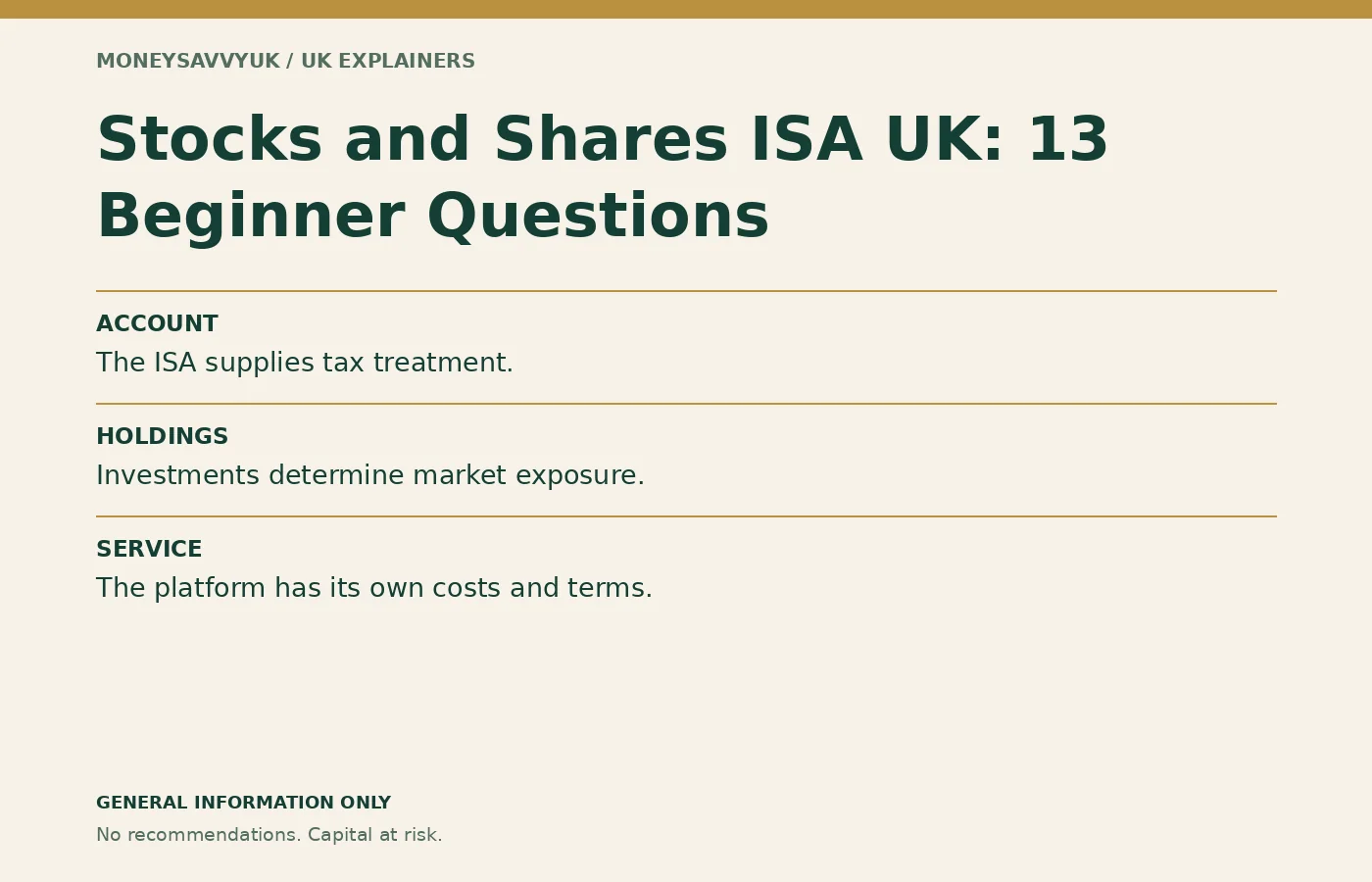
A stocks and shares ISA UK guide should answer two questions straight away: how much can you put in, and what do you actually do after opening one?
I’m Kalpana, a PhD scientist, former teacher and mum—not a financial adviser. I’ve broken the process into small steps, with worked examples of payments, account balances and choices a beginner will encounter.
You do not need to understand every investing term before reading. Each new term is explained where it first appears.
I’m not a financial adviser. This is general information, not a recommendation to buy, sell or hold investments. Capital is at risk: investments can fall and you may get back less than you put in.
stocks and shares ISA UK: your questions, step by step
1. How much can I put into cash and stocks ISAs?
The simplest way to think about the allowance is one yearly basket for your new ISA payments. Opening another account does not create another basket.
Here are valid examples for 2026/27, assuming there are no payments into other adult ISAs. These are illustrations of the rules, not suggested savings plans.
| New Cash ISA payments | New Stocks and Shares ISA payments | Total paid in | Within the limit? |
|---|---|---|---|
| £20,000 | £0 | £20,000 | Yes |
| £0 | £20,000 | £20,000 | Yes |
| £10,000 | £10,000 | £20,000 | Yes |
| £15,000 | £5,000 | £20,000 | Yes |
| £1,000 | £0 | £1,000 | Yes—£19,000 unused |
| £20,000 | £20,000 | £40,000 | No—over the shared limit |
You do not have to use the full allowance. It is a maximum, not a minimum. Payments into a Lifetime ISA also use part of the same adult allowance; the Lifetime ISA guide explains its additional conditions.
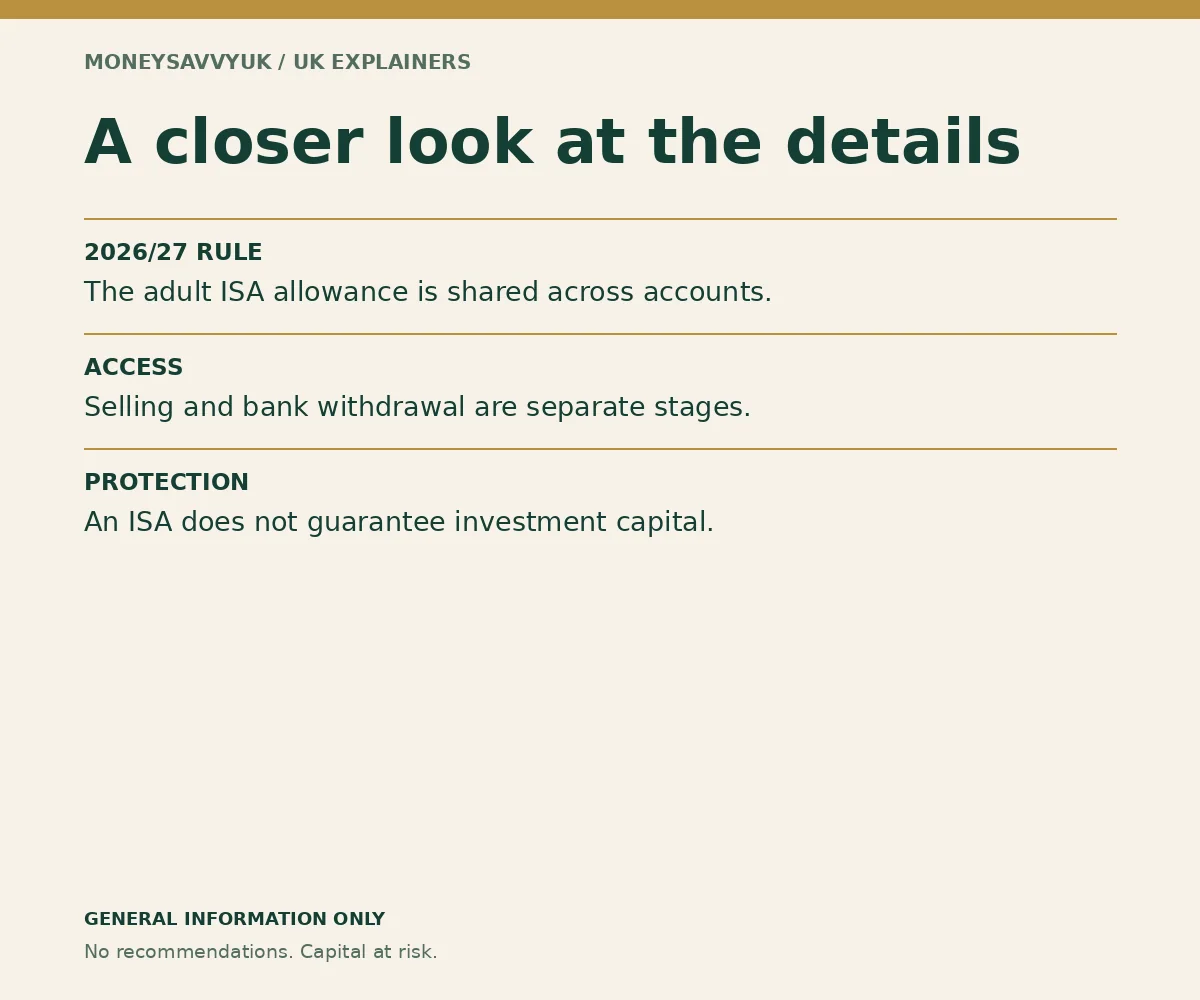
The limit concerns money paid in, not the highest balance an ISA can hold. Money from previous tax years can remain there. Growth inside an ISA does not use a fresh slice of your contribution allowance. Our general ISA guide covers those wider rules.
2. What is the difference between the two accounts?
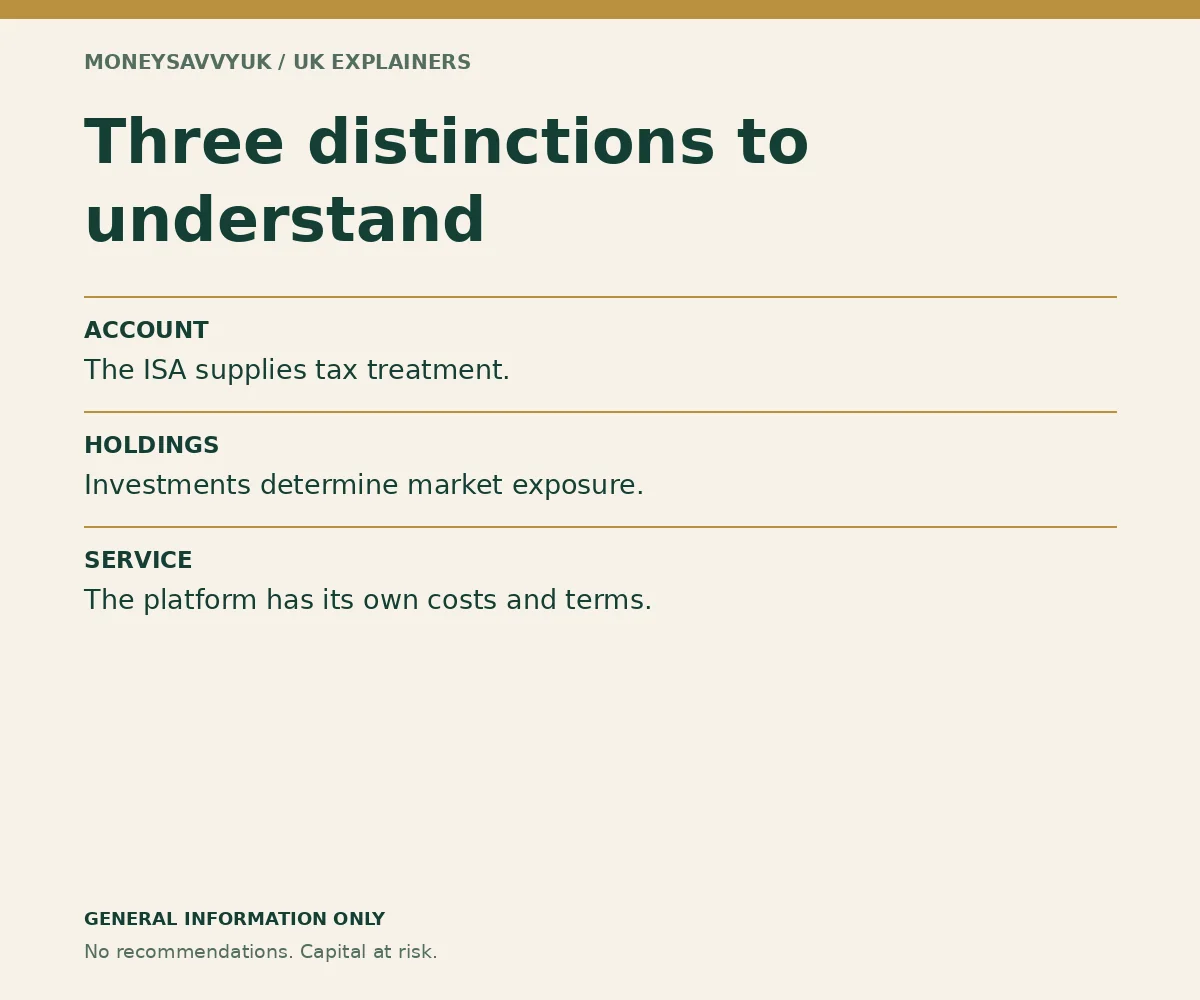
A Cash ISA is a savings account: you pay in cash and receive interest under its terms. A Stocks and Shares ISA is an investment account: you pay in money and use it to hold investments such as funds or company shares.
That means an investment ISA has two stages: opening the account, then putting the money into investments. The ISA is the account; a fund or share is something held inside it.
| Question | Cash ISA | Stocks and Shares ISA |
|---|---|---|
| What happens to the money? | It earns interest under the account terms. | Its value changes with the investments held. |
| Can the value fall with share markets? | The cash deposit is not stock-market priced. | Yes; you can get back less than you paid in. |
| How do you get money out? | According to easy-access, notice or fixed-term rules. | Usually sell holdings, wait for settlement, then withdraw. |
| Is a return guaranteed? | Interest depends on the fixed or variable terms. | Investment returns are not guaranteed. |
For example, a bank account paying interest is different from buying a small ownership stake in companies through a fund. Both may have ISA in their names, but they do not behave the same way. The full Cash ISA versus Stocks and Shares ISA comparison walks through that difference.
3. What if I might need the money soon?
Before the account-opening screens, there is a practical question: when might this money be needed? A bill due in six months and an unspecified later-life goal have different deadlines.
A simple worksheet has three columns: the purpose, the date the money may be needed, and whether that date can move. This helps you describe the goal without starting with a provider’s advert.
| Illustrative goal | Time information to record | Question it raises |
|---|---|---|
| Annual car insurance | Renewal date is known. | Could a fall or delay leave the bill unpaid? |
| Emergency reserve | Could be needed without warning. | How quickly is the money accessible? |
| A later goal | No immediate spending date. | How much uncertainty can the household bear? |
MoneyHelper discusses investing in the context of goals more than five years away. Five years is not a guarantee of profit. MoneyHelper: investing overview explains the distinction. You can use the emergency fund calculator to calculate cash cover separately, and the budgeting guide to see regular spending in one place.
This stage may end with learning more rather than opening anything. Reading an investing guide does not mean a household has to invest.
4. Where can I open an investment ISA?
An investment platform is the company providing the account and the tools for buying and holding investments. Think of the platform as the service, not the investment itself.
There are two broad ways the service can work:
- Self-managed: you select the investments available through the account.
- Managed: the service selects and manages investments under its process, usually using information about your goals and risk level.
A managed service can still lose money. A self-managed account does not automatically include personal advice. The provider’s documents explain exactly what service is included.
A beginner’s comparison sheet needs just a few fields: minimum opening payment, account charge, additional investment costs, available investments, and withdrawal or transfer arrangements. The fees guide shows how to turn percentages into pounds.
Our Vanguard versus Trading 212 comparison demonstrates that process with two services. It does not choose one for you. The FCA’s FCA: Financial Services Register is where permissions and official contact details can be checked; it is separate from a brand’s marketing website.
5. Which account do I select on the website?
On a provider’s website or app, the account menu may contain several products. For the account discussed here, the relevant label is Stocks and Shares ISA, sometimes shortened to Stocks ISA or Investment ISA.
A General Investment Account is a different account without the same ISA wrapper. A Cash ISA is a cash-savings product. A CFD account is a different trading product and is not the Stocks and Shares ISA explained here. Similar menus do not make these interchangeable.
The application normally asks for personal and contact details and checks eligibility and identity. Requirements vary by provider. GOV.UK says you will need your National Insurance number; see GOV.UK: opening an ISA.
For an adult ISA, eligibility normally starts at 18 and requires UK residence, subject to specified exceptions. ISAs are individual accounts, not joint accounts. See GOV.UK: ISA eligibility.
The account-opening stage is complete when the provider confirms the account is open. At that point, there may be no money in it and no investments purchased. An application confirmation is not a trade confirmation.
6. How do I put money into the account?
The funding screen tells you which payment methods the service accepts. These may include bank transfer, card payment or a regular payment arrangement. Minimums, references and charges vary, so the provider’s instructions matter.
Here is a made-up example of what happens after a £100 deposit:
| What the account shows | Amount |
|---|---|
| Cash available | £100 |
| Investments purchased | £0 |
| Total account value, before charges | £100 |
That £100 has reached the ISA, but it has not necessarily been invested. On a self-managed service it may remain cash until an order is placed. A managed service may invest it under its own timetable.
Money paid in counts as an ISA contribution when subscribed to the account; leaving it as cash is not a way to postpone the contribution record until a later investment purchase. Keep a record of payments across providers.
If the money is already in another ISA, the separate transfer process below matters. Moving an existing ISA and adding new money are not the same transaction.
7. What am I actually buying?
A share is a small ownership stake in one company. If that company does badly, its share price can fall. A fund pools investors’ money and holds investments according to its stated rules.
A fund can hold shares in many companies. That spreads exposure, but does not stop its value falling when markets fall. The number of companies and the type of investments depend on the fund.
An index fund aims to follow a stated market index. An index is a set of rules for measuring a group of investments. An ETF, or exchange-traded fund, is a fund traded on an exchange. These labels describe different features, so a fund can be both an ETF and an index tracker.
A fund information page usually shows its full name, what it invests in, risk information and charges. It may also offer versions that pay income out or retain it inside the fund. This is why the complete name or identifier matters.
The global index fund walkthrough explains how to read that page. This guide explains the purchasing process, rather than naming a fund or share to buy.
8. How does an investment purchase work?
On a self-managed account, selecting a fund or share opens its information and order screens. Depending on the service, you may enter a cash amount or a number of units. A unit is simply a small part of a fund.
Before submission, the order screen normally provides relevant price or dealing information and charges. The exact price can be uncertain where a fund deals at its next valuation point. Some exchange-traded orders use limits or other execution conditions. Those details are explained in the service’s order information.
For a simplified illustration only, £50 at exactly £2 per unit would buy 25 units, ignoring charges. This is arithmetic, not an order price for an actual fund.
Here is the difference between an account deposit and an investment order, using a fictional £100 opening deposit:
| Stage | Cash | Investments |
|---|---|---|
| After the deposit, before purchases | £100 | £0 |
| After a £60 purchase, ignoring charges and price changes | £40 | £60 |
This split is an illustration of the mechanics, not a suggested allocation. The order confirmation or holdings screen establishes whether the transaction completed. Pressing a button and seeing a pending order are not the same as a completed purchase.
9. How do monthly payments work?
A monthly payment can mean two different things: money regularly arrives in the ISA, or money is regularly used to buy investments. Some services combine these; others require separate settings.
For a hypothetical £25 monthly payment, 12 completed payments total £300 before fees and investment changes. If the payment only adds cash, it does not automatically buy a fund. If an investment instruction is also set, the service follows that instruction subject to its rules.
The confirmation screen should make clear what repeats, when it repeats and how to amend or stop it. A separate instruction may collect account fees. These are different payments even if they leave the same bank account.
The small-amount investing guide shows the cost arithmetic and payment checks. £25 is just an illustration; each service has its own minimums and each household has its own budget.
10. How can I tell whether I have made a profit?
After the account is running, the useful figures are total money paid in, current cash, current holdings and charges. A rising account balance does not by itself show an investment profit if new money has been added.
For example, suppose someone pays in £300, makes no withdrawals and receives no separate income payments. If the combined cash and holdings are worth £285, the balance is £15 below contributions. If they are worth £315, it is £15 above contributions. This simplified comparison assumes all relevant charges are already reflected.
A percentage shown by an app may cover a different period or use a different performance calculation. The labels beside it explain whether it measures a day, a year or a longer period. The contribution record and the investment return answer different questions.
Account access and security also matter. Confirmation emails, statements and payment records help establish what actually happened if a payment or order needs checking.
11. Can I withdraw or move my ISA?
To spend money held in investments, the usual sequence is a sale, settlement of the transaction, and a withdrawal to a bank account. The precise timetable depends on the investment and service, so an investment balance is not identical to instantly spendable cash.
An ISA transfer uses the receiving provider’s transfer process. Withdrawing personally and paying into a new ISA can use subscription allowance differently. GOV.UK: ISA transfers explains the process.
A flexible ISA allows certain withdrawals to be replaced in the same tax year without reducing the current allowance. Not every ISA is flexible. The provider explains the replacement conditions; see GOV.UK: ISA withdrawals.
For a simple non-flexible example, paying in £1,000 and then withdrawing £200 does not normally turn the contribution record into £800. The withdrawal and the original payment are separate events. This matters when keeping track of the shared annual allowance.
12. Is the money protected?
The short answer is that an ISA does not insure investments against ordinary market falls. A share or fund can lose value inside the account.
FSCS currently describes eligible investment claims up to £85,000 per eligible person, per firm, subject to conditions. Eligible bank deposits use a separate protection limit of £120,000 per eligible person, per authorised firm. These are different schemes for different circumstances; see FSCS: investment protection and exclusions and FSCS: deposit protection.
A failed provider is not the same event as a falling share price. Our losses and protection guide explains those situations with examples. Keeping that distinction clear is more useful than assuming the word ISA means safe.
13. Which tax year do these examples use?
The examples above use the 2026/27 rules. HMRC has announced ISA changes from 6 April 2027, including changes affecting cash subscriptions and cash held in non-cash ISAs. They are not the rules for contributions made in the current tax year.
I keep the detailed future-rule explanation in the ISA overview so a beginner following today’s process does not have to untangle two sets of rules at once. The official announcement is HMRC: announced ISA reforms from April 2027.
The practical record for this year is straightforward: the account name, the provider, the date and amount of each new payment, any withdrawals, and any provider-led transfers. Our calculator directory covers separate household calculations, while the optional Sinking Funds & Savings Pots planner below can hold a written savings-goal record.
What I’d do first
I’d start with one page containing three things: the purpose of the money, the amount already paid into ISAs this tax year, and the account costs in pounds. Then I would use the relevant step above to understand the process I was looking at. That keeps an application screen from becoming the first place I encounter unfamiliar terms. It does not choose an investment or provider.
stocks and shares ISA UK: FAQs
How much can I put in a Cash ISA and a Stocks and Shares ISA?
For 2026/27, the combined adult ISA allowance is £20,000. You can put the full amount into either type or split it, assuming no other adult ISA contributions. For example, £15,000 into cash and £5,000 into investments uses the full allowance. It is not £20,000 for each.
Does opening the account automatically invest my money?
Not necessarily. On a self-managed service, the money can remain in the cash balance until an investment order is completed. Some services allow a separate regular-investment instruction. Managed services invest according to their process. The account’s holdings and confirmation screens show what has actually happened.
Do I need £20,000 to start?
No. £20,000 is the annual maximum contribution allowance, not a minimum opening amount. The provider sets its own minimum payment. A smaller contribution can still face charges and market losses, so the entry minimum and the full cost are separate things to understand.
Can I use both a Cash ISA and a Stocks and Shares ISA?
Yes. Eligible adults can hold and contribute to both, within the shared allowance and account rules. The account choice does not have to be all cash or all investments. The table above explains valid contribution combinations without recommending a personal split.
What happens if the investments fall?
Their value can be lower than the money originally invested. The ISA wrapper does not prevent that loss, and ordinary market falls are not reimbursed by FSCS. The linked losses guide explains market movements, provider failure and protection separately. Recovery is not guaranteed.
stocks and shares ISA UK: summary
- One £20,000 adult allowance is shared across ISAs in 2026/27.
- Opening the account, funding it and investing are separate stages.
- A regular deposit and a regular investment instruction may differ.
- The holdings screen shows what is invested; the payment record tracks allowance.
Sources
Rules and provider figures checked on 19 October 2026. Worked examples are calculations with the assumptions shown; they are not forecasts. Tax treatment depends on individual circumstances and can change.
- GOV.UK: how ISAs work
- GOV.UK: ISA eligibility
- GOV.UK: opening an ISA
- MoneyHelper: investing overview
- GOV.UK: ISA transfers
- GOV.UK: ISA withdrawals
- FSCS: investment protection and exclusions
- FSCS: deposit protection
- HMRC: announced ISA reforms from April 2027
- FCA: Financial Services Register
Reader-question research
A public MoneySavingExpert discussion describes a beginner who could not tell whether opening and funding the account had also bought an investment. The account, cash and order steps above answer that distinction.
Public discussion: Vanguard noobie.. what now?!. Used to identify the question, not as authority for current figures or personal recommendations.
Written by Kalpana, founder of MoneySavvyUK: PhD scientist, former secondary science teacher and mum, in the UK since 2008. I’m not a financial adviser. See the financial disclaimer.