

Updated 19 October 2026 · 2026/27 rules · General information, not financial advice.
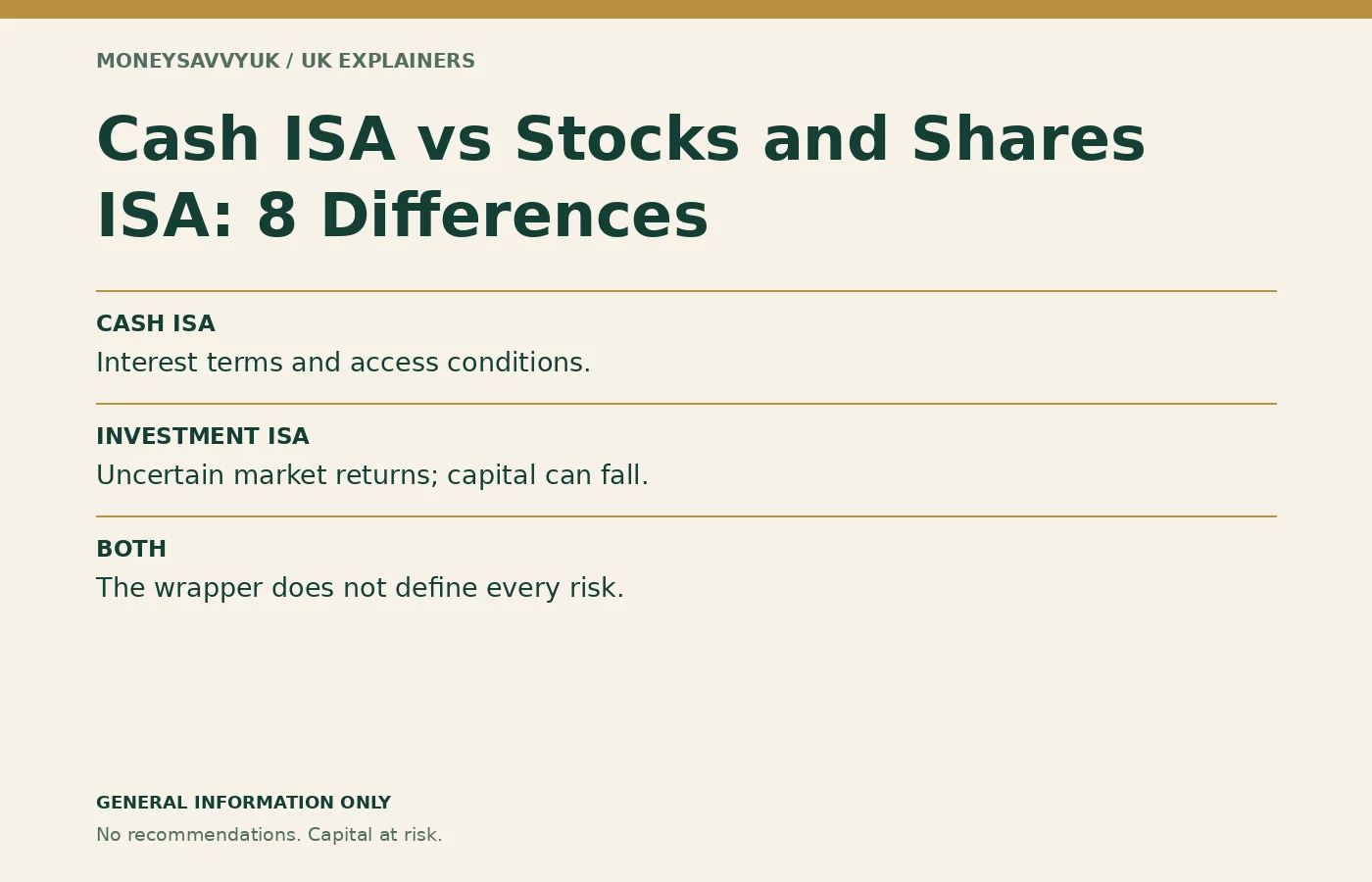
Cash ISA vs stocks and shares ISA: one pays interest on cash, while the other can hold investments that rise or fall in value. Both can use part of the same annual ISA allowance.
I’m Kalpana, a PhD scientist, former teacher and mum. Here is a simple comparison you can work through in order, starting with the money limit rather than financial jargon.
I’m not a financial adviser. This is general information, not a recommendation to buy, sell or hold investments. Capital is at risk: investments can fall and you may get back less than you put in.
cash ISA vs stocks and shares ISA: your questions, step by step
1. How much allowance have I already used?
The first number to find is this year’s new ISA payments, not the current balance. If a Cash ISA holds £18,000 from earlier years and you have paid nothing into any adult ISA this year, the old balance alone does not use this year’s allowance.
If you have made new payments, add them across the accounts. For illustration:
| Cash ISA payments this year | Investment ISA payments this year | Total new payments | Allowance remaining |
|---|---|---|---|
| £5,000 | £0 | £5,000 | £15,000 |
| £5,000 | £2,000 | £7,000 | £13,000 |
| £10,000 | £10,000 | £20,000 | £0 |
These examples assume no other adult ISA contributions. Payments into a Lifetime ISA also need to be included. The ISA overview explains the full account rules, and the Lifetime ISA guide covers its additional conditions.
The split is not compulsory. A reader can hold cash, investments or both; the table explains the limit rather than suggesting how to divide savings.
2. What happens after I pay money in?
In a Cash ISA, a deposit becomes a cash balance earning interest under the account terms. The rate can be fixed or variable, and access conditions vary.
In a Stocks and Shares ISA, a deposit can first appear as uninvested cash. It is used to buy investments through the provider’s process. On a self-managed account, an investment order is normally a separate action.
For a fictional £100 payment, the two routes look like this:
| Cash ISA | Investment ISA |
|---|---|
| £100 reaches a savings balance. | £100 reaches the account’s cash balance. |
| Interest follows the account terms. | A purchase instruction can move cash into investments. |
| No fund needs to be chosen. | The investments determine exposure and possible losses. |
That extra purchase stage explains why simply opening an investment ISA does not necessarily mean money has entered the stock market. The step-by-step investment ISA guide follows that route in more detail.
3. What if I need the money for a bill?
A goal becomes easier to compare when it has a date. A car insurance payment due next spring is different from money with no immediate spending date.
Try describing an example in this format: “£900 needed for a known bill in nine months.” Then the access question is specific: could the account provide the required money at that time, under its conditions?
For another example, “money for a later goal, with no fixed withdrawal date” still needs a risk question: could the household cope if its value fell? A longer deadline does not remove that question.
MoneyHelper discusses investing in relation to goals more than five years away; see MoneyHelper: investing overview. That is a planning guideline, not a guarantee of profit. The emergency fund calculator covers money that might be needed unexpectedly, and the emergency buffer guide addresses building an initial cushion.
4. How quickly could I get money out?
Cash ISA access depends on the product. Easy-access accounts, notice accounts and fixed-term accounts have different rules. A fixed rate does not mean unlimited penalty-free access.
An investment withdrawal usually has more stages: sell the relevant holding, wait for settlement, and request payment to the bank. A fund may deal at scheduled times rather than instantly. The provider gives the relevant timetable.
A useful comparison sheet therefore asks “When would the money reach my bank?” rather than only “Can I press withdraw?” It also records charges or notice periods.
For example, an account might permit a withdrawal request today but make the payment later. That matters if the bill needs paying today. The exact number of days is provider-specific; this guide does not invent a universal withdrawal time.
5. What is the difference between interest and investment returns?
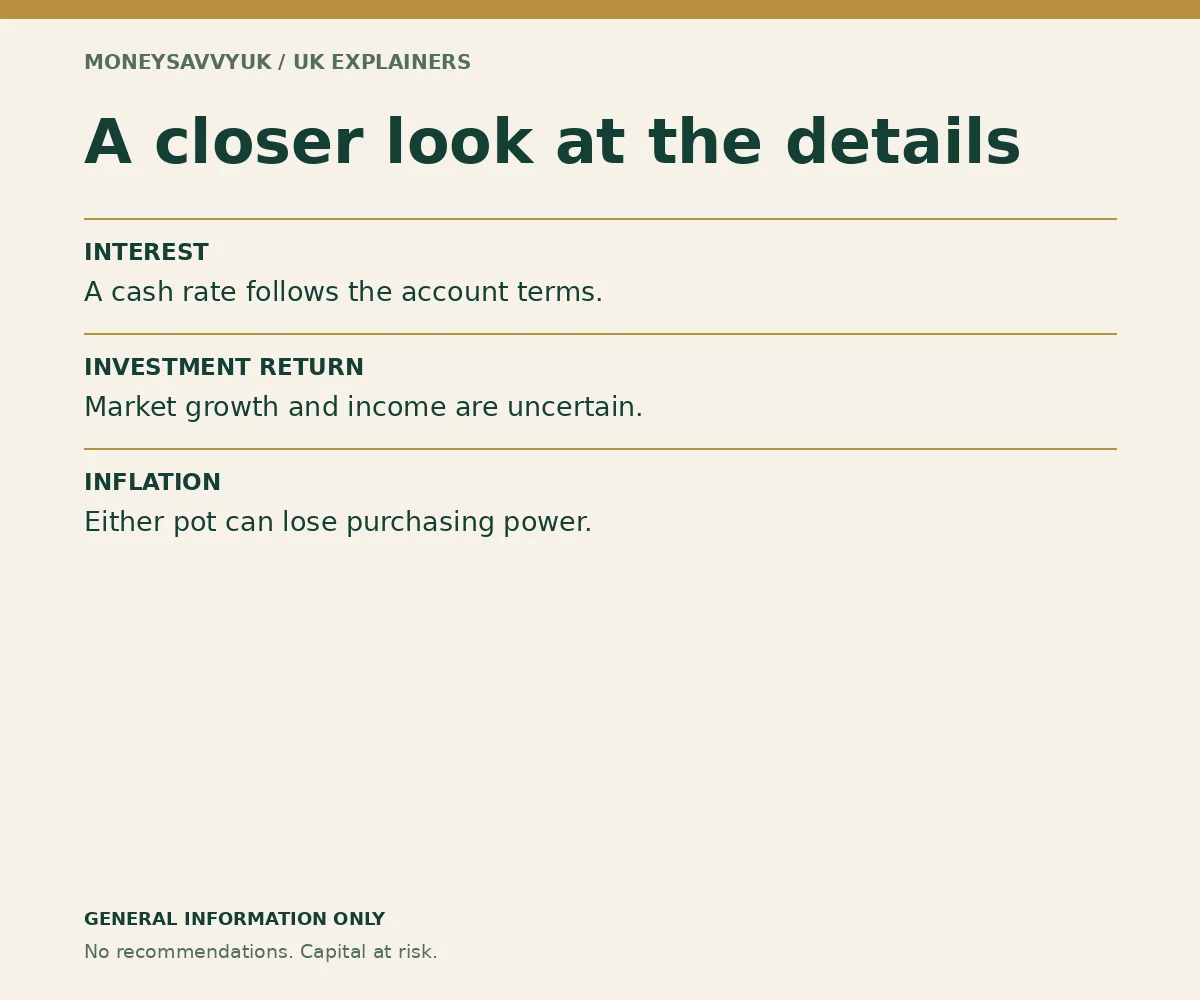
With cash, the account terms describe the interest rate. With investments, the result can include changes in price and income, such as dividends. A dividend is a payment made to shareholders; it is not guaranteed.
Here are two invented examples, not current offers or forecasts. A £1,000 cash balance receiving exactly 3% interest over one year would gain £30, assuming no changing balance or charges. A £1,000 investment worth £950 at year end, having paid £20 income, would have combined value and income of £970: a £30 loss before other costs.
The income payment alone does not tell you whether the investment made a profit. Likewise, a historical growth percentage is not the equivalent of a cash interest rate promised for a coming term.
The fund explainer explains what sits behind some investment returns. The Cash ISA versus Premium Bonds calculator addresses a separate comparison and does not model stock-market losses.
6. How do I compare the costs?
For either account, the terms describe charges and restrictions. For an investment ISA, costs may include the platform, the investments and transactions. A platform is the company operating the account.
A simple fee worksheet records the balance used in the example, the period and which costs are included. For an unchanged £1,000 balance, a hypothetical £20 annual fee equals 2% of that balance. A quoted zero platform fee would not rule out fund charges or other costs.
The step-by-step fee guide shows the arithmetic. The provider comparison walkthrough shows how to read actual published terms. A price comparison does not establish that two accounts hold investments with the same risk.
7. Is the protection the same?
The key distinction is between a firm failing and an investment falling in price. Ordinary market losses are not reimbursed simply because the holding is inside an ISA.
FSCS currently states a £120,000 limit for eligible deposits per eligible person, per authorised firm. Its investment protection can cover eligible claims up to £85,000 per eligible person, per firm, subject to conditions. See FSCS: deposit protection and FSCS: investment protection and exclusions.
Those figures do not mean every investment below a limit is safe. Nor does a platform failure automatically mean that all client investments have vanished. The losses and protection walkthrough explains the separate situations.
8. How do I move an existing ISA?
If money is already in an ISA, moving it through the receiving provider’s ISA-transfer process differs from withdrawing it to a current account and paying it into another ISA.
The usual administrative sequence is to check what the receiving service accepts, complete its transfer application and let the providers arrange the move. Some holdings can move directly; others may need selling. Restrictions, costs and timing depend on both sides. See GOV.UK: ISA transfers.
A flexible ISA has separate rules about replacing withdrawals. Flexibility is not a feature to assume from the account name; see GOV.UK: ISA withdrawals.
For new money, the shared allowance table at the start applies. For an existing ISA, the transfer question belongs alongside it. The calculator directory supplies separate tools for household savings calculations.
What I’d do first
I’d make a one-page comparison with the amount already subscribed this year, the goal’s date, withdrawal conditions and complete costs. That produces an understandable comparison without declaring a winner. The first concrete task is finding those facts—not deciding that one account type must suit everybody.
cash ISA vs stocks and shares ISA: FAQs
Do I get a separate £20,000 for each type?
No. In 2026/27 the £20,000 allowance is shared across adult ISA contributions. For example, £12,000 into a Cash ISA and £8,000 into a Stocks and Shares ISA uses the full allowance, assuming no other adult ISA contributions. It is one combined limit.
Can an investment ISA lose money?
Yes. The investments held can fall in value, and you may get back less than you paid in. The ISA supplies tax treatment, not a capital guarantee. Ordinary investment losses are different from eligible claims involving a failed firm.
Can I have both types?
Yes, eligible adults can hold and pay into both, within the shared contribution allowance and account rules. A split is optional. The relevant questions include what the money is for, how quickly it may be needed, the costs and the uncertainty involved.
Is cash always protected against inflation?
No. Inflation can rise faster than the interest received, reducing purchasing power even when the number of pounds increases. Investment returns can also lag inflation or be negative. Neither account label guarantees that future spending power will be maintained.
cash ISA vs stocks and shares ISA: summary
- Count current-year payments, not just balances.
- Cash interest and investment returns work differently.
- Access depends on the actual product terms.
- Use the provider-led process when transferring an existing ISA.
Sources
Rules and provider figures checked on 19 October 2026. Worked examples are calculations with the assumptions shown; they are not forecasts. Tax treatment depends on individual circumstances and can change.
- GOV.UK: how ISAs work
- MoneyHelper: investing overview
- GOV.UK: ISA transfers
- GOV.UK: ISA withdrawals
- FSCS: deposit protection
- FSCS: investment protection and exclusions
Reader-question research
Public ISA discussions repeatedly separate new contributions from transfers of older balances. The first and final steps above explain those different transactions.
Public discussion: ISA Basics. Used to identify the question, not as authority for current figures or personal recommendations.
Written by Kalpana, founder of MoneySavvyUK: PhD scientist, former secondary science teacher and mum, in the UK since 2008. I’m not a financial adviser. See the financial disclaimer.