

Updated 19 October 2026 · 2026/27 rules · General information, not financial advice.
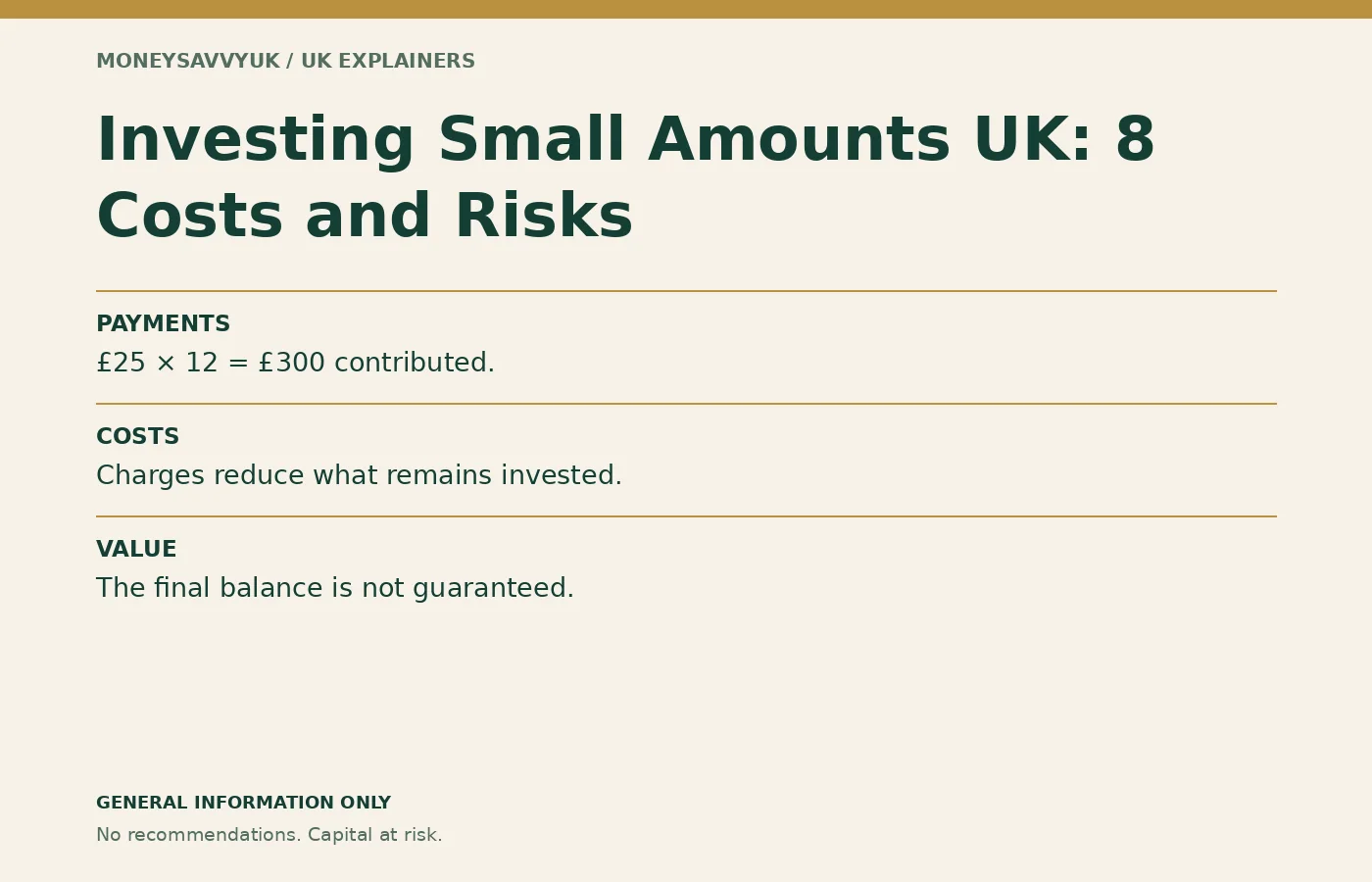
Investing small amounts UK searches often start with a practical question: “I have £25 a month—what actually happens to it?” The answer depends on the account minimums, charges and payment instructions.
I’m Kalpana, a PhD scientist, former teacher and mum. This guide follows a small contribution through the process, without recommending an investment or setting a personal savings target.
I’m not a financial adviser. This is general information, not a recommendation to buy, sell or hold investments. Capital is at risk: investments can fall and you may get back less than you put in.
investing small amounts UK: your questions, step by step
1. How much does my monthly amount add up to?
Start with the contribution total, before discussing growth. This is money paid in, not profit.
| Hypothetical monthly payment | After 12 completed payments |
|---|---|
| £10 | £120 contributed |
| £25 | £300 contributed |
| £50 | £600 contributed |
Those totals assume every payment happens. They exclude an opening balance, fees, withdrawals and investment returns. A final account balance can be higher or lower than the contribution total.
For example, £300 contributed and a final combined cash-and-investments value of £285 is £15 below contributions, assuming no withdrawals or separate income payments. That is why a screenshot showing the balance is not enough to establish a profit.
The budgeting guide and emergency fund calculator deal with the separate question of what is available after household costs.
2. Will the account accept that payment?
The provider sets the minimum deposit and may have different minimums for a one-off payment, a monthly plan or a particular investment. A £1 account minimum does not mean every service or holding follows that rule.
A comparison sheet can use three rows: opening minimum, later-payment minimum and minimum purchase. They answer different questions. Money might be accepted into the account but remain cash if it cannot fund the intended order.
The Vanguard versus Trading 212 walkthrough records dated examples from provider pages. It also explains the difference between a new payment and a transfer of an existing ISA.
An entry minimum is not an affordability test. A household can meet a platform’s minimum while still needing that money for bills. The emergency buffer guide covers a different starting point.
3. How much would a fixed fee take?
A fixed fee stays the same amount under the stated tariff, rather than simply changing in proportion to the balance. On a small pot, that amount can represent a sizeable percentage.
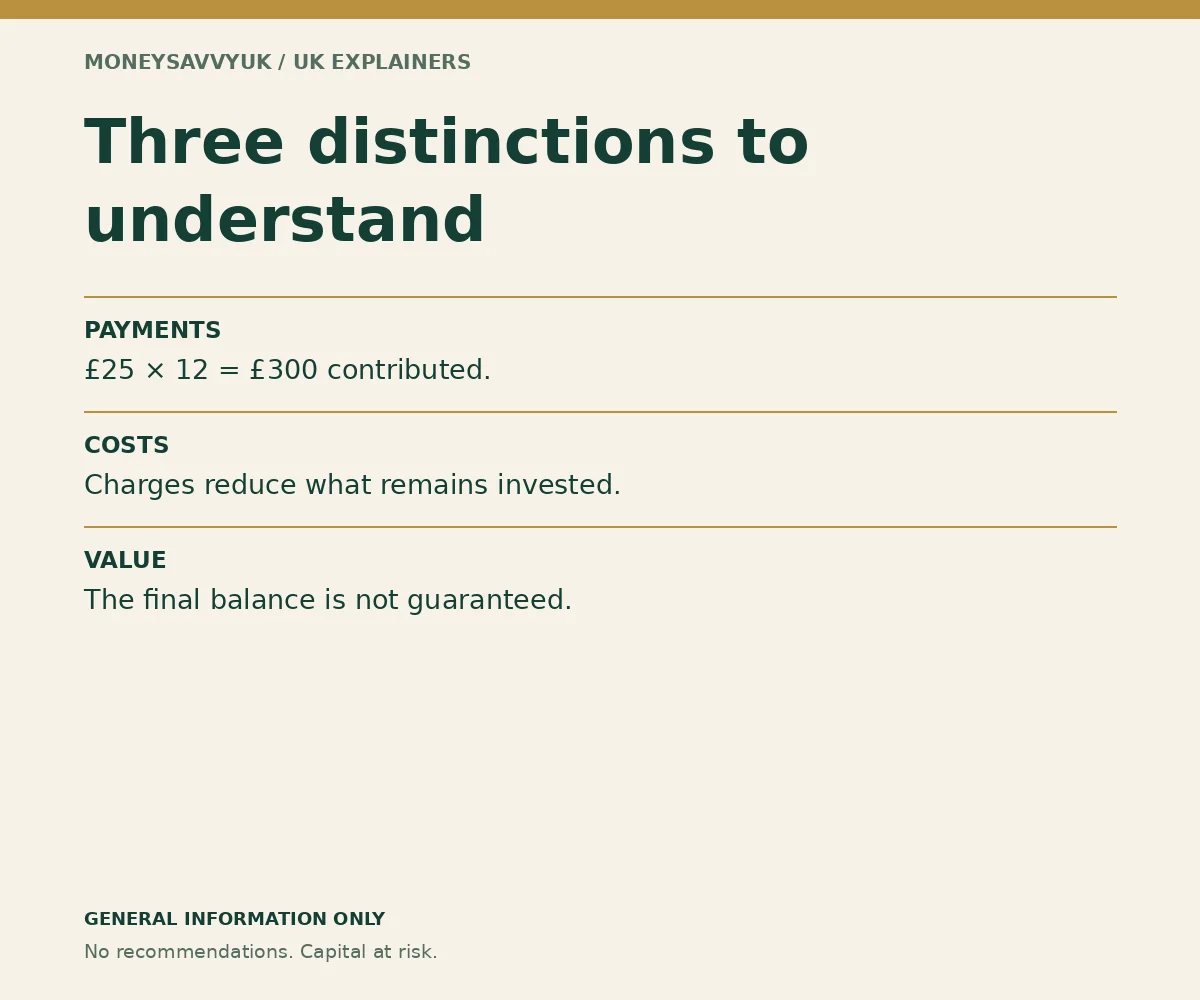
For a hypothetical £24 annual charge on a balance held unchanged for a full year:
| Balance | Annual fee | Fee as a share of balance |
|---|---|---|
| £300 | £24 | 8% |
| £1,200 | £24 | 2% |
| £6,000 | £24 | 0.4% |
These are invented examples, not actual provider quotes. For a balance built gradually through monthly payments, the year-end balance was not present for the whole year. The provider’s real billing method matters.
The fee walkthrough shows how fixed charges, percentages, minimums and caps fit together. A cheap-looking percentage is not a complete quote if a minimum fee applies.
4. Are there other costs on each purchase?
A small payment can face fund expenses, dealing charges, spreads, currency conversion or payment-method charges, depending on the service and activity. Commission-free does not automatically mean every cost is zero.
For a simple illustration, a hypothetical £1 dealing charge on a £10 purchase is 10% of the purchase amount. On £100 it is 1%. That shows why the transaction size and charge need to be written together.
Fund costs may be reflected in the fund’s value rather than shown as a debit from a bank account. MoneyHelper: investment types and charges explains the categories. The calculation needs to include the relevant layers, but not subtract the same expense twice from a return already reported after that expense.
A complete example states which costs are included, the payment method and whether any currencies are converted. It does not simply repeat a provider’s headline fee.
5. What happens after the money reaches the ISA?
The payment appears in the account’s cash balance. On a self-managed service, it may stay there until a purchase happens. Some services let the account holder create a separate recurring order.
For a fictional £25 payment with no charges, the account might initially show £25 cash and £0 investments. If a £20 purchase completes, it would show £5 cash plus investments initially worth £20, before price changes. This is an example of the mechanics, not a suggested split.
The confirmation screen distinguishes completed purchases from pending orders. A regular payment confirmation only establishes that money is due to arrive; it may not establish that an investment will be bought.
The main ISA walkthrough explains the account-opening and funding stages. The fund guide explains the information shown before a fund purchase.
6. Does a Direct Debit buy the investment automatically?
Sometimes a service combines the deposit and purchase settings; sometimes it does not. The recurring instruction needs to say what the money will do, not just when it leaves the bank.
The practical checks are the amount, date, destination account and whether there is an investment instruction. The provider also explains how to amend or cancel the arrangement. A fee-collection instruction may be separate again.
For example, an instruction saying add £25 monthly could build up uninvested cash. An instruction saying buy a specified holding monthly would do something different, under the service’s dealing rules. Labels vary between providers, so this article does not invent a universal button sequence.
Regular purchases do not guarantee a profit. They spread buying across dates; prices can still fall and fees still matter.
7. What are fractional shares?
A fractional holding represents less than one whole share or eligible ETF unit, where the service supports that arrangement. It can allow a smaller purchase without requiring the cash price of a whole unit.
For arithmetic only, if a whole unit costs £100, a £10 purchase would represent one tenth of a unit before charges, if fractions are supported. It would still be exposed to that holding’s price changes.
Fractional arrangements can have transfer restrictions. For example, Trading 212’s published transfer page says fractional shares cannot be transferred as holdings; see Trading 212: portfolio transfer restrictions. Its rules should not be assumed to apply identically to every provider.
A fractional holding is an account feature, not a guarantee of lower investment risk. The losses guide explains what happens when investment values fall.
8. What should the first-month check show?
A first-month record can be very simple: payment sent, payment received, charges, cash balance, completed purchases and any recurring instructions. Those facts show what happened without trying to predict returns.
If a deposit has not appeared, the provider’s payment instructions and reference details are relevant. If cash arrived but no purchase completed, the order or recurring-investment settings are the next factual place to look. A price movement does not explain a missing bank transfer.
For an ISA, the payment record also helps track the shared annual allowance. The ISA rules guide explains that allowance, and the cash-versus-investment comparison explains the different account types.
The calculator directory supplies separate household tools. None of these process checks tells a reader what to invest in or how much investment risk to take.
What I’d do first
I’d start with a single monthly-payment example and trace every stage: the bank payment, cash arrival, charges and any completed purchase. That answers the beginner’s “where has my money gone?” question more clearly than a long-term growth forecast. The amount used in the example would remain a calculation, not a suggested contribution.
investing small amounts UK: FAQs
Can I invest £25 a month?
Some providers and investments accept that amount and others have different minimums. The opening payment, later deposit and purchase minimum can differ. The amount also needs to be considered alongside charges and household needs. This guide explains the process rather than deciding affordability.
Why is my deposit still showing as cash?
A deposit does not always create an investment order. On a self-managed account, a separate purchase or recurring-investment instruction may be needed. The cash balance, order history and provider instructions show whether money arrived and whether a purchase completed.
Will paying monthly stop me losing money?
No. Regular payments spread purchases across time but do not prevent losses. A holding can continue falling, and costs can reduce the balance further. The final outcome depends on prices, income, charges, payment timing and withdrawals.
Is a fractional share safer?
No. It represents a smaller amount of exposure to the same holding, rather than removing the holding’s risks. The provider’s ownership and transfer arrangements also matter. A low purchase minimum is not a statement that the investment is safe.
investing small amounts UK: summary
- Work out contributions before discussing returns.
- Check deposit and purchase minimums separately.
- Translate fees into pounds.
- Confirm whether the instruction adds cash or buys investments.
Sources
Rules and provider figures checked on 19 October 2026. Worked examples are calculations with the assumptions shown; they are not forecasts. Tax treatment depends on individual circumstances and can change.
- MoneyHelper: investment types and charges
- Trading 212: portfolio transfer restrictions
- MoneyHelper: investing overview
Reader-question research
A public question asks about a small monthly amount and access within a few years. This article separates payment mechanics, charges and access instead of predicting what that amount will become.
Public discussion: Suggestions needed on how to invest £25 a month. Used to identify the question, not as authority for current figures or personal recommendations.
Written by Kalpana, founder of MoneySavvyUK: PhD scientist, former secondary science teacher and mum, in the UK since 2008. I’m not a financial adviser. See the financial disclaimer.