

Updated 19 October 2026 · 2026/27 rules · General information, not financial advice.
Vanguard vs Trading 212 ISA: how do you compare them if you have never opened an investment account? Start with the same account type, then fill in the same cost and feature questions for each.
I’m Kalpana, a PhD scientist, former teacher and mum. This is a beginner walkthrough of published terms, not a personal recommendation or a claim that I have used either service.
I’m not a financial adviser. This is general information, not a recommendation to buy, sell or hold investments. Capital is at risk: investments can fall and you may get back less than you put in.
Vanguard vs Trading 212 ISA: your questions, step by step
1. Which accounts am I comparing?
This comparison mainly covers Vanguard Personal Investor’s self-managed Stocks and Shares ISA and Trading 212’s Stocks ISA for UK customers. It does not compare pensions, Cash ISAs or leveraged trading accounts.
A self-managed account means the account holder selects investments from the available range. Vanguard also offers a managed service, which uses a different process and charge structure. Those figures must not be mixed with self-managed figures.
On an app’s account menu, Stocks ISA and Cash ISA mean different things. A General Investment Account is a different tax account. A CFD product is a different trading product and is outside this walkthrough.
The main ISA guide explains those labels, and the Cash ISA comparison shows the cash-versus-investment difference.
2. How much money is needed to open it?
For a new payment, Vanguard’s current ISA opening page says £100 monthly or a £500 one-off. It separately describes an existing-ISA transfer route with no minimum transfer value; see Vanguard UK: opening payments.
Trading 212’s published Stocks ISA information lists a £1 minimum deposit; see its Stocks ISA help page.
| Comparison field | Vanguard new-payment route | Trading 212 Stocks ISA |
|---|---|---|
| Published starting payment | £100 monthly or £500 one-off | £1 deposit minimum |
| Does that pick an investment? | No; the service and investment process are separate. | No; money can arrive as cash. |
These are provider conditions, not suggested household payments. The small-amount guide shows why a low minimum alone does not explain total costs or affordability.
3. What account fee would I pay?
Vanguard’s current self-managed account schedule lists £4 a month, or £48 a year, below £32,000 invested. At £32,000 and above it lists 0.15% annually, capped at £375. Relevant combined-account rules apply. Fund costs are additional; see Vanguard UK: current fees.
Trading 212 publishes free custody and trading commission for its Stocks ISA, with a 0.15% FX charge where relevant. FX means foreign-exchange conversion. Other costs can still apply; see its official fees explanation.
A beginner’s worksheet therefore has two separate lines: the account fee and the other investment or activity costs. It does not turn a zero on the first line into a zero for every line.
4. What does the fee mean in pounds?
Here is a limited calculation using Vanguard’s £48 annual minimum as the starting amount. It is not a complete customer quote.
| Hypothetical invested balance held unchanged for a full year | £48 as a share of that balance |
|---|---|
| £1,000 | 4.8% |
| £5,000 | 0.96% |
| £10,000 | 0.48% |
The calculation ignores fund costs, changing values, payments and other accounts. It shows the effect of a fixed fee, not a predicted return or a reason to choose another provider automatically.
The fee guide explains the remaining calculation layers. The same assumptions need to be used on both sides of a provider comparison, otherwise the totals answer different questions.
5. Can I buy the same investments on both?
Not necessarily. Vanguard’s own UK platform provides its available Vanguard funds and ETFs. Trading 212’s Stocks ISA provides supported eligible shares and ETFs. Neither description means every investment in the market is available.
ETF means exchange-traded fund. Some Vanguard investments are ETFs and others use traditional fund structures. A Vanguard-branded ETF appearing on another platform is not the same thing as holding an account directly with Vanguard.
The practical comparison field is the exact investment name and share class, not simply the manager’s brand. The fund walkthrough explains how to read those details. Vanguard UK: funds and ETFs provides Vanguard’s current product list.
This step establishes what each service supports. It does not provide a fund shortlist or tell a beginner which holding to select.
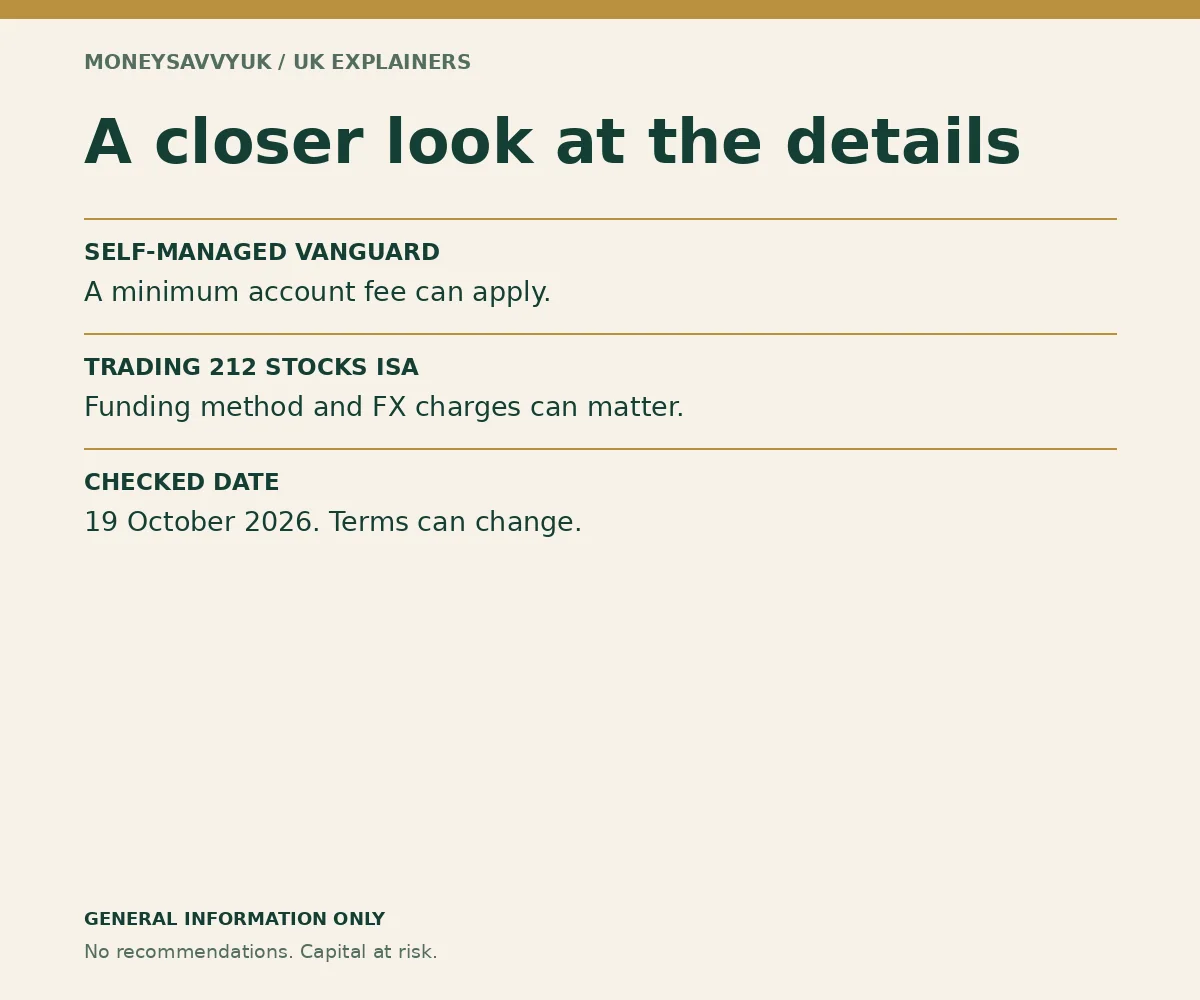
6. Are deposits and currency conversions chargeable?
Trading 212’s published funding guidance says bank transfers remain free. For relevant card and digital-wallet payment methods, it describes a cumulative £2,000 free-deposit threshold and a 0.7% charge after it. See Trading 212: account funding fees.
For illustration, a £100 payment fully subject to a 0.7% funding fee creates a £0.70 charge. The threshold is cumulative, not a fresh yearly allowance. Payment-method terms should be checked in the account before relying on a headline.
Separately, a hypothetical £1,000 trade fully subject to a 0.15% conversion fee creates a £1.50 charge. A later conversion can be another event under the terms.
Currency conversion fees are different from the exchange-rate exposure of overseas investments. A fund traded in pounds can still have that exposure. These are separate entries on the comparison sheet.
7. How would an existing ISA move?
The administrative route normally starts with the receiving provider’s transfer form. It checks the old account and supported holdings. An investment can sometimes move directly, or it may need to be sold and transferred as cash.
Trading 212’s published transfer page describes restrictions, including that fractional shares cannot transfer as holdings. See Trading 212: portfolio transfer restrictions. A fraction is less than one whole share or ETF unit under the service’s arrangement.
The provider-led ISA route is different from personally withdrawing to a bank account and making a new payment. GOV.UK: ISA transfers explains that distinction.
A beginner’s transfer checklist records supported holdings, whether sales are needed, charges on both sides and access during the move. This guide does not guarantee one service will accept every holding or complete every transfer within the same time.
8. What else belongs on the comparison sheet?
The last rows are permissions, protection, service features and help channels. The FCA: Financial Services Register is the official starting point for permissions and contact details. It does not certify that every product from an authorised business carries identical protections.
The losses guide explains why ordinary market falls are not covered by FSCS. A provider’s reputation and an app’s appearance do not make investments capital-guaranteed.
Useful service questions include statement access, accessibility options, communication methods and how orders are confirmed. This article has not tested response times or app usability and does not invent ratings for them.
The ISA overview covers the shared allowance; the emergency calculator and calculator directory cover separate household calculations. With each row filled in, a beginner can understand the differences without being handed a universal winner.
What I’d do first
I’d fill the same rows for both services, using the same balance and payment assumptions. Anything not checked would stay marked unknown rather than receive an invented score. That gives a beginner a usable comparison of facts, while leaving personal provider and investment decisions outside this article.
Vanguard vs Trading 212 ISA: FAQs
Is Vanguard always a 0.15% account fee?
No. Its current self-managed schedule includes £4 monthly below £32,000 invested; the percentage schedule and cap apply above that threshold, subject to account-combination rules. Managed services have different charges. The linked provider page supplies the current terms, with fund costs additional.
Does Trading 212 charge nothing?
No. Free custody and trading commission do not rule out currency conversion, relevant funding-method fees, fund expenses, spreads or applicable taxes. The account type and activity determine the costs. The official fee and funding pages are linked in the relevant steps.
Do I automatically invest when I add money?
Not necessarily. A deposit can appear as uninvested cash. The service’s purchase or recurring-investment process determines what happens next. A payment confirmation differs from an executed order or a holding appearing in the account.
Which is best for a beginner?
There is no winner stated here. The worksheet explains minimums, investment availability, costs and transfer arrangements. It does not assess an individual’s finances or recommend a provider. Questions of personal investment suitability can be discussed with an appropriately authorised adviser.
Vanguard vs Trading 212 ISA: summary
- Compare the same account type and service.
- Record minimums and fee layers separately.
- Check exact holdings, not just brand names.
- Use written transfer and funding terms.
Sources
Rules and provider figures checked on 19 October 2026. Worked examples are calculations with the assumptions shown; they are not forecasts. Tax treatment depends on individual circumstances and can change.
- Vanguard UK: opening payments
- Vanguard UK: current fees
- Vanguard UK: funds and ETFs
- Trading 212: account funding fees
- Trading 212: portfolio transfer restrictions
- GOV.UK: ISA transfers
- FCA: Financial Services Register
Reader-question research
A public comparison question illustrates the beginner’s difficulty: both names appear in searches, but the services are not identical. The current provider facts above supply the comparison, rather than old forum fee claims.
Public discussion: Advice on deciding between Vanguard and Trading212 for S&S ISA. Used to identify the question, not as authority for current figures or personal recommendations.
Written by Kalpana, founder of MoneySavvyUK: PhD scientist, former secondary science teacher and mum, in the UK since 2008. I’m not a financial adviser. See the financial disclaimer.