

Last updated: October 2026. General information, not financial advice.
When we first came to the UK, I learned the price of everything. Living on one salary at a time, I walked to the shops near closing time to find the yellow-sticker bargains, and I planned our meals around whatever was cheap that week. It wasn’t glamorous, but it worked, and it taught me that a cheap weekly shop is mostly about planning, not deprivation.
If you’re feeding four people and the food bill keeps creeping up, this guide is for you. Here is the simple routine I’d use to do a cheap weekly shop for a family of four in the UK, without anyone going hungry or feeling like they’re missing out.
Start with your own number, not someone else’s
You’ll see lots of “feed a family for £X” headlines, but those numbers rarely fit real life. Instead, gather your receipts for two normal weeks, including the quick top-up shops, school snacks and the meal deal on a busy day. That total is your starting point.
Then pick a weekly target that’s a little lower, perhaps £10 or £15 less, and write it at the top of your list. Small, steady cuts are much easier to stick to than a dramatic new budget. If you’d like to see what that saving becomes over a year, try my grocery savings calculator.
Plan seven dinners your family will actually eat
A meal plan is the single biggest money saver in my kitchen. It stops the “what’s for dinner?” panic that ends in a takeaway, and it means you only buy what you’ll use. Keep it simple: five or six dinners, plus one night for leftovers.
Here’s the kind of week that keeps costs down for a family of four:
- Monday: big pot of chilli or bolognese, bulked out with lentils or beans (make double)
- Tuesday: leftover chilli with jacket potatoes or rice
- Wednesday: egg fried rice with frozen peas and sweetcorn
- Thursday: pasta bake with whatever vegetables need using up
- Friday: homemade pizzas on wraps, so everyone chooses their own toppings
- Saturday: a roast chicken or tray bake, keeping the leftovers
- Sunday: soup made with leftover chicken and vegetables, with bread
Let each child choose one dinner a week. They’re far more likely to eat it, and it saves the food that ends up scraped into the bin.
Shop your cupboards, fridge and freezer first
Before you write a single item on your list, look at what you already have. That half bag of rice, the tins at the back of the cupboard and the frozen veg can usually become one or two meals. I like to build Monday’s dinner around something that needs using up, so the week starts with no waste.
Write your list by aisle and stick to it
Group your list by section (fruit and veg, chilled, cupboard, frozen, household) so you move through the shop once and don’t wander back past the offers. If you can, shop without the children or after everyone has eaten. Shopping hungry is an expensive habit.
Online shopping can help too, because you see the running total before you pay and you aren’t tempted by end-of-aisle displays. Just watch delivery charges and minimum spends.
Choose the right supermarket for your basket
Discount supermarkets are often cheapest, but the best shop for you depends on what you buy and how far you have to travel. A cheaper shop that needs a car journey, or a second trip for the things it doesn’t sell, may not save you anything. My Aldi vs Lidl comparison walks through how to choose, and my guide to supermarket loyalty apps shows when member prices are worth using.
Swap down one brand at a time
You don’t have to switch everything to the value range overnight. Try swapping one or two items a week, such as pasta, tinned tomatoes, flour or washing-up liquid, and ask the family to judge honestly. Keep the swaps nobody notices and spend a little more on the things that really matter to you. I explain how I did this in my supermarket downshift challenge.
Make friends with yellow stickers and your freezer
Reduced items near the end of the day can be a real bargain, as long as you’ll use or freeze them. Bread, meat and baked goods freeze well, so pop them in the freezer the day you buy them. A freezer that’s well organised is like a second, cheaper shop at home. I share more of these habits in how I spend less on groceries.
Plan lunches and snacks, the hidden budget leak
With children, lunches and snacks can cost almost as much as dinners. Buying multipacks and individual snack bars adds up quickly. Instead, buy bigger packs and portion them into reusable tubs, bake a simple batch of flapjacks or muffins at the weekend, and keep fruit where everyone can see it.
Claim the help you’re entitled to
Please don’t skip this part. Depending on your situation, you may be able to get:
- Healthy Start payments if you’re pregnant or have a child under four and get certain benefits. Some supermarkets add a top-up; see my Sainsbury’s Healthy Start top-up guide.
- Free school meals. In England, every child in Reception, Year 1 and Year 2 at a state school gets a free lunch, and older children may qualify through benefits. Check on GOV.UK.
- Cheap family meals out during the holidays. I keep a list of where kids eat free or for £1.
If money is very tight right now, local food banks and community pantries are there to help, and there is no shame in using them.
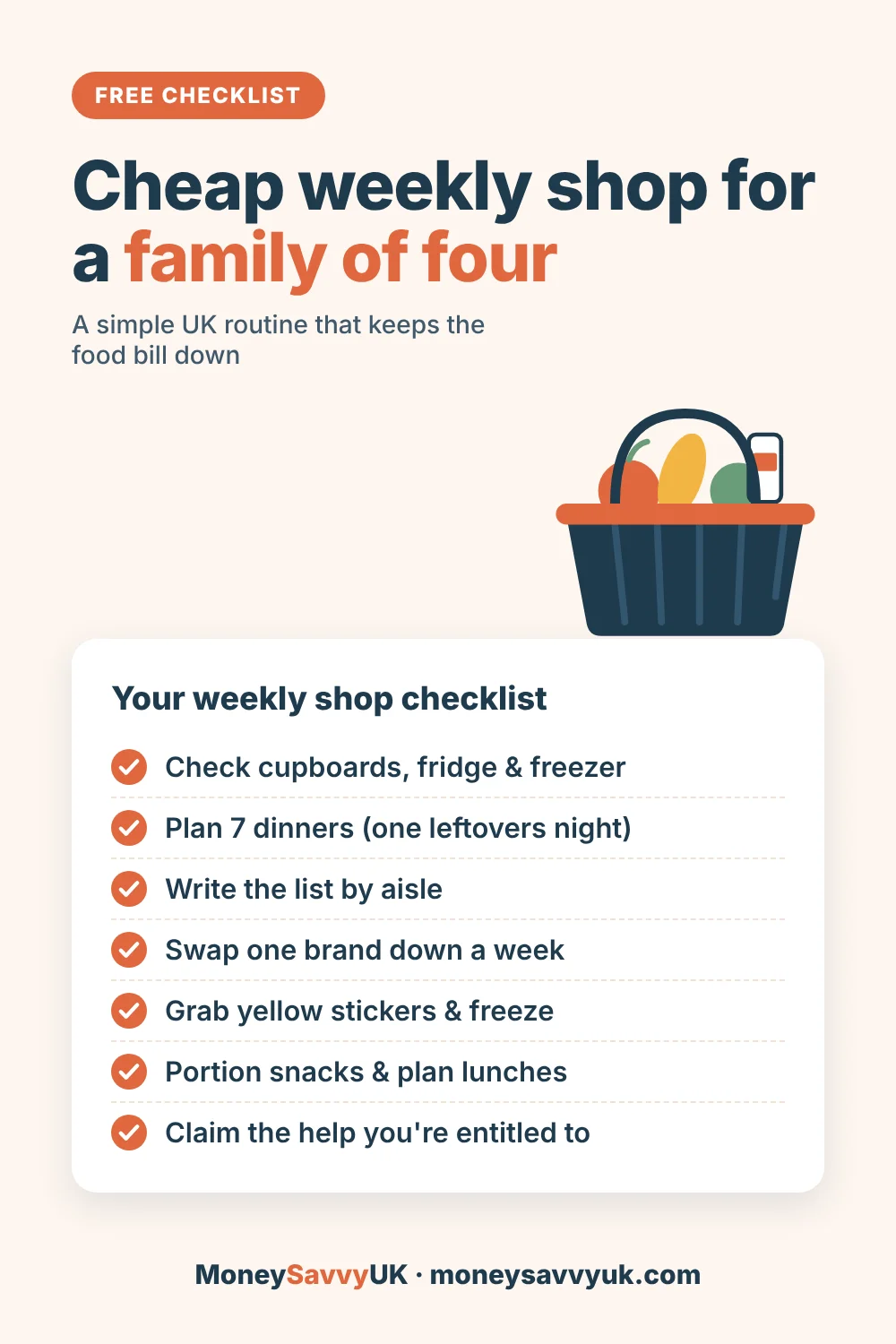
Your cheap weekly shop checklist
- Check the cupboards, fridge and freezer
- Plan five or six dinners plus a leftovers night
- Write the list by aisle, with your weekly target at the top
- Shop once, after eating, ideally without little helpers
- Swap one or two brands down
- Look for yellow stickers and freeze what you won’t use soon
- Portion snacks and plan lunches
- Check you’re claiming any help you’re entitled to
Whatever you save, give it a job before it disappears. Even a few pounds a week can start your first £1,000 emergency fund.
Cheap weekly shop for a family of four: your questions answered
How much should a family of four spend on food a week in the UK?
There isn’t one right number, because rent, diets, children’s ages and where you live all change it. The most useful figure is your own: add up two normal weeks of receipts, including top-up shops and snacks, then set a weekly target a little below that. My grocery savings calculator helps you see what a small weekly saving adds up to over a year.
What is the cheapest supermarket in the UK?
Aldi and Lidl usually come out cheapest in the monthly Which? price comparisons, often by only a pound or two on a big basket. The cheapest shop for you is the one closest to your usual basket that you can reach without extra travel. I compare the two in Aldi vs Lidl: which is cheaper?
How can I feed my family cheaply but still healthily?
Build meals around cheap, filling basics such as oats, rice, pasta, potatoes, lentils, beans, eggs, frozen vegetables and seasonal fruit. Cook a big pot once and eat it twice, and keep treats for the weekend so they stay special. Frozen and tinned vegetables count towards your five a day and don’t go off in the fridge.
Is it cheaper to do one big weekly shop or lots of small ones?
For most families, one planned weekly shop is cheaper. Every extra trip is a chance to pick up things that weren’t on the list. If you need fresh milk or bread midweek, take a small list and a fixed amount of cash or a set budget.
What are some cheap family meals that children will actually eat?
Pasta bake, jacket potatoes with beans and cheese, homemade pizza on wraps, egg fried rice, chilli or bolognese bulked out with lentils, and a big soup with bread are all family favourites that stretch a long way. Let children pick one dinner each week so they’re more likely to eat it.
Can I get help with food costs for my children?
You may be able to. If you’re pregnant or have a child under four and get certain benefits, you might qualify for Healthy Start payments for milk, fruit and vegetables. In England, children in Reception, Year 1 and Year 2 at state schools get free school lunches, and older children may qualify through benefits; check with your school or council. Local food banks and community pantries can also help when money is very tight.
I hope this helps you feel a little more in control of your food bill. Start with just one or two ideas this week. Small changes really do add up.
I’m not a financial adviser. This guide shares my own experience and general information to help you make your own decisions. Prices and offers change, so check before you shop.
About the author. Dr Kalpana Govindaraasan is the founder of MoneySavvyUK, a PhD scientist, former science teacher and UK mum. Living on one salary at a time, her family saved a 20% deposit in three years and bought their first home in 2011. Read her story.