

Last updated: 18 October 2026 · Checked during the 2026/27 tax year. Shopping rights and sale dates do not follow tax-year boundaries.
Wondering how to spot fake Black Friday deals UK shoppers are shown each November? I start with the exact product’s price history, rather than the percentage on the sale label.
When looking for a washing machine, fridge or tumble dryer, I have watched prices for more than a month using comparison tools such as PriceSpy and CamelCamelCamel. If the discount is not genuine, I skip it and am prepared to wait for Boxing Day.
Here is the checklist I use to judge the price, check the seller and decide whether buying now makes sense. Start with your spending limit using my budget calculator.
How to spot fake Black Friday deals UK: 10 checks
A disappointing discount and a fraudulent shop are different problems. An established retailer might offer a real product at an unremarkable price. A fake website might take your payment without supplying anything. Check both the value of the offer and the identity of the seller.
1. Start with the exact model
Write down the full model code before comparing washing machines, fridges, TVs or laptops. A similar name or photograph is not enough. Capacity, dimensions, energy use, storage, accessories and warranty terms can differ.
If one listing has an extra letter or different suffix, check the manufacturer’s specifications. A retailer-exclusive version is not automatically inferior, and a low price does not prove it was specially downgraded for Black Friday. Compare the actual features instead of guessing.
For an appliance, also check that it fits through your doorway and into the available space. A bargain fridge that cannot be installed is an expensive inconvenience. If you are making a smaller purchase, the same principle applies to the measurements in my small kitchen organisers wishlist.
2. Read the price history
A crossed-out price tells you what the seller wants you to compare with. A price-history graph helps you see what shoppers could actually have paid.
Look across several months where records are available. Was the item regularly sold around today’s price? Did the price rise shortly before the sale? Is the advertised reduction a new low, a repeat offer or simply a return to a familiar price?
In research published on 25 November 2025, Which? tracked 175 home, tech and health appliances at eight retailers from May 2024 to May 2025. It found 83% were available for the same price or less at least once outside the four-week Black Friday sales period, which ran from 15 November to 12 December 2024.
That does not mean 83% were scams, or that every product was cheaper beforehand. The comparison included dates before and after the sale. It is evidence against rushing, not a prediction of the best price for your particular appliance in 2026.
3. Check Amazon UK price history
For an Amazon listing, I use CamelCamelCamel’s UK website as a starting point. It tracks Amazon prices; it is not a comparison of every UK shop.
- Copy the URL for the exact Amazon product and selected variant.
- Paste it into the tracker’s search box and open the matching result.
- Check the model, size and condition again.
- Read the relevant Amazon, third-party new or used price series. Do not compare a used offer with a new product.
- Choose a longer history where available and note a price you would be comfortable paying.
- Set an alert if useful, then verify the live seller, availability and final price on Amazon before ordering.
The tracker’s feature guide explains its price series and alerts. Tracking records can have gaps, and vouchers, membership offers or delivery costs may need checking separately. A historical low is context, not a promise that the same offer will return.
If an extra subscription is needed to access an offer, include that commitment in your comparison. My subscription cost calculator helps show the wider cost, while the Amazon Prime benefits guide can help you review whether you would use the membership.
4. Compare shops with PriceSpy
For appliances and other products sold by several retailers, search the full model number on PriceSpy UK. Its price-history explanation distinguishes the lowest market price from individual shops’ prices.
- Find the exact model and compare specifications with the manufacturer.
- Open the price-history section to see whether the current offer is unusual.
- Compare the listed shops, then visit their own websites directly.
- Check delivery, stock, condition, installation and collection of your old appliance.
- Use a price alert if you can wait for your target.
Comparison sites do not cover every shop or every offer. Prices and stock can change between the comparison page and checkout. Treat the results as a shortlist to verify, rather than proof that the cheapest displayed shop is the best choice.
5. Question “was” prices and RRPs
There is no blanket “28-day loophole” that makes an exaggerated UK discount acceptable. Current ASA guidance on savings claims assesses whether the reference price represents an established usual selling price. Relevant evidence includes its recency, duration, pricing history and sales.
The ASA’s pricing guidance also says an RRP comparison can mislead where it differs significantly from the price generally charged. A manufacturer’s original launch price is not automatically a useful guide to today’s value.
My practical question is simpler: “What would this exact item normally cost me elsewhere?” If the answer is close to the sale price, I would not call the big headline percentage a big saving.
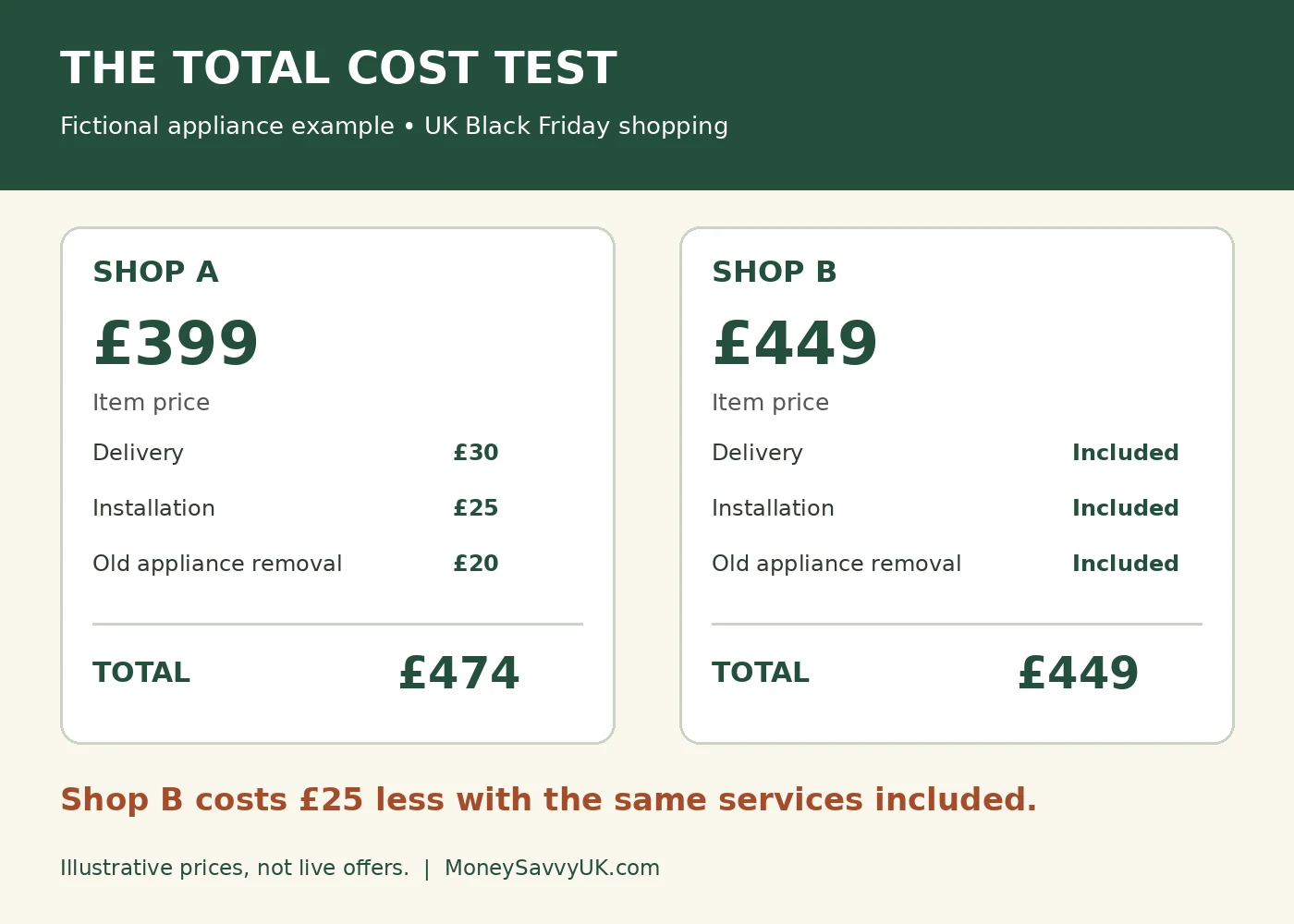
Fictional illustration only, not live retailer offers.
6. Add up the delivered cost
For a washing machine, compare the item price plus the services you actually need. Delivery, installation and removal of the old machine can change which offer costs less.
Fictional example, not live retailer prices: Shop A lists a machine at £399, with £30 delivery, £25 installation and £20 old-appliance removal. The total is £474. Shop B charges £449 with those same services included. Shop B costs £25 less in this example, despite its higher headline price.
Do the comparison before cashback. A potential reward does not reduce the amount due at checkout, and tracking or eligibility can fail. Compare the base price first, then read my cashback guide and TopCashback versus Quidco comparison if you already use those services.
Do not count unwanted extras as savings. A free accessory has little value to your household if you would never have bought or used it.
7. Step away from countdowns
A timer, low-stock message or “people viewing now” banner may make a purchase feel urgent. It does not tell you whether the price is competitive.
The CMA’s guidance on urgency and price-reduction claims explains that these claims must not mislead or put unfair pressure on shoppers. A genuine deadline can exist, but a timer is not evidence of a genuine discount.
I would close the tab, compare the item elsewhere and return only if it still fits my list and budget. If the purchase only makes sense while a red clock is counting down, that is a reason to pause.
8. Verify the shop independently
Open the retailer through its established app or type its known website address yourself. Check the full domain before entering payment details. A copied logo, polished wording, convincing video or celebrity endorsement is not proof of authenticity.
The NCSC’s online-shopping guidance warns that criminals can copy genuine stores and use deceptive web addresses. Look for independent reviews, a credible trading history and clear contact and returns details. HTTPS encrypts the connection; it does not establish that the seller is honest.
AI-generated images and endorsements can add another layer of persuasion. You do not need to diagnose whether a video is a deepfake: verify the offer independently with the real retailer. Avoid paying an unfamiliar seller by bank transfer just because an advert or private message says it is required.
For person-to-person selling, the checks in my Vinted safety guide are useful alongside the platform’s own instructions. Stay within the platform’s supported payment process.
9. Read payment and returns terms
Payment protection depends on how you pay and the circumstances. This is general information about existing protections, not a recommendation to borrow for a sale.
| Payment method | What to check |
|---|---|
| Credit card | Section 75 can cover qualifying purchases where an individual item or qualifying set costs more than £100 and up to £30,000. Paying a deposit can be sufficient; conditions apply. |
| Debit, credit or prepaid card | Chargeback is a card-scheme process, not the same statutory protection. It is not restricted to purchases below £100. Ask the provider promptly about eligibility and deadlines. |
| PayPal or another intermediary | Check its buyer-protection rules and how the payment route affects other rights. Do not assume every layer of protection applies together. |
| Bank transfer | Eligible UK APP scam payments can fall within reimbursement protections. Ordinary disputes with genuine sellers are different. Contact your bank immediately. |
Sources: MoneyHelper’s Section 75 and chargeback guide and the Payment Systems Regulator’s APP fraud guidance. Reimbursement is not automatic in every case. I have avoided quoting a universal deadline or promising a refund.
Also check who pays return postage and what happens if an appliance does not fit. GOV.UK confirms that sale purchases retain their refund rights. For most online goods, you generally have 14 days after receipt to notify the seller that you wish to cancel, followed by another 14 days to return them. Exceptions apply; in-store change-of-mind returns depend on the shop’s policy. Faulty-goods rights are separate.
10. Decide whether to buy or wait
A sensible purchase should meet three tests: you need the item, the complete price is competitive, and you can afford it without disrupting essential spending.
For a planned appliance replacement, I watch the model over more than a month and compare Black Friday with other opportunities, including Boxing Day. I buy only when the discount looks genuine. Waiting is an option, not a guarantee that Boxing Day will be cheaper.
If a fridge has failed and you need a replacement promptly, compare suitable in-stock models and delivery dates rather than chasing an unavailable historical low. If the current appliance is working and the offer is ordinary, leaving the purchase until later can be perfectly reasonable.
Keep emergency money distinct from a sales budget. My emergency fund calculator can help you assess that boundary. For planned smaller gifts, start with a list such as my useful Secret Santa ideas rather than browsing unlimited offers.
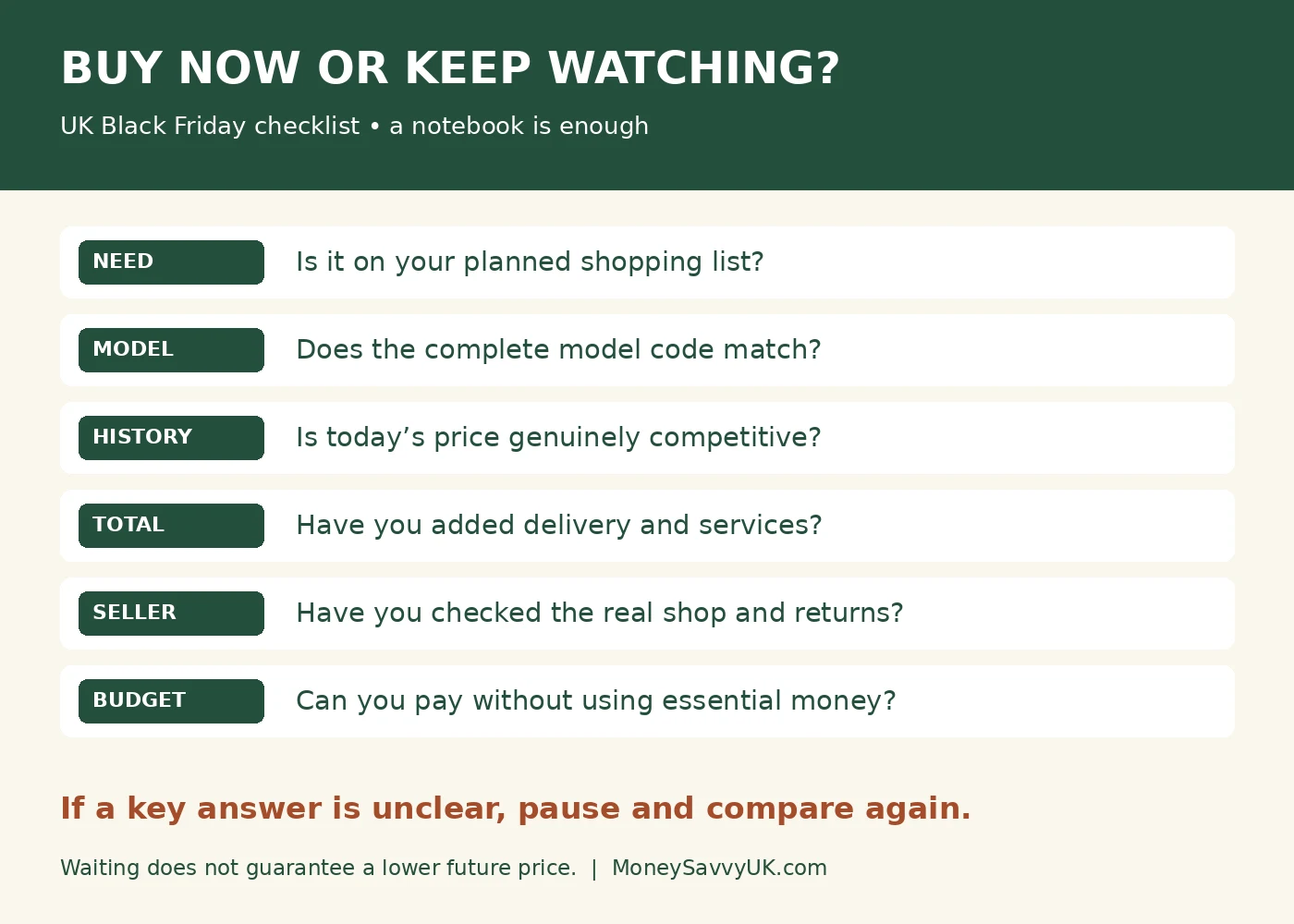
What I’d do first before Black Friday
- Choose one priority purchase. Record the model, essential features and maximum total budget.
- Start tracking now. Save the price-history link and record the delivered price on the dates you check.
- Make the decision before checkout. Buy when the evidence and budget support it; skip an ordinary offer and keep watching if you can wait.
A basic notebook is enough. Use columns for date, model, retailer, item price, delivery, services and total. My shopping and gift guides can help with ideas, but the shortlist should remain yours.

Pin this checklist for later. AI-generated illustrative artwork.
What happens if I get scammed on Black Friday UK?
Tell your bank or payment provider immediately using its official app, website or the number printed on your card. If a suspicious call is involved, hang up first. 159 can connect customers to participating banks; it is not available for every bank and network.
Keep receipts, messages, payment details and screenshots. Change any reused password through the genuine service and enable two-step verification. Do not pay a “recovery agent” who promises to retrieve the money for an upfront fee.
Report fraud in England, Wales and Northern Ireland to Report Fraud. In Scotland, contact Police Scotland on 101. Report Fraud replaced Action Fraud in December 2025, so older articles may use the previous name.
Forward suspicious texts to 7726 and suspicious emails to report@phishing.gov.uk, following NCSC reporting guidance. For a poor discount rather than fraud, keep evidence of the advertisement and consider reporting misleading advertising to the ASA.
Fake Black Friday deals UK FAQs
Are Black Friday deals actually cheaper in the UK?
Some are, but the sale label does not prove it. Compare the exact model’s price history and today’s total cost across shops. The Which? research discussed above concerns a particular sample and period; it does not mean every Black Friday offer is poor value or fraudulent.
How do I check the price history of an item on Amazon UK?
Paste the exact Amazon product URL into CamelCamelCamel’s UK search, confirm the variant and condition, and inspect the relevant price series. Compare that history with the live listing, seller and delivered cost. Missing data, vouchers and membership conditions mean the graph may not tell the whole story.
Is a 28-day “was” price enough to prove a real discount?
No. Current ASA guidance considers the established usual selling price using pricing history, duration, recency and sales evidence. A product being advertised at a higher price for a particular number of days does not, by itself, establish that a later savings claim is fair.
Should I wait for Boxing Day to buy appliances?
Waiting can make sense when your current appliance works and today’s price is unremarkable, but a lower Boxing Day price is not guaranteed. Track the exact model, set a total budget and consider delivery times. An urgent replacement may justify buying a suitable, competitively priced model sooner.
Can I get a refund on a Black Friday sale item?
Sale labels do not remove your statutory rights. Faulty goods and change-of-mind returns have different rules, and online purchases generally have cancellation rights subject to exceptions. Check the seller’s terms and GOV.UK’s returns guidance, and contact your payment provider promptly if you suspect fraud.
How to spot fake Black Friday deals UK: summary
- Match the complete model and condition.
- Read several months of price history and compare other shops.
- Calculate the delivered cost, including any services you need.
- Verify the seller and read payment and returns terms.
- Buy because the item fits your needs and budget, not because a timer is running.
Which purchase are you tracking this year, and what would make you walk away from the offer? Share your approach in the comments without posting personal or payment details.
For practical planning, get the free 7-Day Financial Reset Kit or browse my optional Bills & Renewal Dashboard (my own paid product).
Sources and checks
- Which?, 25 November 2025: 175-product investigation of Black Friday 2024 prices.
- ASA: promotional savings claims and general pricing guidance.
- CMA: urgency and price-reduction claims online.
- CamelCamelCamel: tracker features and PriceSpy: price-history methodology.
- MoneyHelper: Section 75 and chargeback.
- Payment Systems Regulator: APP fraud reimbursement.
- GOV.UK: returns and refunds.
- NCSC: shopping and paying safely online.
- Report Fraud: service launch and Stop Scams UK: 159.
I’m not a financial adviser; this is general information, not individual financial or legal advice. Check current terms and obtain appropriate help for your circumstances. Read my financial disclaimer.
About the author
Dr Kalpana Govindaraasan is a PhD scientist, former secondary science teacher and mum who has lived in the UK since 2008. At MoneySavvyUK, I share practical household money ideas and my own shopping experiences. Read more about me.