

Last updated: 17 November 2026. General information, not financial advice.
Most overspending doesn’t happen in one big moment. It happens in the small, in-between ones: a “quick” trip to the shop that turns into £30, an evening scrolling Amazon, Temu, Shein or AliExpress because you’re bored, or a one-tap checkout because your card details are already saved. None of it feels like much at the time, but by the end of the month it adds up.
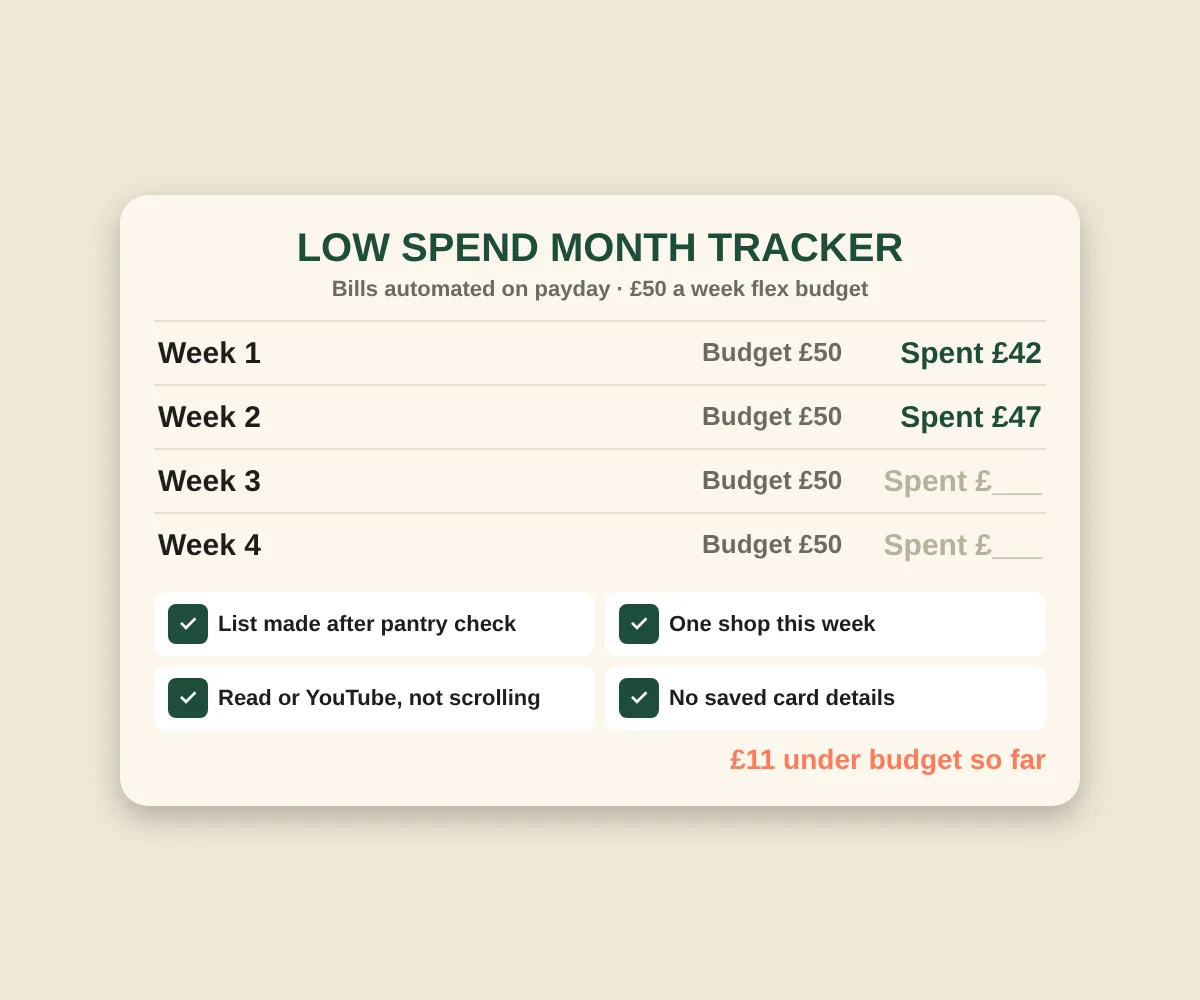
These are the rules I actually use to keep my spending low without feeling deprived. Before I write a shopping list, I check the pantry and fridge so I don’t buy what we already have. I make the list, go to the shop and stick to it. I limit shop visits to once a week, or only when it’s really necessary. I don’t scroll shopping apps when I’m bored: I read a book or watch YouTube for entertainment or learning instead. I don’t store my card details anywhere, because that one extra step is often enough to stop an unnecessary purchase. And everything important (mortgage, council tax, utilities and savings) is automated to go out as soon as my pay arrives.
The short answer: a low spend month means paying all your essential bills and savings first, then living on a small, fixed “flex” budget for food top-ups and fun. The best low spend rules are simple: check what you have before shopping, shop once a week with a list, remove saved card details and stop shopping when you’re bored.
What is a low spend month?
A low spend month is a gentler version of a no-spend challenge. Instead of cutting all non-essential spending to £0, you set a small budget for the extras and stick to it. That makes it much more realistic for families, and much easier to keep going after the month ends.
| No spend month | Low spend month | |
|---|---|---|
| Non-essential spending | £0 | A small, fixed weekly budget |
| Best for | A hard reset | Families and long-term habits |
| How strict | Very | Flexible, with clear limits |
| Easy to keep going? | Hard after 30 days | Yes, it can become your normal |
If you’d like to try the stricter version, my No Spend January guide has the rules, 31 free ideas and a printable tracker.
My low spend rules (the ones I actually use)
- Check the pantry, fridge and freezer before making a list. It stops you buying a third tin of chickpeas.
- Make a list and stick to it. If it’s not on the list, it waits until next week.
- Shop once a week, or only when necessary. Fewer trips means fewer chances to impulse buy.
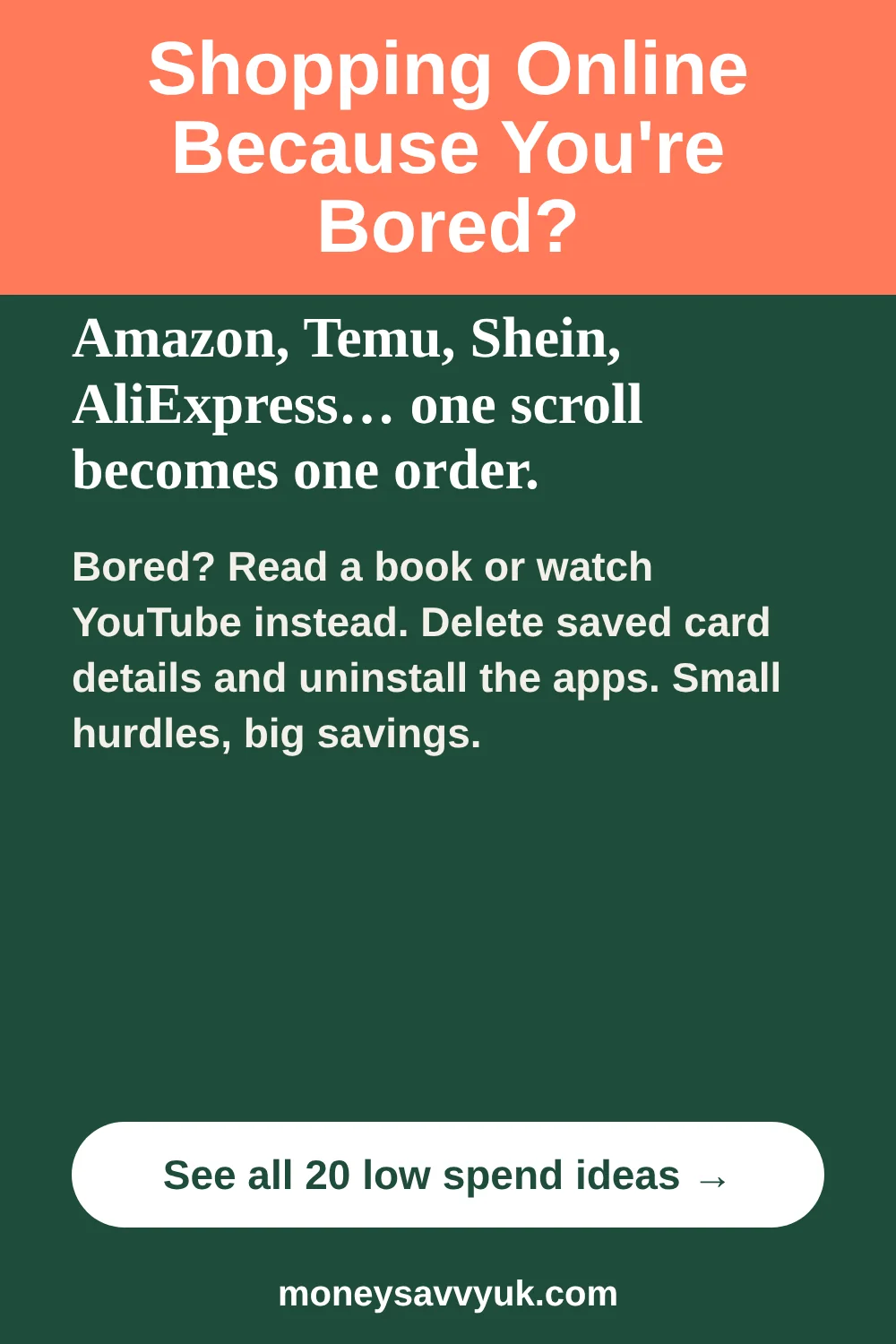
- No boredom scrolling on shopping apps. When I’m bored, I read a book or watch YouTube for entertainment or learning.
- Don’t store card details. Typing your card number in every time adds a pause, and that pause saves money.
- Automate the essentials on payday. Mortgage or rent, council tax, utilities and savings go out first, so what’s left is genuinely spare.
20 low spend month ideas for UK households
Set-up and habits
1. Automate bills and savings on payday
Set standing orders and direct debits for the day your pay arrives: rent or mortgage, council tax, energy, water, phone and broadband, plus a transfer to savings. Whatever is left is your spending money, so you never accidentally spend the council tax. My payday routine guide shows how to set this up.
2. Set a weekly flex budget
Decide one weekly amount for everything flexible: food top-ups, petrol, kids’ extras and fun. For example, £50 a week is £200 over a four-week month. Months with five weeks need a little extra, so plan for those.
3. Check the pantry, fridge and freezer first
Before every shop, look at what you already have and plan meals around it. It’s the simplest way to cut food waste and stop doubling up.
4. Shop once a week, with a list
Every extra trip to the shop is a chance to pick up things that weren’t on the list. One planned shop a week, with a list you stick to, keeps your food bill predictable. My guide to a cheap weekly shop for a family of four has a full routine.
My extra rule: I shop alone, early and never hungry. I always eat before I go, so I’m not tempted by sweets. I go early in the morning or after 7pm, when the yellow stickers come out on bread, veg, fruit, milk and cheese, and I go on my own, without my son or my husband. I’ve noticed I’m much calmer and stick to the budget when I’m alone. When they come, there’s a lot of overspending and impulse buys. More of my food-shop habits are in my cheap vegetarian family dinners post.
5. Delete saved card details
Remove your card from Amazon, Temu, Shein, AliExpress and any other shopping sites, and from your browser’s autofill. Without one-tap checkout, you’ll find you abandon a lot more baskets.
6. Uninstall shopping apps and unsubscribe from sale emails
Apps and “your basket is waiting” emails are designed to pull you back in. Delete the apps for the month and unsubscribe from marketing emails. If you need to buy something, use the website with a list. I explain how I do this on Temu in my Temu guide.
7. Replace boredom scrolling with a book or YouTube
When you’d normally reach for a shopping app, pick up a book or watch YouTube for entertainment or learning instead. Your local library is free to join, and many libraries also offer free e-books and audiobooks through apps such as Libby or BorrowBox.
8. Use a 48-hour wishlist rule
Anything that isn’t essential goes on a wishlist for at least 48 hours. If you still want it after two days, and it fits your flex budget, you can buy it. You’ll be surprised how many things you forget about.
9. Use cash for fun money
Withdraw your weekly fun money in cash. When it’s gone, it’s gone. My cash stuffing challenges guide explains how to use envelopes.
Food
10. Meal plan around what you already have
Plan five or six dinners and one leftovers night, starting with what needs using up. See my cheap family dinners for ideas.
11. Have a “use it up” night every week
One night a week, cook only from what’s in the fridge, freezer and cupboards: omelettes, fried rice, soup or a pasta bake.
12. Batch cook and freeze
Make a double batch of chilli, curry or bolognese and freeze half. It’s your defence against “too tired to cook, let’s get a takeaway”.
13. Take lunch to work
Worked example: swapping a £4 meal deal for a packed lunch four days a week saves £16 a week, or about £69 a month.
Free fun
14. Plan free days out
Parks, beaches, woodland walks, free museums and galleries, and free local events all cost nothing but the journey. Pack a picnic and a flask.
15. Borrow, swap or get it free
Before you buy, ask: can I borrow it, swap it or find it free? Libraries, Freecycle, Olio and local Facebook groups are full of things people are happy to pass on.
16. Plan one treat a week
A low spend month isn’t a punishment. Choose one planned treat a week, like a takeaway, a coffee out or a film night, and enjoy it guilt-free because it’s in the budget.
Bills and money admin
17. Pause or cancel two subscriptions
Pausing two subscriptions at £10.99 and £7.99 saves £18.98 a month. My guide to cancelling subscriptions explains how.
18. Check your energy direct debit
Submit meter readings and check your direct debit matches your usage, especially before winter. See my guide on whether your energy direct debit is too high.
19. Sell one thing a week
List one unwanted item every week on Vinted, eBay or Facebook Marketplace and move the money to savings. My list of things to sell for cash will give you a head start.
20. Do a 10-minute money check every Sunday
Look at what you spent from your flex budget, what’s coming up next week, and whether anything needs adjusting. Ten minutes a week is enough to stay on track.
What a low spend month could save
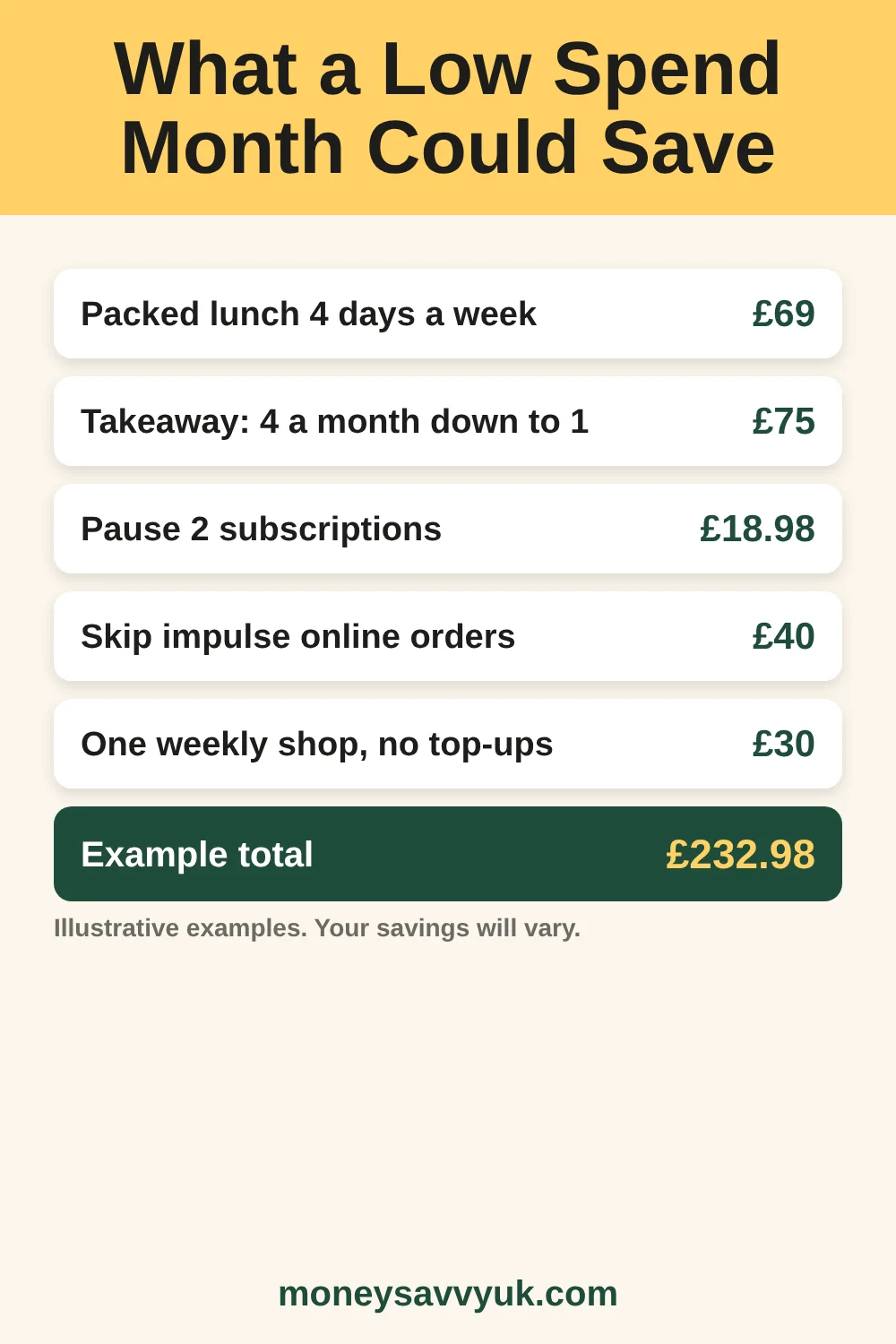
| Change | Example monthly saving |
|---|---|
| Packed lunch 4 days a week instead of a £4 meal deal | £69 |
| Takeaways cut from four a month to one (at £25 each) | £75 |
| Pause two subscriptions (£10.99 and £7.99) | £18.98 |
| Skip impulse online orders | £40 |
| One weekly shop, no midweek top-ups | £30 |
| Example total | £232.98 |
These are illustrative figures, so use your own bank statement to see where your money really goes.
How to set your low spend budget
- List your essential bills and automate them for payday.
- Set your savings transfer for payday too, even if it’s small. Pay yourself before the flex spending starts.
- Add up last month’s flexible spending from your bank statement: food top-ups, takeaways, online orders, coffees and fun.
- Set your weekly flex budget a little lower than that, and stick to it for the month.
- Plan for irregular costs like birthdays and the MOT with sinking funds, so they don’t wreck your low spend month.
If you’d like a step-by-step budget, my budget planner guide includes a free printable planner.
A low spend month with children
- Let children choose one free activity each weekend from a list you make together.
- Give older children their own small weekly budget, so they learn to make choices.
- Use the library for books, films and free holiday activities.
- Explain the goal: “We’re saving for our holiday” works much better than “We can’t afford it.”
My guide to teaching kids about money has more age-by-age ideas.
Common low spend month mistakes
- Setting the flex budget too low: if you run out by Wednesday every week, raise it slightly and cut elsewhere.
- Forgetting five-week months: a weekly budget needs an extra week of money in some months.
- Not automating savings: if savings come last, there’s usually nothing left.
- Swapping one habit for another: stopping takeaways but adding online orders doesn’t save anything.
- Making it miserable: keep one planned treat a week so you stick with it.
Planners to keep your low spend month on track
ADHD Budget Planner UK (payday budget): simple payday budget pages, a savings tracker and a No Spend January challenge. View on Etsy →
2027 Budget Planner UK (printable & digital): bill tracker, savings pots and spending log in £. View on Etsy →
These are my own planners, sold in my MoneySavvyUK Etsy shop.
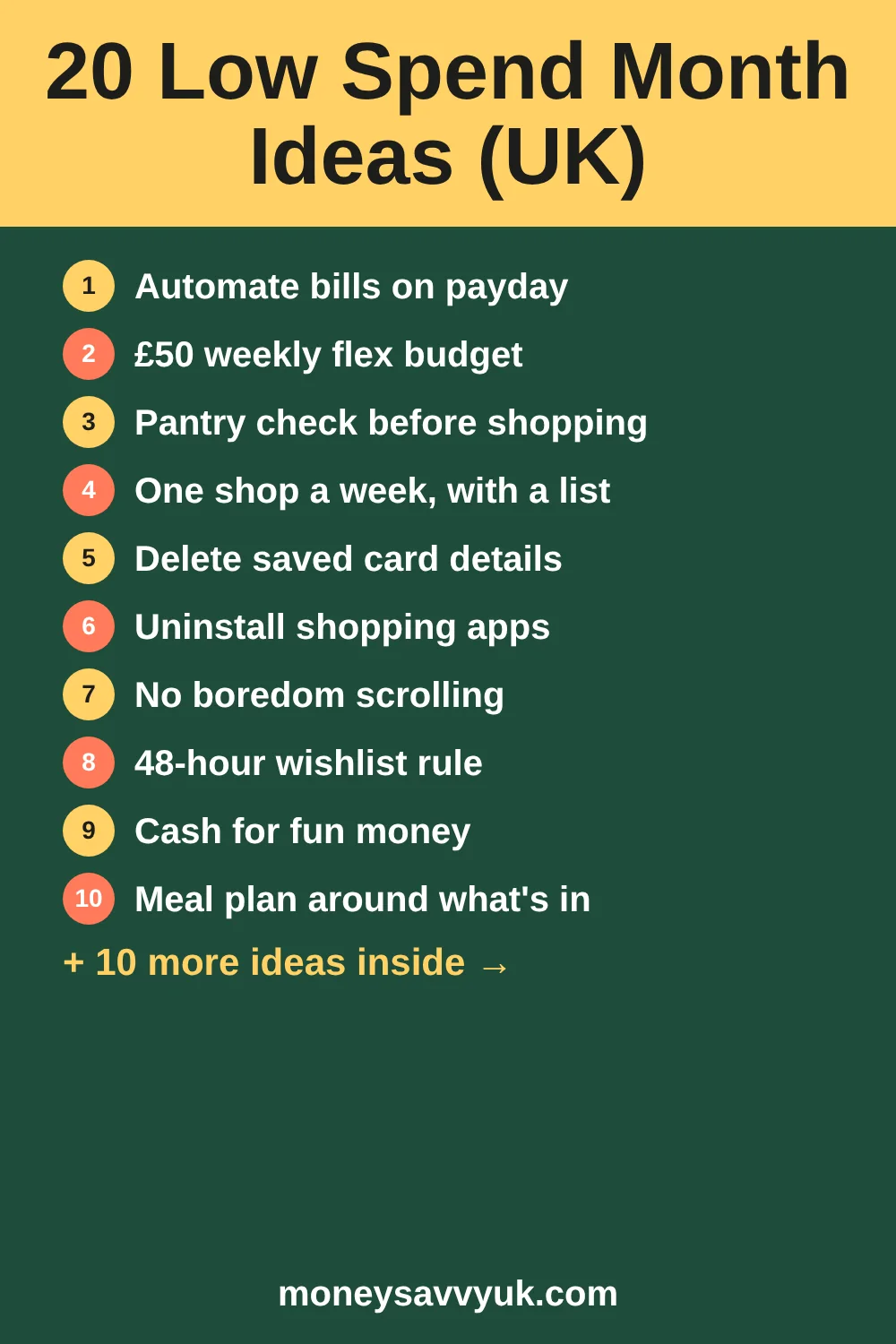
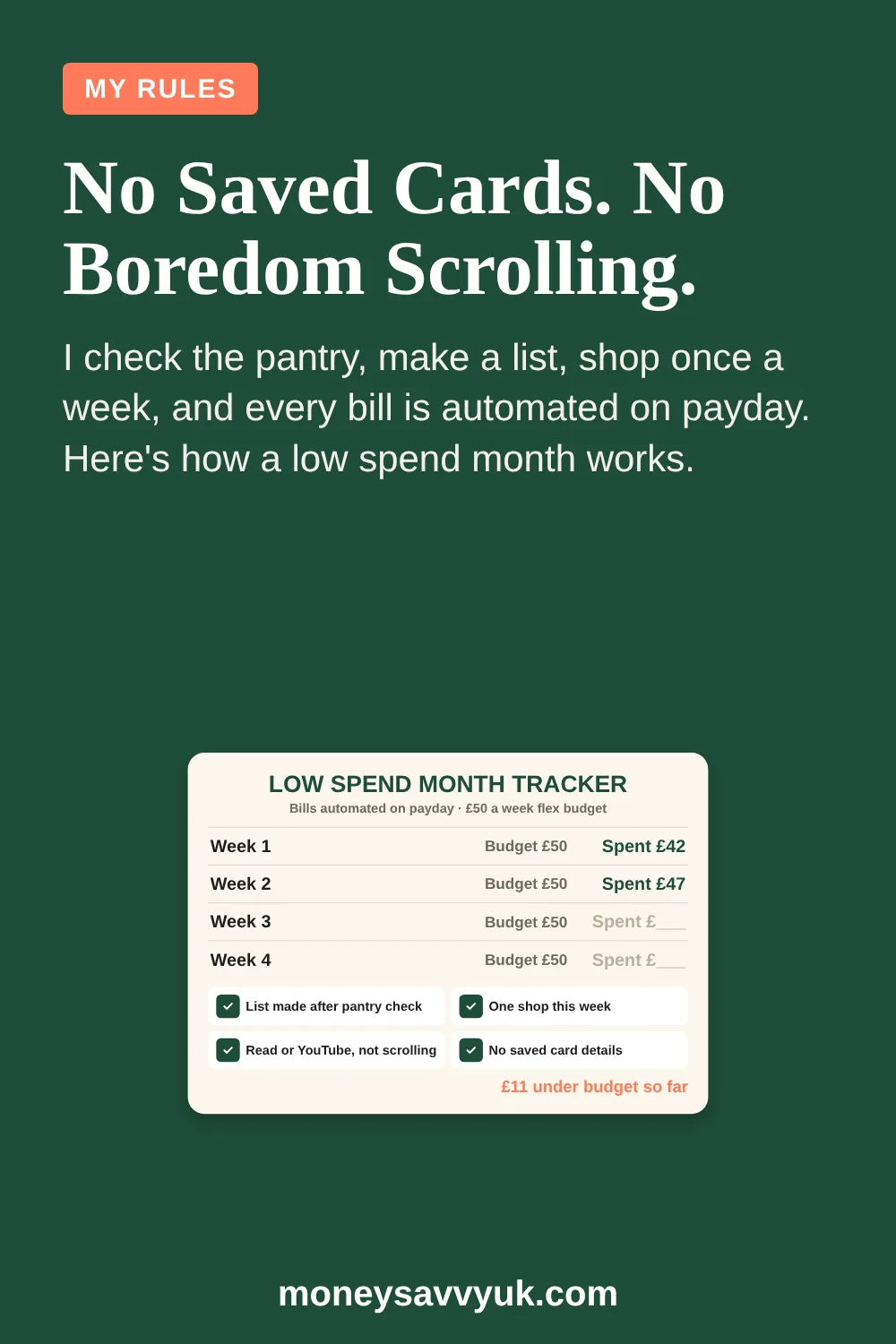
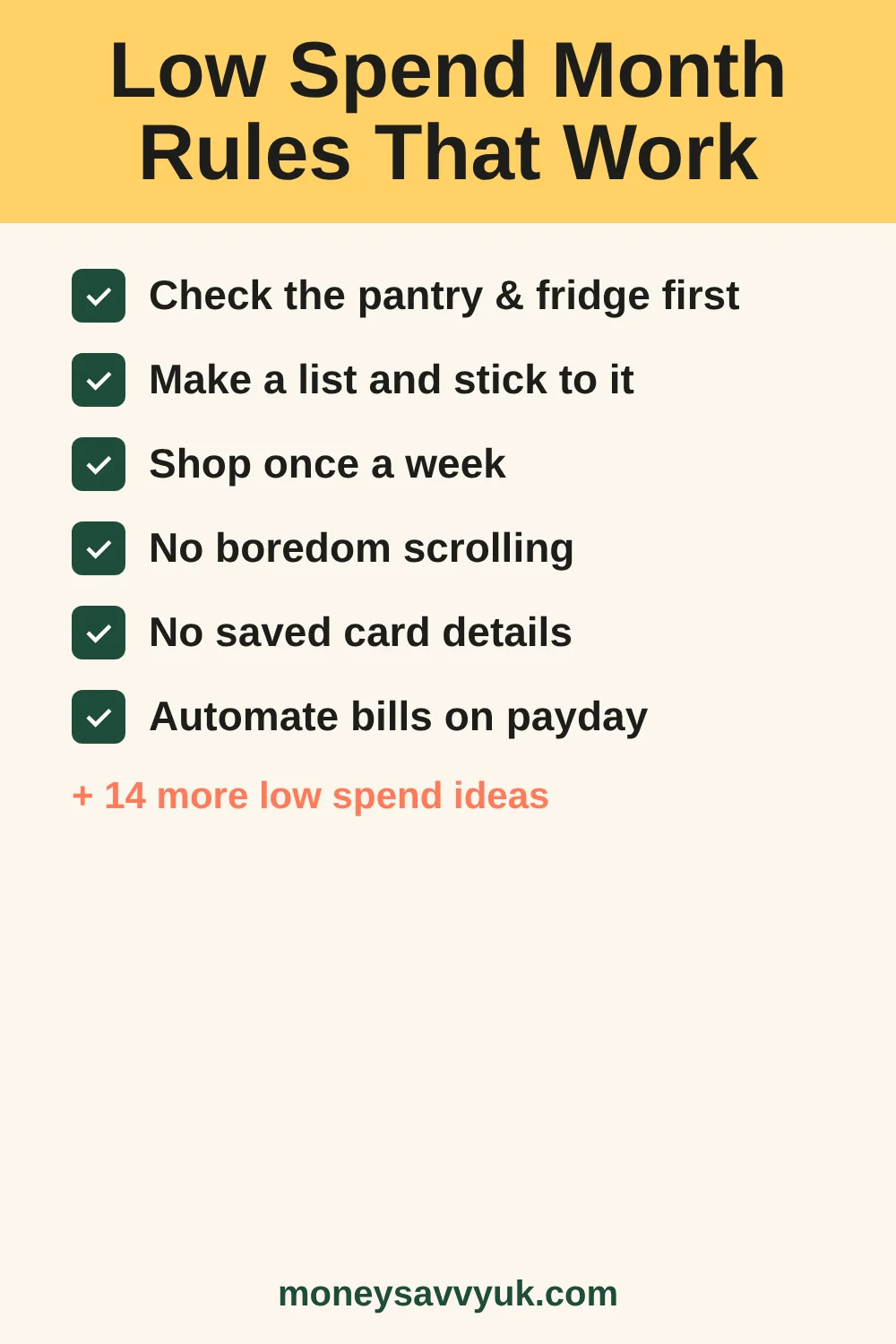
Save these low spend pins
Pin one so you can come back to these ideas when your low spend month starts.
Low spend month: people also ask
What is a low spend month?
A low spend month is a challenge where you pay your essential bills and savings first, then live on a small, fixed budget for everything else, such as food top-ups and fun. It’s more flexible than a no-spend month, which makes it easier for families to stick to and turn into a long-term habit.
What are the rules of a low spend challenge?
Common low spend rules are: automate bills and savings on payday, set a weekly flex budget, shop once a week with a list, check what you have before shopping, remove saved card details and avoid shopping when you’re bored. Decide your rules before you start and write them down.
How much can you save with a low spend month?
It depends on your usual spending, but small changes add up quickly. In our example, packed lunches, fewer takeaways, pausing two subscriptions and skipping impulse orders and top-up shops saves £232.98 in a month. Check your own bank statement to find your biggest leaks.
How do I stop shopping when I’m bored?
Make shopping less convenient and replace the habit. Delete shopping apps, remove saved card details and unsubscribe from sale emails. When you feel the urge to scroll, read a book, watch YouTube for entertainment or learning, go for a walk or call a friend instead.
Is a low spend month better than a no spend month?
For most families, yes, because it’s realistic. A no spend month is a powerful short reset, but it can be hard to keep going. A low spend month builds habits you can keep, like weekly shopping, a flex budget and automated savings, so the savings last beyond one month.
Summary
- Automate bills and savings on payday, then live on a weekly flex budget.
- Check the pantry and fridge first, shop once a week with a list, and stick to it.
- Remove saved card details, uninstall shopping apps and swap boredom scrolling for a book or YouTube.
- Small changes add up: our example saves £232.98 a month.
Next step: grab my free 7-Day Financial Reset Kit to find your money leaks, then plan your first low spend week. For impartial budgeting help, the government-backed MoneyHelper budgeting guides are also a good place to start.
Examples are illustrative; your savings will depend on your own spending. This article is general information, not financial advice.