
Quick answer: you can start investing in the UK with as little as £1 on some apps, or £25 a month on most platforms. Build a small emergency fund first, clear expensive debt, grab any free workplace pension matching, then open a Stocks & Shares ISA, pick one low-cost global index fund or ready-made fund, and set up a monthly payment. Leave it for at least five years.
If you’ve ever thought “investing is for rich people”, I get it. I used to think the same. I pictured city traders, flashing screens and people with thousands sitting spare in the bank.
The truth? You can start investing in the UK with as little as £1. And the earlier you start, even with tiny amounts, the harder your money gets to work for you.
In this beginner-friendly guide, I’ll walk you through exactly how to start investing in the UK, step by step:
- What to sort out before you invest a single penny
- The best UK accounts to invest through (and the tax-free ones to use first)
- What to actually invest in if you’re a total beginner
- How to start with £1, £25 or £50 a month
- The mistakes I see beginners make all the time
Grab a cuppa, and let’s do this together.
Quick note: I’m not a financial adviser, and this post is for education only. Investing involves risk, and the value of your investments can go down as well as up. If you’re unsure, speak to a regulated adviser.
Step 1: Get these 3 things sorted before you invest
I know you’re keen to jump in (I love that!), but investing works best when it sits on solid ground. Here’s what I’d tick off first.
1. Build a small emergency fund
Aim for at least £500 to £1,000 to start, then build towards three to six months of essential bills. Keep it in an easy-access savings account or a Cash ISA.
Why? Because if your boiler packs in, you don’t want to be forced to sell investments when the market is down. Your emergency fund protects your investments. Good news: UK savings are protected by the FSCS up to £120,000 per person, per bank (this went up from £85,000 in December 2025). Need a plan? See my £1,000 emergency fund guide.
2. Clear expensive debt
If you’ve got credit card debt at 20%+ interest, paying that off is like getting a guaranteed 20% return. No investment can promise that. Tackle high-interest debt first, then invest. (Student loans and a normal mortgage are different: you don’t need to clear those before investing.)
3. Grab your free workplace pension money
If you’re employed, you’re probably already investing without realising it! Your workplace pension is invested in the stock market. Check whether your employer will match extra contributions. If you put in an extra 1% and they add 1%, that’s an instant 100% return. It’s the best deal in personal finance, so please don’t leave it on the table.
Not sure where to find the money? Try the 50/30/20 rule or my 50/30/20 calculator.
Step 2: Choose where to invest (the UK “wrappers”)
This is the bit that confuses most people, so let’s make it simple. Before you pick what to invest in, you choose the account that holds it. In the UK, some accounts are tax-free, and you should use those first.
| Account | Best for | Yearly limit | The big perk |
|---|---|---|---|
| Stocks & Shares ISA | Most beginners | £20,000 total ISA allowance | No tax on growth or withdrawals; take money out anytime |
| Lifetime ISA (LISA) | First home or retirement; open aged 18 to 39 | £4,000 (counts towards the £20,000) | Government adds a 25% bonus, up to £1,000 a year |
| Workplace pension / SIPP | Retirement | Generally up to 100% of earnings | Tax relief: £80 in becomes £100 for basic-rate taxpayers |
| Junior ISA | Your children | £9,000 | Tax-free, locked until they turn 18 |
| General Investment Account | Once ISAs are full | No limit | Flexible, but taxable |
My pick for beginners: a Stocks & Shares ISA
For most people starting out, a Stocks & Shares ISA is the perfect first step. Everything inside grows tax-free, you never have to declare it to HMRC, and you can usually withdraw whenever you need to. My Stocks and Shares ISA step-by-step guide goes deeper.
Budget update (28 October 2026): the planned cut to a £12,000 Cash ISA limit has been scrapped, so you can still put the full £20,000 into cash, investments, or a mix. Not sure which suits you? Read my Cash ISA vs Stocks and Shares ISA guide.
A quick word on the Lifetime ISA
The 25% bonus is brilliant, but be careful: if you withdraw for anything other than a first home (up to £450,000) or after age 60, you pay a penalty, which means you can lose more than the bonus. The October 2026 Budget confirmed the penalty is being cut from 25% to 20%, and that the LISA will be replaced by a new First Time Buyer ISA from April 2029. Check the latest rules before opening one.
Step 3: Decide what to invest in
Here’s a secret that took me far too long to learn: you don’t need to pick individual shares. In fact, most beginners are better off not trying.
Index funds and ETFs: the beginner’s best friend
An index fund (or its cousin, the ETF) buys a tiny slice of hundreds or thousands of companies in one go. Instead of betting on one company, you own a bit of all of them. A global index fund, one that tracks companies all over the world, is a popular, simple starting point. One fund, instant variety, low fees.
Why I love them:
- Low cost: many charge under 0.25% a year
- Spread risk: if one company has a bad year, it barely dents you
- No research needed: you’re not trying to outsmart the market
- Hands off: buy, set up a monthly payment and get on with your life
What about risk?
The stock market goes up and down, sometimes a lot. Some years your pot might drop 20% or more. That’s normal, and it’s why investing is for money you won’t need for at least five years.
If the wobbles worry you, look at a ready-made fund with a mix of shares and bonds (often labelled “cautious”, “balanced” or “adventurous”, or with a percentage like 60% shares). More bonds usually means a smoother but slower ride.
Step 4: How to start investing with little money (£1 to £50 a month)
This is where it gets exciting. Gone are the days when you needed a stockbroker and a big lump sum. Today, lots of UK apps let you start with pocket change.
Pick a low-cost platform
Fees matter far more when you’re investing small amounts. A £4 monthly fee on a £25 monthly investment eats 16% of your money! So look for percentage-based fees or no platform fee when you’re starting out.
| Platform | Platform fee (ISA) | Minimum to start | Good for |
|---|---|---|---|
| Trading 212 | No platform fee | Low (from £1) | Low-cost DIY ETFs |
| InvestEngine | Free DIY; 0.25% managed | £100 | Cheap ETF portfolios |
| AJ Bell Dodl | 0.15% (min £1 a month) | £25 a month | Simple app, small regular amounts |
| Interactive Investor | From £4.99 a month flat | £25 | Bigger pots (flat fees win as you grow) |
| Vanguard | 0.15% (min £4 a month) | £500 lump sum | Vanguard funds, once your pot grows |
Fees change, so always double-check on the provider’s site before you open an account. Compare more in my investment fees explained and Vanguard vs Trading 212 guides.
Your 5-step starter plan
- Choose your platform from the list above (or another FCA-regulated one).
- Open a Stocks & Shares ISA. It takes about 10 minutes with your National Insurance number and bank details.
- Pick one simple fund: a global index fund or a ready-made fund.
- Set up a monthly direct debit for the day after payday, even if it’s just £25.
- Leave it alone! Check in once or twice a year, not every day.
Can’t spare £25? Find it here
- Switch broadband or mobile at the end of your contract (here’s the script I used)
- Trim your food shop with my 15 ways to cut your grocery bill
- Earn a little extra with one of my 50 side hustle ideas
Check your money actually gets invested (small-amount traps)
When you’re investing small amounts, a couple of sneaky things can quietly hold you back. Here’s what to check.
1. Hidden costs on each purchase
“Commission-free” doesn’t always mean every cost is zero. Small purchases can face fund charges, dealing fees, spreads or currency conversion fees. A £1 dealing charge on a £10 purchase is 10% of your money; on £100 it’s 1%. So the smaller your payment, the more these costs matter. MoneyHelper’s guide to investment charges explains the different types.
2. Your payment might just sit there as cash
On many DIY platforms, your monthly payment lands in the account’s cash balance and stays there until you buy something. A Direct Debit only moves the money in; it doesn’t always buy your fund. Look for a “regular investment” or “auto-invest” setting that buys your chosen fund each month, otherwise you might find a year’s worth of payments sitting uninvested.
3. Fractional shares are handy, not magic
Some apps let you buy a slice of a share, so £10 can buy part of an expensive share. That’s useful for small amounts, but it’s not safer: a fractional share rises and falls just like a whole one. For beginners, a single global fund still gives far more spread than a handful of fractional shares.
4. Do a first-month check
- Did your payment arrive in the ISA (not a general account)?
- Did it actually buy your fund, or is it sitting as cash?
- Do the fees on your statement match what you expected?
- Is the regular investment set to repeat next month?
The magic of compound growth (why starting small still matters)
Compound growth is when your returns start earning returns of their own. It’s slow at first, then it snowballs.
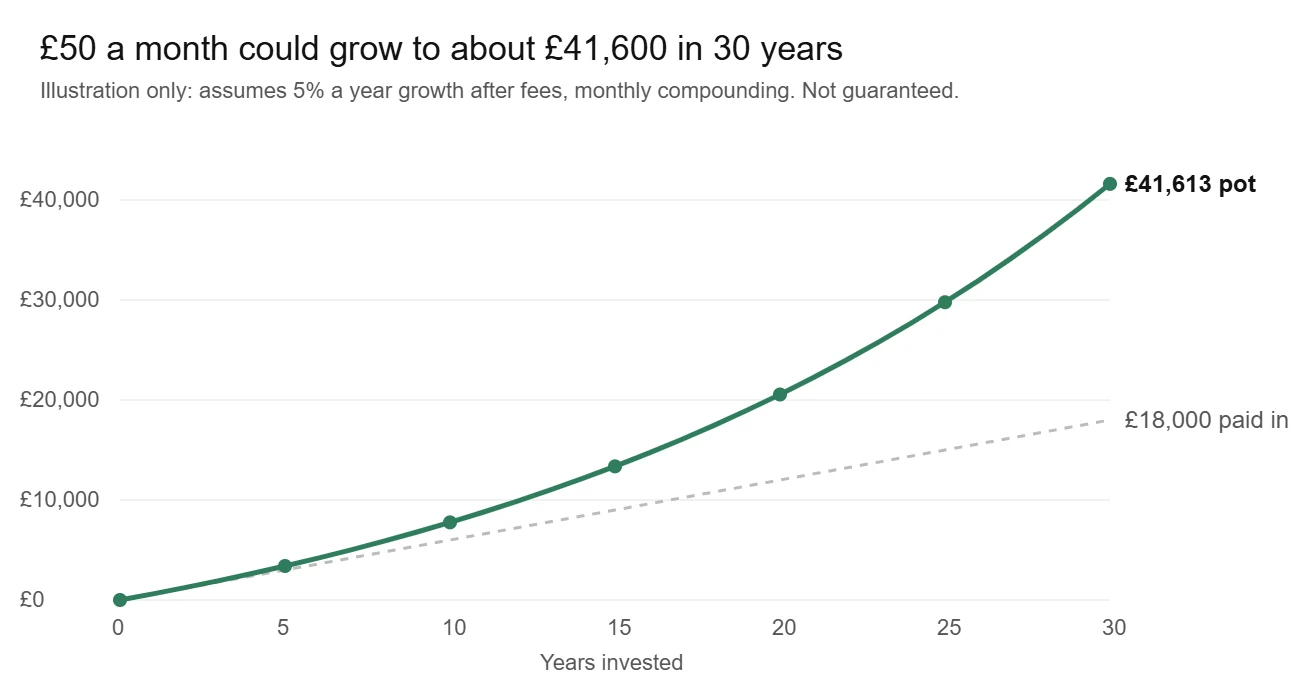
After 30 years, £50 a month (£18,000 paid in) could grow to about £41,600, so more than half of the pot is growth you never paid in. Over 20 years at the same 5%, £25 a month could become roughly £10,300, and £100 a month roughly £41,100.
The lesson? Time in the market matters more than the amount. Starting with £25 today beats waiting five years to start with £100.
Illustration only: assumes 5% a year growth after fees, compounded monthly. Returns are not guaranteed. Investments can fall as well as rise, and you may get back less than you put in.
7 beginner investing mistakes to avoid
I’ve made a few of these myself, so please learn from me!
- Waiting for the “perfect” time. Nobody can time the market. Regular monthly investing smooths out the ups and downs for you.
- Checking your app every day. It’s a recipe for stress and panic-selling. Once a quarter is plenty.
- Selling when the market drops. Falls are normal. Selling locks in the loss; staying put gives your pot time to recover.
- Ignoring fees. A 1% difference in fees can cost you thousands over 20 years. Keep total costs low.
- Putting everything in one company. Your favourite brand might be great, but one share is a gamble. Spread your risk with funds.
- Chasing hot tips on social media. If someone promises guaranteed returns, walk away. Check any firm on the FCA register first.
- Investing money you’ll need soon. Saving for a wedding next year? Keep it in cash. Investing is for five years-plus.
FAQs about investing in the UK
How much money do I need to start investing in the UK?
You can start with as little as £1 on some apps. Many platforms let you set up a regular investment from £25 a month.
Is investing better than saving?
For money you will not need for five years or more, investing has historically beaten cash savings. For short-term goals and your emergency fund, cash is safer.
Is a Stocks and Shares ISA safe?
The ISA itself is just a tax-free wrapper. Your investments can rise or fall in value. If an FCA-regulated platform goes bust, the FSCS may protect up to £85,000 per person, per firm, but it does not cover investments falling in value.
Do I pay tax on investments in an ISA?
No. There is no Income Tax or Capital Gains Tax on anything inside an ISA, and you do not need to tell HMRC about it.
What should a complete beginner invest in?
Many beginners choose a low-cost global index fund or a ready-made fund. They spread your money across hundreds of companies in one simple purchase.
Can I invest £25 a month in the UK?
Yes. Platforms such as AJ Bell Dodl and Interactive Investor accept regular investments from £25 a month, and some apps let you start from £1.
Why is my deposit still showing as cash?
On many DIY platforms, money paid in sits in the cash balance until you buy an investment. Set up a regular investment or auto-invest so each payment buys your chosen fund.
Are fractional shares safer for small amounts?
No. Fractional shares let you buy part of a share with a small amount, but they rise and fall in value just like whole shares. A global fund usually spreads risk far more.
You’ve got this!
Starting to invest doesn’t need a big salary or a finance degree. It just needs a first step. Sort your emergency fund, open a Stocks & Shares ISA, pick one simple fund and set up a small monthly payment. Future you will be so grateful you started today.
Your next read: The 50/30/20 Rule UK: How to Budget Your Take-Home Pay
Sources
- MoneySavingExpert: Cash ISA limit cut cancelled (Oct 2026)
- FSCS: What we cover
- GOV.UK: Individual Savings Accounts
- Yahoo Finance: Every ISA rule change in the Budget
Disclaimer: This article is for general information and education only and isn’t financial advice. I’m not a regulated financial adviser. The value of investments and any income from them can fall as well as rise, and you may get back less than you invest. Tax rules can change and depend on your circumstances. Figures correct as of October 2026.
Plan your next money step
My free 7-Day Financial Reset Kit helps you review household spending. If you prefer a paid planner, my Bills & Renewal Dashboard gives you a place to keep your own figures and reminders.
This is general information, not personal financial advice. Check official guidance and current retailer terms for your circumstances. Financial disclaimer.
About the author: Dr Kalpana Govindaraasan is the PhD scientist, former secondary science teacher and mum behind MoneySavvyUK, turning complex household money topics into practical steps.