

By Dr Kalpana Govindaraasan
Last updated: 20 October 2026 · Autumn family activity guide during the 2026/27 tax year.
Free stargazing UK families can try this autumn starts with looking up, not buying equipment. The Orionid meteor shower reaches its peak around 21–22 October 2026, but bright moonlight and cloud can limit what you see.
I’m a PhD scientist, former science teacher and mum. I like an activity with room for questions, without making a purchase the starting point.
Here is a simple plan for an evening outside, an honest explanation of the late-night meteor window and a cloudy-night alternative. For more options, see our free and cheap half-term activities.
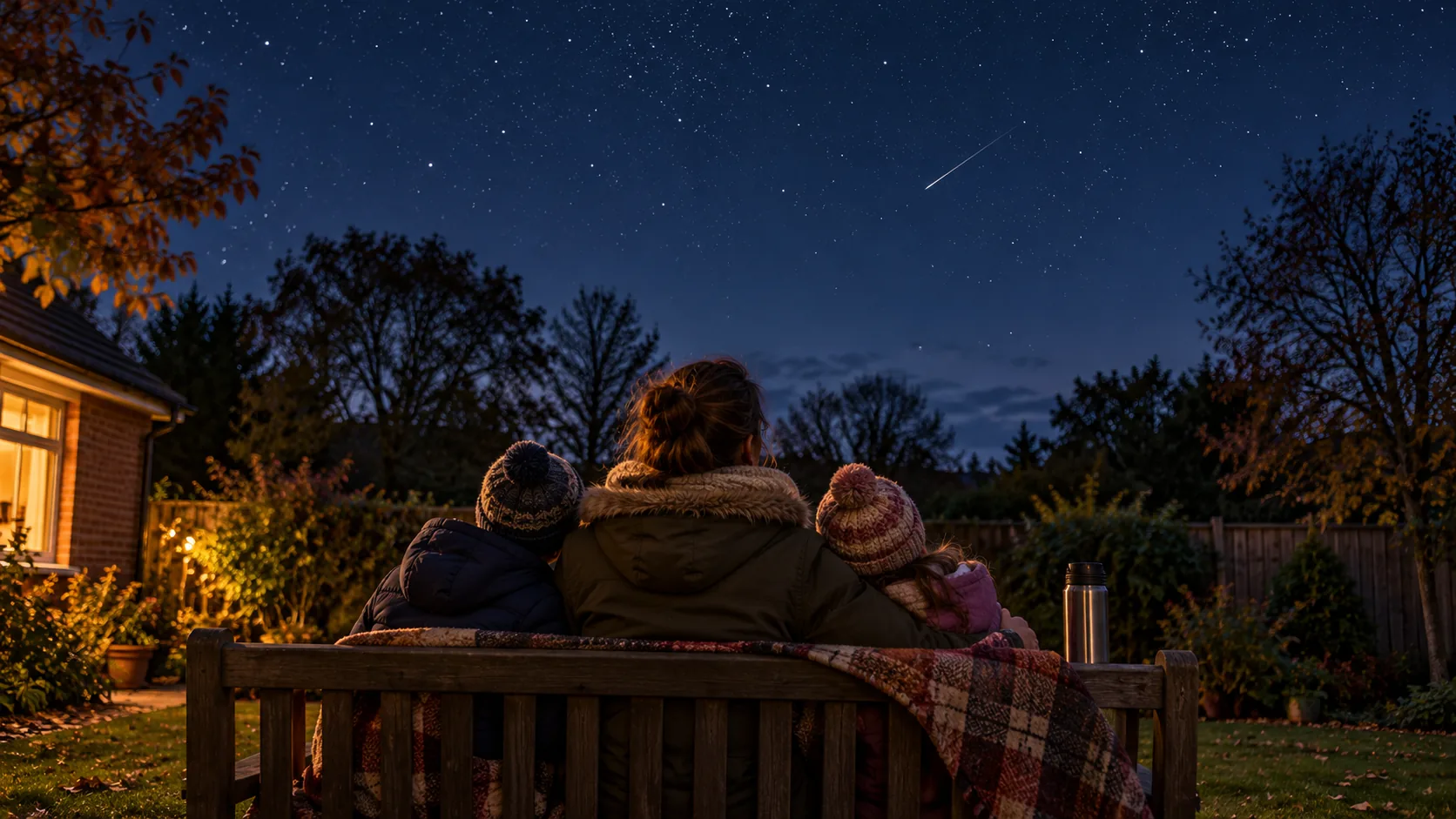
Free stargazing UK: 7 steps for an autumn family evening
1. Set realistic meteor expectations
The Orionids are associated with debris from Halley’s Comet. As Earth passes through that debris, particles entering the atmosphere produce the streaks often called shooting stars. They are not stars falling out of the sky.
Royal Observatory Greenwich’s October 2026 guide places the peak on the night of 21–22 October. The Natural History Museum warns that moonlight makes this year’s conditions less favourable.
Tell children you are going to explore the night sky and might see a meteor. A short outing with no shooting stars can still include spotting stars, noticing the Moon or asking why the sky changes.
There is no reason to spend money travelling simply because a headline promises a spectacular display. This is a weather-dependent opportunity, not a timed show with an admission ticket.
2. Choose a suitable time
NASA’s Orionid guidance identifies the hours after midnight as the viewing period. That is important for parents: an early-evening family session is not equivalent to watching during the more favourable meteor window.
If young children need their usual bedtime, keep the plan as general stargazing. You could look at a star chart indoors, step outside briefly and discuss what you notice. Do not promise that moving the activity earlier will give the same chance of Orionids.
Older children and adults who choose a later session can check the local weather and moonrise/moonset information before committing. The exact useful window depends on location and conditions; this guide is not a forecast for your garden.
If the outing falls in your local school holiday, great. If it does not, choose a routine that works for your household. October half-term dates differ, so check your own school calendar.
Our October clock-change checklist is another practical reminder for the week. The meteor peak and the clock change are separate events; do not alter your clock early for this activity.
3. Start close to home
A back garden, permitted communal space or a familiar local viewing spot can keep the activity simple. Choose somewhere you can reach and leave safely, with a clear view of a useful area of sky.
Move away from bright light where practical without creating a safety problem. Leave public lighting alone and respect neighbours. A comfortable place near home can be a better choice than an unfamiliar remote location with children after dark.
If you use a balcony, stay safely behind the barrier. Do not lean over railings, climb onto a roof or stand in a road to improve the view.
For households without outdoor space, a window can be a starting point for looking at the night sky, although glass, reflections and the limited view make it less suitable for meteor watching. Turn it into a short observation activity rather than a promise of a meteor sighting.
If travelling is necessary, use our fuel and journey cost calculator to estimate the drive. Add any parking separately. “Free to look at the sky” does not make the whole journey cost-free.
4. Verify access before travelling
A Dark Sky designation is not a guarantee of free parking, open toilets or unrestricted overnight access. Check the individual site’s official visitor information, including gates, parking restrictions and any booked events.
The South Downs National Park stargazing directory illustrates why the details matter: its listings include sites where parking charges apply. Read the actual location entry rather than treating an entire National Park as one free attraction.
| Option | Why consider it? | What to verify |
|---|---|---|
| Home or permitted shared space | No travel needed | Safe access, lights and an unobstructed view |
| Familiar local public place | A possible improvement in sky view | After-dark access and a safe route home |
| Official dark-sky site | A location chosen for darker skies | Travel, parking, gates, terrain and event charges |
If you cannot establish that a location is suitable at night, choose somewhere else. An attractive daytime photograph does not tell you whether a car park will be open or a path easy to navigate in darkness.
5. Use what you already own
For meteor watching, a broad view matters more than magnification. The Natural History Museum’s meteor advice explains why your unaided eyes are useful. You do not need to make a telescope purchase for this plan.
Collect warm layers, a seat or blanket and something suitable to keep ground dampness away if you will sit down. Take a torch for the route and use it thoughtfully once you are settled. Bring a warm drink if that fits your family’s routine.
My suggested packing list is deliberately ordinary: coats, hats if needed, a comfortable seat, a drink and a way to get home. Use suitable things you have, rather than treating the activity as an excuse for a shopping basket.
If you are already organising autumn clothes, our guide to pieces children can wear again uses the same buy-less approach. You do not need themed stargazing outfits or a special picnic purchase.
6. Give your eyes time
Once you are safely settled, put bright screens away and allow your eyes to adjust. NASA suggests allowing roughly half an hour in darkness. Look across a broad area of sky rather than staring at one small point.
It is fine to use a chart beforehand to understand what you hope to find. A phone app is optional, not part of the equipment list. If you try one, check whether the function you want is free before starting a trial or subscription.
With children, give the session a purpose that does not depend on a meteor: describe a pattern, compare the brightness of two points of light, or write down a question to investigate tomorrow. Those are my suggested activities, not claims about what will be visible at a particular time.
You could keep a notebook of the date, approximate time, sky conditions and what you noticed. “Cloudy, saw nothing” is still an observation. There is no need to buy an app to record it.
If an app trial tempts you, first read our subscription cancellation checklist and use the subscription cost calculator before adding another recurring payment.
7. Keep a cloudy-night alternative
Check the Met Office forecast for your location before setting out. The forecast should guide whether the outing is worthwhile; a meteor peak date is not evidence of clear skies.
If it is wet, windy or heavily clouded, keep the plan indoors. Read NASA’s explanation of the Orionids, draw a comet and its debris trail, or ask children to explain the difference between a star and a meteor in their own words.
Another option is a short family film night. Our free film guide is a seasonal starting point for later in autumn; check the individual service’s access and viewing requirements. For now, an astronomy article and a drawing may be all you need.
For the rest of October, our Halloween on a budget guide offers another family plan. Choose activities because they work for you, rather than feeling that every seasonal event needs spending.
If you like planning for occasional outings, my paid Sinking Funds & Savings Pots planner can help organise future costs. A free evening at home needs no planner purchase. Browse the free UK money calculators if you are reviewing the wider budget.
What I’d do first for a free stargazing evening
I would check the weather, choose a safe place close to home and set expectations before taking children outside. For a normal bedtime, I would call it a stargazing session and treat a meteor as a possibility, not the promised highlight.
I would only plan a later Orionid watch if the timing, conditions and people taking part made it worthwhile. The activity should fit the family rather than the other way round.
Free stargazing UK: FAQs
When is the Orionid peak in 2026?
Royal Observatory Greenwich’s October guide identifies the night of 21–22 October 2026. The shower has a wider activity period, but that does not mean a sighting is guaranteed on any particular night. Weather, moonlight, light pollution and viewing time all affect the experience.
Can children watch before bedtime?
Children can enjoy general stargazing before bedtime if skies and conditions allow. However, NASA places Orionid viewing after midnight, so an early family session should not be sold as equivalent to the better meteor-viewing window. Set the plan around observing the sky rather than promising shooting stars.
Do we need a telescope?
No telescope purchase is needed for meteor watching. A broad view with your unaided eyes is appropriate, because a meteor can cross a wide area of sky. Bring ordinary warm clothing and a comfortable seat instead, and use a torch when needed to move safely.
Are dark-sky sites completely free?
Not necessarily. A designation describes the location’s dark skies, not its parking or event prices. Check the named site’s official visitor information for access, charges and opening restrictions. Starting near home is usually the simplest way to avoid travel and parking expenditure.
Free stargazing UK: summary
- The Orionid peak is around 21–22 October, with moonlight affecting conditions.
- After midnight is more relevant for meteors than a normal children’s bedtime.
- Start in a safe, permitted spot close to home and use existing supplies.
- Keep an indoor alternative and make no sighting promises.
Would your family choose a short garden session or a later watch with older children? Share your plan without posting your home address or children’s identifying details.
Sources
- Royal Observatory Greenwich: October 2026 sky guide
- NASA: Orionids and observing advice
- Natural History Museum: meteor watching and 2026 conditions
- South Downs National Park Authority: location information
- Met Office: local weather forecasts
I’m not a financial adviser; this is general family-budget information. See the financial disclaimer. This is not a live sky forecast or a guarantee that any location is suitable for your party.