Last updated: 18 October 2026 · Reviewed during the 2026/27 tax year. Card offers follow their own dates.
Cashback credit cards UK can return a small part of everyday spending, but the headline percentage is only the starting point. This guide compares ten cashback and reward credit cards, including their fees, ongoing rates, payout rules and practical limitations.
I use an M&S credit card, pay it off every month and use the rewards towards things such as my son’s uniform and socks. I’ll explain that approach, and how Nectar points can be used towards Tu purchases, after the card comparison.
First, a boundary: rewards are only useful if the account fits your budget. MoneyHelper explains the repayment risks. I’m not a financial adviser, and this article contains no credit-card affiliate links or application recommendations.
10 cashback and reward credit cards UK: comparison
These ten products cover different everyday spending patterns. The order is for navigation, not a best-to-worst ranking. Some pay cash or statement credit; others pay points or vouchers. Rates and representative examples were checked on 18 October 2026. Existing account terms can differ.
| Card | Reward on eligible purchases | Account fee | Payout / redemption | Representative APR, variable |
|---|---|---|---|---|
| 1. Amex Cashback Credit Card | 0.75% on the first £10,000; 1.25% above that | £25 a year | Annual statement credit, subject to terms | 34.6% |
| 2. Amex Cashback Everyday Credit Card | Ongoing: 0.5% to £10,000; 1% above. Separate introductory offer | £0 annual fee | Annual statement credit; £3,000 annual minimum spend | 29.1% |
| 3. Lloyds Ultra Credit Card | 1% in the first year; 0.25% afterwards | £0 monthly account fee | Paid to the card account each January | 14.9% |
| 4. Barclaycard Rewards | 0.25% on eligible purchases | No annual account fee | Credited annually or on request | 28.9% |
| 5. Santander Rewards Credit Card | Year one: 3% on eligible travel, fuel and dining; 0.25% otherwise. Later: 0.25% | £0 monthly account fee | Monthly to the credit-card account | 24.9% |
| 6. Amazon Barclaycard | 1% on eligible Amazon purchases; elsewhere 0.5% for twelve months, then 0.25% | £0 monthly account fee | Amazon gift cards, redeemable in £5 multiples | 28.9% |
| 7. Amex Nectar Credit Card | 2 Nectar points per full £1 on eligible purchases; partner/loyalty collection rules apply | £30 annual fee; £0 in the first year | Nectar points, redeemed under the chosen partner’s terms | 35.8% |
| 8. M&S Rewards Credit Card | 1 point per £1 at M&S; 1 point per £5 elsewhere; 200 points = £2 vouchers | No annual card fee; optional Club Rewards costs extra | Quarterly M&S vouchers | 23.9% |
| 9. NatWest Travel Reward Credit Card | 1% on eligible travel; 0.1% on other spending; selected partner offers vary | £0 annual fee | MyRewards; redemption available from £5 of Rewards | 27.9% |
| 10. Santander All in One Credit Card | 0.5% on eligible purchases, capped at £10 cashback per month | £3 monthly fee (£36 over twelve months) | Monthly on the statement date | 29.8% |
Read before using the table: cashback does not make borrowing free. All cards are subject to status and their own eligibility and exclusions. Representative APR is not a guaranteed personal rate. Each example below uses an assumed credit limit of £1,200. Fees and interest can exceed rewards. This is an informational comparison, without card affiliate links or an instruction to apply.
The ten cards: rewards, fees and everyday limits
1. Amex Cashback Credit Card
This is the fee-paying Amex cashback product, rather than the similarly named Platinum charge-card product. Its ongoing rates apply in bands: spending above the threshold does not retrospectively earn the higher rate on everything. The annual fee reduces what you keep. A separately advertised introductory cashback offer has its own cap, eligibility and timing rules; it is excluded from the ongoing comparison below.
Small-print check: Check eligible Amex spending and the anniversary payout conditions. If only part of your normal shopping accepts Amex, use that smaller amount in the fee calculation.
Provider’s representative example: 34.6% APR representative (variable); purchase rate 29.1% p.a. (variable); assumed credit limit £1,200; account fee: £25 a year. Provider details and full terms.
2. Amex Cashback Everyday Credit Card
The no-annual-fee version has lower ongoing tiers and a minimum spending condition for cashback. The current page separately advertises 2% introductory cashback, capped at £200 during the first twelve months, with conditions. That introductory arrangement must not be confused with the ongoing tiers used in the fee table. Check the offer actually attached to your application or existing account.
Small-print check: Do not spend extra to reach the minimum. A household that cannot meet it through ordinary eligible purchases should not count on receiving cashback.
Provider’s representative example: 29.1% APR representative (variable); purchase rate 29.1% p.a. (variable); assumed credit limit £1,200; account fee: £0 annual fee. Provider details and full terms.
3. Lloyds Ultra Credit Card
Lloyds Ultra separates its first-year reward from the lower rate that follows. It states there is no monthly account fee and no foreign transaction fee on purchases. Its cashback is shown on statements but paid in January, so an accumulating balance is not immediately spendable cash. Cashback does not count as a repayment.
Small-print check: Review the second-year return, and distinguish overseas purchase fees from interest on cash withdrawals. A fee-free cash withdrawal can still attract interest from the withdrawal date.
Provider’s representative example: 14.9% APR representative (variable); purchase rate 14.94% p.a. (variable); assumed credit limit £1,200; account fee: £0 monthly account fee. Provider details and full terms.
4. Barclaycard Rewards
Barclaycard Rewards provides a flat cashback structure rather than an Amex-style spending tier. Barclaycard describes Visa exchange rates on its page; the research’s Mastercard label should not be used for this product. Cashback exclusions include cash-like transactions, transfers and gambling-related transactions. Its overseas terms are a separate feature from the ordinary purchase reward.
Small-print check: A non-Amex payment option can address an acceptance gap, but no card works everywhere. Check whether another account adds useful flexibility or merely another payment to manage.
Provider’s representative example: 28.9% APR representative (variable); purchase rate 28.9% p.a. (variable); assumed credit limit £1,200; account fee: No annual account fee. Provider details and full terms.
5. Santander Rewards Credit Card
The higher first-year rate applies to specified categories, not the whole household budget. Merchant category codes determine classification, so a payment that looks like dining or fuel may not receive the rate you expected. The provider specifically flags exceptions involving some pubs, hotel restaurants and petrol stations. After the first year, the standard reward is lower.
Small-print check: Split your actual spending by qualifying category. Do not extend the first-year rate into a long-term forecast or treat a conditional welcome voucher as an unconditional cash payment.
Provider’s representative example: 24.9% APR representative (variable); purchase rate 24.9% p.a. (variable); assumed credit limit £1,200; account fee: £0 monthly account fee. Provider details and full terms.
6. Amazon Barclaycard
This earns Amazon Rewards rather than unrestricted cashback. Rewards can be converted into Amazon gift cards once the redemption threshold is reached. Prime members may receive a higher rate during selected eligible shopping events, but that is not the ordinary rate on every Amazon order. The increased welcome-gift promotion ending 13 October 2026 has passed, so it is not presented here as a current offer.
Small-print check: Count gift-card rewards only at the value you will use. Check app requirements and digital-wallet compatibility rather than assuming every payment feature is available.
Provider’s representative example: 28.9% APR representative (variable); purchase rate 28.9% p.a. (variable); assumed credit limit £1,200; account fee: £0 monthly account fee. Provider details and full terms.
7. Amex Nectar Credit Card
This earns Nectar points instead of cash. Card-earned points and points earned by scanning an ordinary Nectar loyalty card are separate components: do not count the combined partner total twice. Convert points using the redemption route you will actually use, then subtract the card fee in later years. Introductory bonus points have additional qualifying conditions and are excluded from a normal ongoing return.
Small-print check: The Tu sale approach below can use Nectar points earned through this card. It does not make the card necessary for using Nectar or guarantee that rewards outweigh its fee.
Provider’s representative example: 35.8% APR representative (variable); purchase rate 29.1% p.a. (variable); assumed credit limit £1,200; account fee: £30 annual fee; £0 in the first year. Provider details and full terms.
8. M&S Rewards Credit Card
The current Rewards product has different point earning at M&S and elsewhere. Its voucher conversion gives a face-value equivalent of 1% at M&S and 0.2% elsewhere before transaction rounding and exclusions. Other M&S products, including Purchase Plus, can have different earning rules. This is why I would read the exact product name on my own statement rather than apply a new-card advertisement to an existing account.
Small-print check: My own M&S experience appears below. I have not assumed that my existing account is this exact current product, nor that every reader will use M&S vouchers.
Provider’s representative example: 23.9% APR representative (variable); purchase rate 23.9% p.a. (variable); assumed credit limit £1,200; account fee: No annual card fee; optional Club Rewards costs extra. Provider details and full terms.
9. NatWest Travel Reward Credit Card
The standard travel reward is category-specific and is not a flat return on all purchases. Other ordinary spending earns a smaller rate, while selected retailer offers are separate. NatWest states that overseas purchases have no foreign transaction fee, but cash-machine transactions and money advances can carry charges. Its Rewards redemption options should be checked separately from the purchase rate.
Small-print check: Use eligible travel expenditure in the higher-rate calculation. Do not describe a commuter or travel product as the highest-return option for an unrelated grocery budget.
Provider’s representative example: 27.9% APR representative (variable); purchase rate 27.9% p.a. (variable); assumed credit limit £1,200; account fee: £0 annual fee. Provider details and full terms.
10. Santander All in One Credit Card
All in One combines capped cashback with a monthly account fee. On cashback alone, £600 of eligible monthly purchases would earn £3, equal to that month’s fee, before interest or other charges. At the monthly reward cap, £10 less the £3 fee leaves £7; annualising that maximum gives £84 only if the cap is reached in every month and the terms stay unchanged.
Small-print check: The fee applies even in a low-spending month. A promotional purchase or transfer period does not remove the account fee or the obligation to make required repayments.
Provider’s representative example: 29.8% APR representative (variable); purchase rate 23.9% p.a. (variable); assumed credit limit £1,200; account fee: £3 monthly fee (£36 over twelve months). Provider details and full terms.
Why Zopa is not one of these ten: its current credit-card page does not substantiate the research’s “0.5% instant cashback” claim. Zopa’s Biscuit current-account rewards are a different product. Santander All in One, also discussed in the research, is included instead so that the table contains ten verified reward-bearing credit cards.
How to compare everyday cashback without losing the benefit
Check repayment before rewards
Rewards are secondary to being able to repay the borrowing. If ordinary household costs already exceed your income, adding a rewards target can make the problem worse. A credit limit is not extra household income.
MoneyHelper explains that rewards cards usually only make sense when the balance is repaid in full each month. Interest and other charges can outweigh the reward. Read its credit-card guide before comparing incentives.
For an existing card, check whether your Direct Debit collects the full statement balance, the minimum or a fixed amount. Those settings do different jobs. Confirm when a new instruction becomes active, keep enough money in the paying account and continue checking statements. A Direct Debit does not remove the need to monitor payments.
Start with my household budgeting guide and the free calculators if you need to work out what your current spending allows.
Compare the same spending
Use recent statements to estimate purchases you already make. Separate food, transport, online shopping and other spending, then identify which transactions would actually qualify. Do not include rent, council tax or other bills automatically: the payment method, acceptance and reward exclusions matter.
A card advertised for travel or dining may use merchant category codes to classify purchases. The name above the shop door is not a guarantee of the code its payment system uses. Returns, cash withdrawals and transfers can also be treated differently from ordinary purchases.
Keep your spending estimate realistic. Reducing the food-shop total can matter more than earning rewards on a larger basket. A cheaper suitable item without cashback may leave you better off.
Subtract the annual fee
Net reward = eligible rewards actually earned − card fees − interest − other charges. For a tiered scheme, calculate each band separately. Do not multiply all your spending by the highest advertised rate.
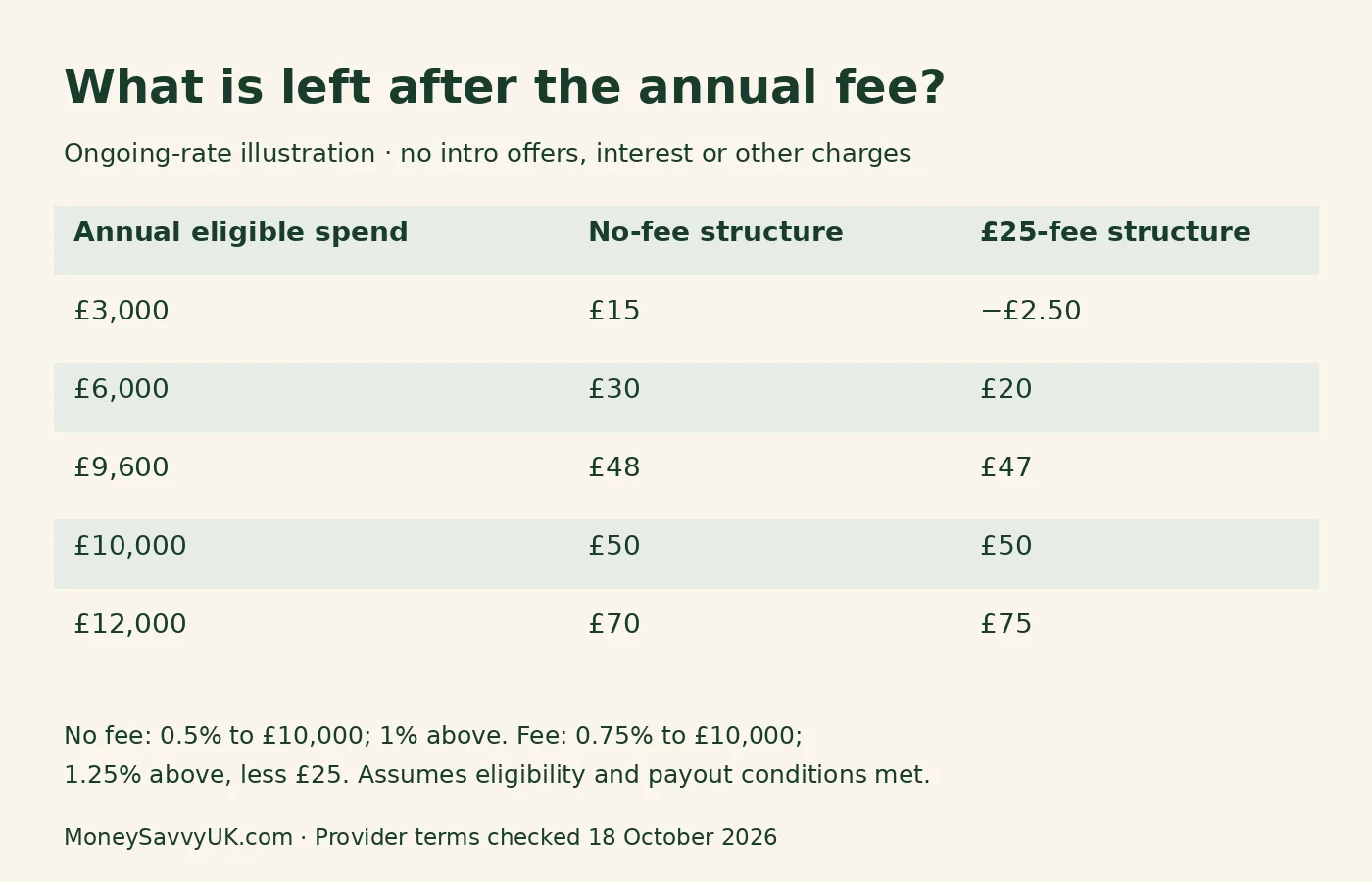
The following is an ongoing-rate illustration using Amex’s published cashback structures, excluding introductory offers. It assumes eligible spending, no interest or other charges, and that payout conditions are satisfied. It is a calculation exercise, not a recommendation or a forecast of first-year earnings.
| Annual eligible spend | No-fee structure: 0.5% to £10,000; 1% above | £25-fee structure: 0.75% to £10,000; 1.25% above, less fee | Difference after fee |
|---|---|---|---|
| £3,000 | £15 | −£2.50 | No-fee structure £17.50 ahead |
| £6,000 | £30 | £20 | No-fee structure £10 ahead |
| £9,600 (£800/month) | £48 | £47 | No-fee structure £1 ahead |
| £10,000 | £50 | £50 | Equal |
| £12,000 | £70 | £75 | Fee-paying structure £5 ahead |
Sources: Amex Cashback Everyday terms and Amex Cashback terms. The Everyday page specifies a minimum annual spend of £3,000 for cashback. Read the full current conditions, including account status and payment timing.
At £12,000, the calculation is £75 on the first £10,000 plus £25 on the remaining £2,000, less the £25 fee: £75 net. That is only £5 above the no-fee structure. An annual fee is not automatically worthwhile just because the headline rate is higher.
Separate first-year and ongoing rewards
A temporary offer can change a comparison substantially. Record its end date, maximum reward, eligible spending and any previous-cardholder restrictions. Then make a second calculation for the following year.
For example, Lloyds Ultra’s published terms distinguish first-year cashback from the lower ongoing rate and state there is no monthly account fee. Santander Rewards’ terms also distinguish temporary category rewards from later earnings. Neither example establishes which card suits an individual household.
Amex’s current Everyday introductory offer differs from the ordinary rates used in the illustration above. That is why a reusable ongoing comparison should not be presented as a prediction of what a new applicant will earn immediately. Recheck the provider’s page before relying on an offer.
Understand cash versus vouchers
Cashback paid to a statement, money paid to an account and a retailer voucher are different rewards. A voucher has practical value only if you can use it for something you need before it expires. It cannot necessarily cover an unrelated bill.
My M&S rewards work for me because I use them for household purchases. M&S Bank’s rewards guidance explains that points become vouchers and that earning rules vary between its card types. Do not assume that a rate shown for a new product applies to an older card already in your wallet.
I would check the exact card name, the points on the statement, the conversion into vouchers and the expiry date. Sparks offers, credit-card rewards and any paid Club Rewards subscription are separate features; do not count a subscription benefit without subtracting its cost.
For rewards that do not require new borrowing, compare supermarket loyalty schemes and receipt cashback apps. Their conditions and rewards still need checking. My Morrisons More vs Tesco Clubcard comparison explains how to compare rewards with the price of the actual basket.

Use sale rewards without double-counting
I prefer waiting for deeper clothing reductions when the sizes I need are available. I look for reductions of 50%, and sometimes 70%, rather than assuming a smaller sale is the best opportunity. Those are my shopping preferences, not a promise of a current sale or stock availability.
The trade-off is practical: a lower price is no help if the right size has gone. I would compare the current price of an item I need and check the voucher rules at checkout. I would not buy unsuitable clothes simply to use rewards.
Amex Nectar: the same idea for Tu sale purchases. Points earned on eligible Amex Nectar spending can be added to your Nectar balance and later used towards qualifying Tu purchases. Repaying the card in full and checking the card fee remain separate responsibilities. The same budgeting principle can apply to Nectar points used towards Tu clothing. Tu confirms that points can be collected and spent online and in store, with account-linking and redemption conditions. Ordinary Nectar points do not require an Amex Nectar credit card. Amex’s current Nectar card page lists an annual fee of £30, waived in the first year. Include that fee when judging the value in later years. This is an explanation of redeeming points, not a recommendation to take out that card.
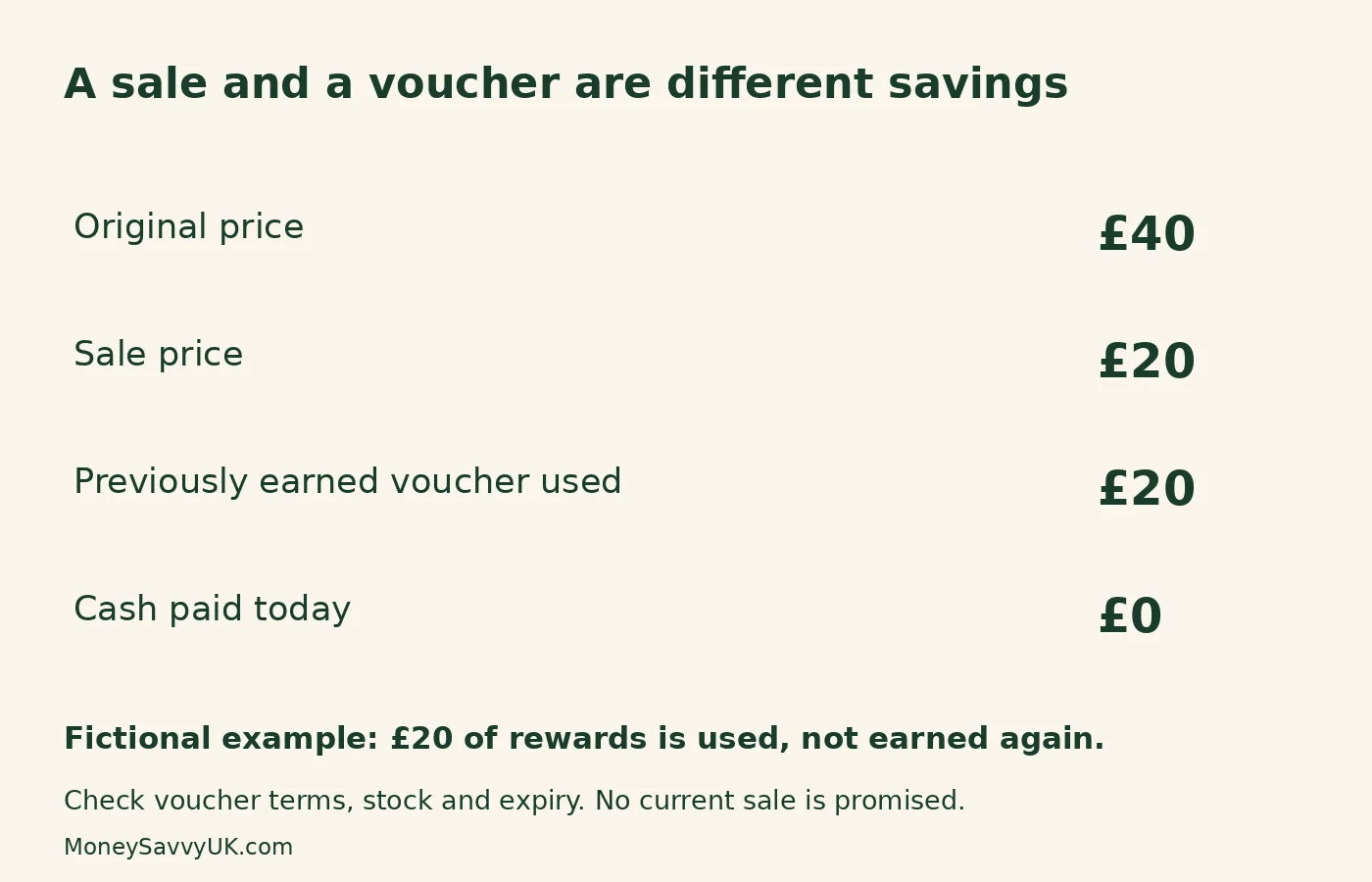
A fictional example: an item originally priced at £40 is reduced to £20. Paying with £20 of previously earned vouchers reduces the cash needed today to zero, but uses £20 of rewards. It is not another £20 reward earned by that purchase, and the original spending that earned the vouchers was not free.
Check acceptance and debit alternatives
A second card can provide another way to pay where your usual card is not accepted. It also creates another balance, payment date and account to monitor. Two cards do not guarantee acceptance everywhere, and an existing debit card may already provide the backup you need.
Compare debit rewards using the same discipline: eligibility, caps, qualifying categories and account requirements. A purchase paid with a debit card does not also earn purchase cashback on a credit card. These are alternative payment routes, not two rewards automatically earned on the same payment.
Chase’s current cashback guidance sets out category restrictions, a monthly cap and qualification conditions. Its Direct Debit guidance says Direct Debits do not themselves earn cashback. Do not assume repaying a credit-card bill creates an additional reward.
For online shopping, compare TopCashback and Quidco separately. A shopping portal may sometimes be compatible with a payment-card reward, subject to both schemes’ terms; two competing click-through portals should not be assumed to pay together. See my tracking checklist and how cashback sites work.
Read eligibility-check wording
A soft-search eligibility check estimates whether you may qualify without the same effect as a full credit application. It is not a guarantee of acceptance, a particular limit or a particular interest rate. Read what the checker says it does before entering details.
Experian distinguishes soft and hard credit searches. A full application can leave a hard-search record visible to lenders. Several applications close together can affect how a lender assesses you; a rejection is not a universal, automatic score penalty with a fixed outcome.
A hard-search record is not a permanent mark on your report. Search-record retention and its influence on a lending decision are different things. Check your own report and the lender’s current process rather than relying on a single promised approval percentage.
Read protection and payout rules
Payment protection can matter more than a small reward difference. Read MoneyHelper’s explanation of Section 75 and its linked detailed guidance. Protection is conditional: not every credit-card payment creates a valid claim, and payment intermediaries can complicate the relationship between buyer, lender and supplier.
Do not treat an entire shopping basket as automatically protected because its total exceeds a threshold. Equally, chargeback is a different process from Section 75. For a specific dispute, get guidance on the transaction rather than assuming a refund is guaranteed.
Read when rewards become payable, whether the account must remain open and what happens after a return or closure. Lloyds states its Ultra cashback is paid in January and is not treated as a payment. Do not subtract an expected reward from the repayment your statement requires; follow the provider’s actual payment instructions.
Set a review date
Write down the offer expiry, next fee date, reward-payment date and voucher expiry. Review whether you used the rewards and whether fees or extra spending cancelled out their value. Keep a copy of the terms relevant to your account.
Include the review in a wider subscription and recurring-payment check. If rewards tempt you to spend more, simplifying your payment setup may be more useful than adding another product.
What I’d do first
First, confirm that the current balance can be cleared and that ordinary spending fits the budget. Second, look at actual statements and vouchers rather than an advertised maximum. Third, compare the next year after fees and introductory offers end. My M&S experience is a practical example of using rewards, not evidence that everybody needs the same card.
Cashback credit cards UK FAQs
Is an annual-fee cashback card always better?
No. Compare the extra reward against the fee using spending that actually qualifies. In the ongoing-rate illustration above, the fee-paying and no-fee structures are equal at £10,000 of eligible annual spending. Introductory offers, payout conditions, interest and other charges can change the result.
Can cashback replace my minimum repayment?
Do not assume it can. A reward may reduce a balance without counting as the payment required by the agreement. Check the statement and provider’s instructions, and maintain the required repayment. Pending cashback or points should never be treated as money already available to pay a bill.
Do I need an Amex Nectar card to spend points at Tu?
No. Tu’s published guidance allows ordinary Nectar points to be spent subject to its redemption and account-linking rules. A credit card is one possible source of points, not a requirement for using the loyalty scheme. Check the checkout conditions for the specific purchase.
Does checking eligibility guarantee approval?
No. A soft-search estimate is an indication based on the information available at that stage. Final acceptance, credit limit and terms depend on the lender’s assessment. Check whether a service uses a soft search before using it, and distinguish checking eligibility from submitting a full application.
Are retailer vouchers as useful as cashback?
That depends on whether you will use them. Vouchers can help pay for planned purchases, as mine do for family essentials, but they restrict where and sometimes when you spend. Compare their usable value after expiry rules and fees rather than treating every points total as cash.
Cashback credit cards UK: summary
Check affordability first, calculate eligible spending, subtract fees and separate temporary offers from ongoing terms. Value vouchers by what they replace in your budget. Keep rewards, sale reductions and repayment obligations separate. Which matters most in your household: flexibility, simplicity or rewards for purchases you already make?
Sources and editorial notes
Primary sources checked on 18 October 2026: MoneyHelper; Amex Everyday; Amex Cashback; Lloyds; Santander; M&S Bank; Tu; Chase; and Experian. Product terms can change. The calculation excludes introductory rewards and does not rank products.
I’m not a financial adviser; this is general information, not a recommendation to apply for credit.
About the author: Dr Kalpana Govindaraasan is a PhD scientist, former secondary science teacher and mum who has lived in the UK since 2008. MoneySavvyUK shares practical household money information and clearly distinguishes personal experience from illustrative calculations.
Save this guide for later