

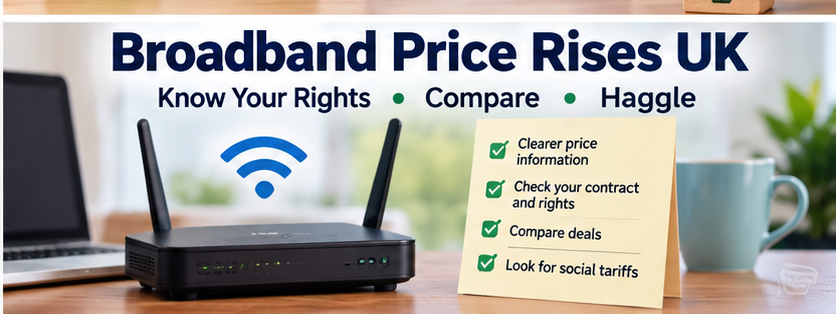
Last updated: October 2026. Provider prices and terms change; always check your own contract before switching.
The original MoneySavvyUK article was built around spring 2026 provider announcements. Those individual “act before April” claims have expired. The useful question now is: what are your rights when a broadband provider raises its prices, and how can you reduce the bill?
Current Ofcom rule on scheduled price rises
For new contracts since January 2025, providers cannot use inflation-linked or percentage-based formulas for scheduled in-contract rises. If a provider plans a specified increase, it must tell you clearly before you sign up what the rise will be in pounds and pence and when it will happen.
If the increase was part of the contract you agreed to, you do not automatically gain a penalty-free right to leave when it arrives. If a provider raises the price beyond what you agreed, Ofcom says it generally must give at least one month’s notice and a right to exit without penalty. Read Ofcom’s current guidance.
1. Check your contract
Find your latest bill or online account and note your monthly price, minimum-term end date, broadband speed, package extras and any scheduled price rise.
2. Compare what you actually need
A cheaper package is not a saving if it cannot support your household. Equally, paying for very high speeds or TV/phone services you rarely use can waste money. Compare speed, setup fees, equipment charges, contract length, scheduled rises and bundles.
3. Haggle if you want to stay
Use competitor prices as evidence when asking your provider for a better deal. Compare the total cost over the contract rather than assuming a retention offer is automatically cheapest.
For a real MoneySavvyUK example, see how I cut my Sky broadband bill.
4. Check social tariffs if money is tight
Ofcom says people receiving Universal Credit, Pension Credit or certain other benefits may qualify for a social tariff. These are lower-cost packages for eligible households, and Ofcom notes that they do not have mid-contract price rises. Use Ofcom’s current money-saving guidance rather than an old provider table.
MoneySavvyUK takeaway
The strongest broadband strategy is no longer a one-off “beat the April hike” trick. Put a reminder around your contract end date, review the package when your provider announces a change and compare the full cost before renewing.
Mobile customer? See our updated O2 April 2027 price-rise guide.