

Last updated: 21 October 2026.
This guide explains ev home charger rules in plain English, with the practical checks to make before changing your household budget.
Quick answer: from 21 October 2026, qualifying cross-pavement EV charging installations in England can use new permitted-development rights. An approved highway-authority scheme and the conditions of the rules still matter; some properties still need planning consent. That’s a small channel (or “gully”) set into the pavement so a cable can run safely from your house to your car parked on the street. The government says this saves up to £300. But you still need your council’s permission. In practice, it mostly helps people whose council runs, or will run, an approved cross-pavement charging scheme.
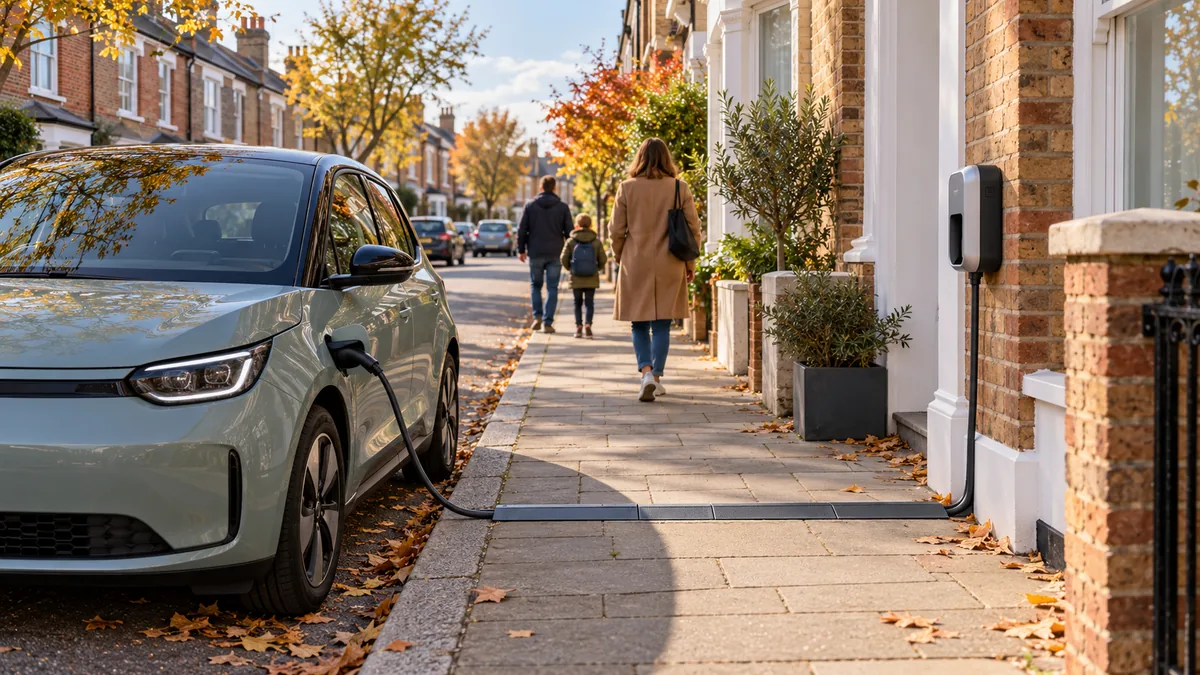
If you live in a terrace or a flat with on-street parking, home charging has always been the tricky bit of going electric. Do not trail a loose cable over a public pavement. Ask your highway authority which approved charging arrangements it permits, and compare the full home and public charging costs. Today’s change makes a safer middle option easier, so here’s what it means in plain English.
What are the new EV home charger rules?
The GOV.UK announcement (21 October 2026) covers three things:
- New permitted-development rights for qualifying cross-pavement installations from today, subject to conditions and exceptions. This is the big one for households without driveways.
- Easier planning rules for bigger public charging hubs, so charge point companies can build faster.
- Two consultations, open until 16 December 2026: one on building regulations for EV charging, and one on helping tenants and leaseholders get charging access.
| Before 21 Oct 2026 | From 21 Oct 2026 | |
|---|---|---|
| Planning permission for a cross-pavement gully | Needed | Not needed where the England permitted-development conditions are met |
| Council permission to work on the pavement | Needed | Still needed |
| Saving on install | n/a | Up to £300 (government figure) |
| Where it applies | England only. Scotland, Wales and NI set their own planning rules. | |
What is EV pavement gully charging?
A gully is a narrow channel cut into the pavement with a cover on top, level with the surface. You lay your charging cable in it when you plug in, so nobody trips over it. Your home charger stays on your wall or inside your house, and the electricity comes from your own home supply at your home tariff.
The highway authority controls works on the public pavement; ownership and highway rights are not the same thing. So the council decides whether a gully can go in outside your house. They check for things like underground gas, water and broadband cables, and whether the pavement is wide enough.
Does this mean I can install one tomorrow?
Not every property qualifies. The council guidance identifies exceptions for scheduled monuments, listed-building curtilages and conservation areas. Ask the planning and highways teams to confirm the route for your address.
Probably not. One step has gone, but the main hurdle hasn’t:
- You still need council authorisation. The new planning right applies where the charger is part of an approved council scheme (North Northamptonshire Council).
- Some councils say “wait”. North Northamptonshire Council, for example, has told residents without off-street parking not to install a charger until its trial launches.
- Check reinstatement requirements with the authority, including what happens if you move or stop using the charger.
- Renters and leaseholders also need their landlord’s or freeholder’s permission. That’s what the new consultation is about.
As EVA England put it, it’s “now up to local authorities and landlords” to make this work in practice.
How to check if you can get a cross-pavement charger: step by step
- Search your council’s website for “cross-pavement charging”, “EV gully” or “on-street EV charging”.
- If there’s a scheme, check whether your street is included and how to apply. Some councils use approved products and installers only.
- If there’s nothing on the website, email your council’s highways team and ask whether they allow cross-pavement charging solutions, and how to apply.
- If you rent or own a leasehold flat, ask your landlord or freeholder for written permission first.
- Get at least two quotes from installers your council approves. Ask for the total price: charger, gully, council fees and reinstatement.
- Before signing, check your energy supplier’s EV tariff. The cheap overnight rate is where the real saving is.
How much could home charging save?
The government says home charging through a cross-pavement cable can cost as little as 2p per mile, on a cheap overnight EV tariff. It also says residents without off-street parking could save up to £1,750 on running costs compared with relying on public chargers. These are “up to” figures, so your saving depends on your tariff, your mileage and how much public charging you use now.
Here’s how to work out your own figure in a minute:
- Find your electricity rate per kWh on your bill (or the overnight rate on an EV tariff).
- Find your car’s efficiency in miles per kWh. It’s usually shown in the car’s app or on the dashboard. Use your own measured figure rather than a generic average.
- Divide the rate by the miles per kWh. For example, a 7p overnight rate ÷ 3.5 miles per kWh = 2p a mile. Do the same with what you pay at public chargers to see the difference.
What people are asking
Can I just run a cable over the pavement?
No. Loose cables across a pavement are a trip hazard, and many councils don’t allow them. If someone is hurt, you could be held responsible. Use only the arrangement expressly approved by your highway authority; do not assume a loose cable cover is permitted.
Does this apply in Scotland or Wales?
No. The planning change is for England only. Check with your local council if you live elsewhere in the UK.
Is there a grant for EV chargers?
The announcement didn’t include a new charger grant. It mentions the Electric Car Grant, which takes up to £3,750 off some new electric cars. Check the GOV.UK announcement for the latest.
Can I have my say?
Yes. If you rent or live in a leasehold flat, the consultation on charging access for tenants and leaseholders is open until 16 December 2026. Links are on the GOV.UK announcement.
ev home charger rules: summary
This is a helpful step for people without driveways, but it doesn’t mean everyone can install a pavement charger straight away. The useful thing to do today is check your council’s website. If there’s no scheme yet, a polite email to the highways team helps show there’s demand. And whatever you charge, make sure you’re on the right tariff. See my free UK money calculators.
Last checked: 21 October 2026 against GOV.UK. This is general information. Always check your council’s rules before installing anything on a public pavement.
What I’d do first before paying an installer
1. Confirm the street is eligible
Ask the highway authority whether it has an approved scheme and whether your property can participate. A neighbouring council’s policy does not apply to your road. Get the application route and conditions in writing, including any restrictions affecting listed buildings, conservation areas or scheduled monuments. Do not book pavement works simply because a national headline says planning rules have changed.
2. Compare the complete installation cost
Request a written breakdown covering the chargepoint, electrical work, pavement channel, permissions, ongoing fees and any reinstatement obligations. Ask who maintains the channel and what happens if it becomes damaged. If you rent or own a leasehold property, establish the permissions needed before paying a deposit. Check whether your preferred parking space is actually available; permission for a charger does not reserve a public parking space.
3. Compare the whole electricity bill
A cheap overnight rate is only one part of a tariff. Check daytime rates, standing charges, the hours available, compatible cars and chargers, and any minimum-term conditions. Compare the cost of your household’s expected use alongside the car. Include charging losses when estimating energy drawn from the meter, rather than assuming every unit bought becomes usable energy in the battery.
Related MoneySavvyUK guides and tools
- Reduce household electricity waste
- Compare energy tariff scenarios
- Work out commuting costs
- Check your energy Direct Debit
- Review car insurance renewal costs
- Keep a buffer before paying for installation
- Review recurring household spending
- Browse household money calculators
Sources and further reading
- Department for Transport announcement
- North Northamptonshire Council: scheme conditions
- 2026 permitted-development amendment
I’m not a financial adviser; this is general information. Check the linked official terms for your circumstances. Read the financial disclaimer.