

Last updated 6 November 2026 · Savings tax section covers 2026/27
The Bank of England interest rate is 4% after a rise from 3.75% on 5 November 2026, the first increase in more than three years. Tracker mortgage payments can rise, existing fixes stay the same until they end, and savings rates depend on your provider.
My own five-year fix is coming to an end, so I’m comparing a fixed rate with a tracker. With the next decision due on 17 December, I’m checking what another pre-Christmas rate rise could mean for a tracker payment.
Why did the Bank of England raise rates to 4%?
The Bank pointed to high global energy prices following disruption to supply and transport in the Middle East. Dearer oil and gas affect fuel and household energy bills, and businesses facing higher costs may raise their prices too. The Bank raised rates to limit how far those higher costs spread.
The Bank factored the 28 October Autumn Budget into its November forecasts. Its report separates the effect of the Budget from the wider energy shock.
How the 4% base rate affects your mortgage
1. Check your tracker or standard variable rate
A tracker typically charges Bank Rate plus a margin set out in your deal. A standard variable rate (SVR) is set by your lender, which decides how much to change it and when. Check your lender’s notice for the effective date and your new direct debit.
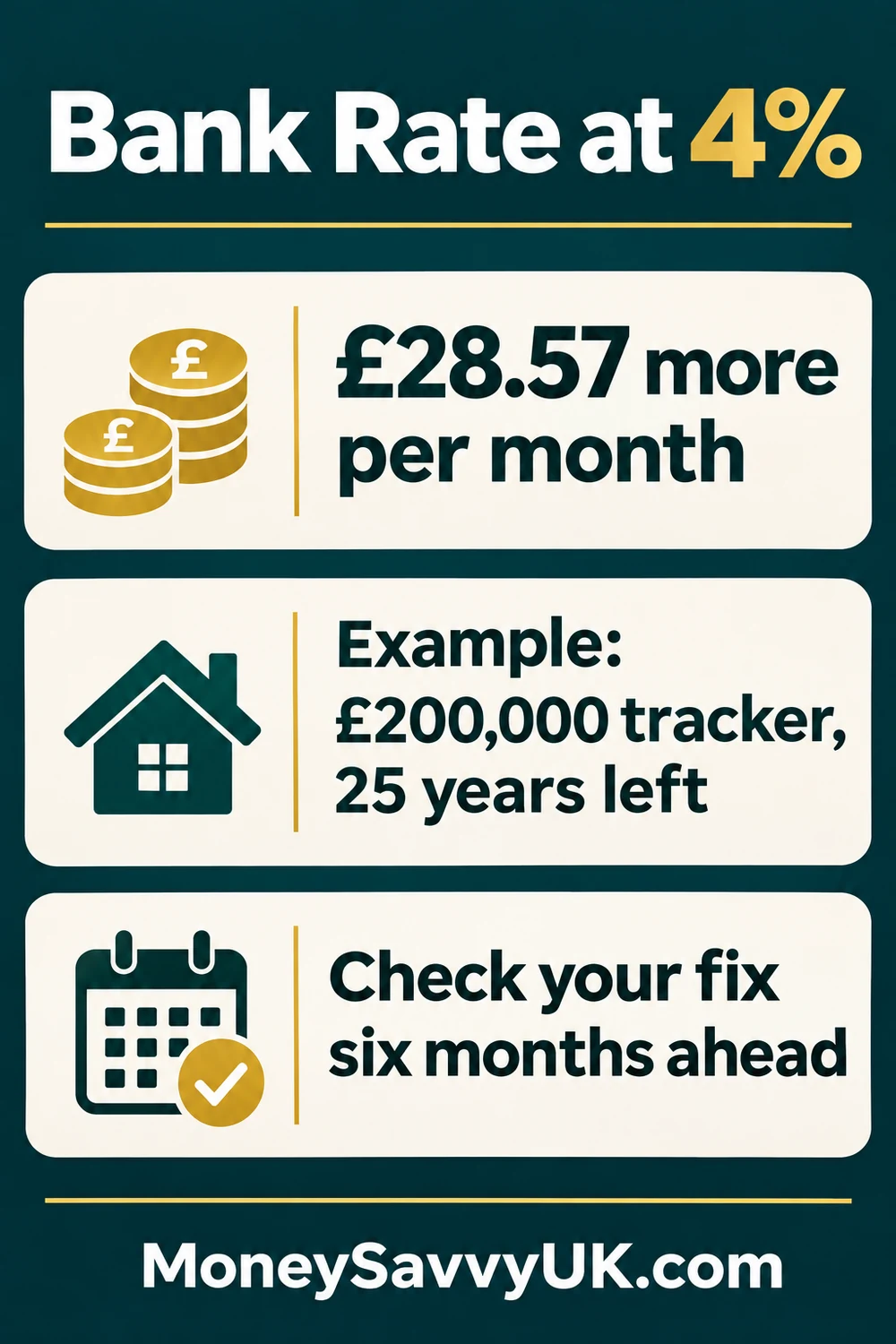
On a £200,000 repayment mortgage with 25 years left, an illustrative rate change from 4.50% to 4.75% takes the monthly payment from £1,111.66 to £1,140.23. That’s £28.57 more per month for this example. Your increase depends on your balance, remaining term and starting rate.
2. Check your fixed deal’s end date
My second home mortgage was fixed for five years at 1.75%, and that deal ends in February 2027. We started looking about six months ahead and received a new five-year fixed-rate offer at 4.8% before the November Bank Rate rise. If we go ahead, we’ll move from 1.75% to 4.8% when the new deal starts.
When I looked again, some of the rates I saw were around 5.1% to 5.2%. Those were rates I saw while shopping around. The deals you’re offered depend on the lender, the loan size relative to your home’s value, and the product fees.
Starting early gave us time to compare. We plan to look again in January or February before deciding whether to go ahead, as long as the offer is still valid and there’s enough time to complete before our current deal ends.
Moneyfacts reported that two-year fixed mortgage rates had risen before the November decision, as lenders factored in expectations about future borrowing costs.
If your fix ends within six months, you can start comparing a product transfer with your current lender and a remortgage elsewhere. Ask how long an offer lasts, when it can start, whether you can switch to a cheaper offer before completion and which fees you would lose if you changed your mind.
UK mortgage rates for buyers and remortgagers in November 2026
These are published examples for residential borrowing at up to 60% loan-to-value, meaning a deposit or equity of at least 40%. They show initial rates and product fees. Availability and eligibility can change, and other charges may apply.
| Purpose | Deal | Lender | Initial rate | Product fee | Source date |
|---|---|---|---|---|---|
| Buying | Two-year fixed | Barclays | 4.95% | £899 | 3 November |
| Buying | Five-year fixed | Barclays | 5.14% | £0 | 3 November |
| Buying | Two-year tracker | Nationwide | 4.34% | £999 | 5 November |
| Remortgaging | Two-year fixed | Barclays | 5.05% | £999 | 3 November |
| Remortgaging | Five-year fixed | Barclays | 5.10% | £999 | 3 November |
| Remortgaging | Two-year tracker | Nationwide | 4.42% | £999 | 5–6 November |
| Remortgaging | Five-year tracker | Barclays | 4.60% | £999 | 6 November |
In these examples, the trackers started below the fixed rates. The starting payment is only part of the comparison. Check how much your tracker could rise, whether the lender charges for overpaying or leaving early, and what happens when the initial deal ends.
Sources: Barclays fixed-rate changes effective 3 November, reported by Mortgage Solutions, Mortgage One tracker snapshot, 5 November and Go Direct remortgage snapshot, 6 November.
3. Compare the trade-offs for your household
| What to compare | Fixed-rate mortgage | Tracker mortgage |
|---|---|---|
| Main advantage | A predictable interest rate throughout the fix. | Payments can fall if Bank Rate falls and your deal passes on the cut. |
| Main drawback | You usually keep the agreed rate if market rates fall. Leaving early may cost you. | Payments can rise again. Any rate floor can limit the benefit of cuts. |
| Fees and overpayments | Some deals charge a product fee or cap penalty-free overpayments. | Some deals offer more flexibility. Check the fee, overpayment cap and exit charges on the actual offer. |
In our search, a fix we looked at came with a fee of about £1,000 and less flexibility for the overpayments we want to make. Across a two-year comparison, £1,000 is about £42 a month before any interest on the fee. I’d compare payments and fees over the same period, then check the balance I’d still owe at the end. The Compare Two Mortgages Calculator can help.
You have to decide whether a tracker or a fixed mortgage works for you. If an increase would eat into money you need for Council Tax, food or childcare, put that into the comparison. If you plan to make large overpayments or move home, ask what each lender would let you do and what it would charge.
4. Stress-test another rate rise before Christmas
The next Bank Rate decision is due on 17 December 2026. The Bank of England’s November minutes show an 8–1 vote to raise rates to 4%, with one member preferring a larger rise to 4.25%. Use 4.25% to test your budget if you’re on a tracker. If the MPC raises rates again, your payment could rise a second time, with the timing set by your mortgage terms.
| Scenario | Bank Rate | Tracker rate | Monthly repayment | Extra per month |
|---|---|---|---|---|
| Current Bank Rate | 4.00% | 4.75% | £1,140.23 | Baseline |
| One further rise | 4.25% | 5.00% | £1,169.18 | +£28.95 |
| Two further rises | 4.50% | 5.25% | £1,198.50 | +£58.27 |
| Three further rises | 4.75% | 5.50% | £1,228.17 | +£87.94 |
The example uses a repayment mortgage at Bank Rate plus 0.75 percentage points. The higher rows are budget scenarios with no assumed dates. Check your balance, remaining term, tracker margin and when your lender applies rate changes before setting money aside.
5. Understand what an offset changes
When I arrived in the UK in 2008, I had £1,000. By 2011, we’d saved a 20% deposit for our first home and took an offset mortgage with a tracker rate. Our linked savings reduced the balance the lender charged interest on, and we could still draw on those savings in an emergency.
For example, £20,000 in linked savings against a £200,000 offset mortgage would mean interest is calculated on £180,000 while the savings stay there. Withdrawing savings increases the amount charged interest. Compare the interest saved with what the money could earn elsewhere using the Offset Mortgage vs Savings Calculator.
If you want to see where a higher payment would fit, my free 7-Day Financial Reset Kit can help you review regular spending. The Emergency Fund Calculator can help you work out how much cash you want to keep accessible.
What the rate rise means for your savings and tax
Check the rate your account actually pays. Providers can change easy access rates on their own timetable, and existing fixed savings accounts generally keep the agreed rate for the term. For any headline AER, check the balance limit, introductory bonus, access rules and when interest is paid.
| Account type | Published AER | What to check |
|---|---|---|
| Easy access savings | 5.00% | Cahoot example applies to balances up to £3,000. |
| One-year fixed savings | 5.17% | Afin Bank example. Check early withdrawal terms and when interest is paid. |
| Easy access Cash ISA | 5.02% | Trading 212 example for new money. Check the rate and terms for transfers. |
These are dated examples from MoneySavingExpert’s savings and Cash ISA comparisons. Check current terms with the provider.
For 2026/27, add up taxable savings interest across your accounts and compare it with your Personal Savings Allowance. Cash ISA interest is tax-free and sits outside that calculation. If £550 of your projected interest comes from one taxable account and £120 from another, compare the combined £670 with your allowance.
The Autumn Budget announced higher tax rates on taxable savings interest from 6 April 2027. If a fixed account pays interest at maturity, check which tax year the interest falls into. See the HMRC policy note for the announced rates.
Compare what you can keep after tax and whether you can get at the money when you need it. See ISAs explained and the separate guide to savings tax changes from April 2027.
What I’d do first: 3 moves to make now
- Find the mortgage paperwork. Note your rate type, current balance, deal end date and fee to leave early. Check your lender’s payment notice if you’re on a variable rate.
- Compare two quotes side by side. Record the payment, fees, overpayment rules and exit costs. Run the tracker at today’s rate and with three more rises, then compare those payments with the fix.
- Review each savings pot. Check what rate it earns and when you need the money. The Sinking Funds & Savings Pots planner is one way to keep track of money earmarked for different bills and goals.
Bank of England interest rate at 4%: key takeaways
- Check your mortgage type and when any new payment takes effect.
- A fix gives payment certainty. A tracker can move either way, and overpayment rules vary by deal.
- Use further rate rises to test your budget and compare the total costs of your own quotes.
- Review savings access, interest after tax and when any bonus expires.
Frequently asked questions
When is the next Bank of England interest rate decision?
The next decision after the November increase is scheduled for 17 December 2026. The Bank of England publishes its meeting calendar.
Should I choose a fixed or tracker mortgage now?
Choose based on the payment you can afford, your plans to overpay or move, and the terms of the deals you’re offered. A fix gives you a known rate for the term, while a tracker leaves you exposed to rises and can benefit from cuts.
Will savings rates rise after the Bank of England decision?
Some providers may raise variable savings rates, and changes depend on the individual account. Check the AER on your own balance, how easily you can withdraw and what you’ll keep after any tax.
Sources and related tools
- Bank of England November decision and November Monetary Policy Report
- Reuters market pricing, 5 November
- Moneyfacts mortgage and savings market snapshot
- MoneyHelper mortgage guidance and MoneyHelper Cash ISA guidance
- HMRC savings interest rules
- Autumn Budget guide · Mortgage overpayment calculator · Free UK money calculators
Dr Kalpana Govindaraasan is a PhD scientist, former secondary science teacher and mum behind MoneySavvyUK.
I’m not a financial adviser. I’ve shared my own experience and general information to help you compare your options. This article does not constitute regulated financial advice.