

Last updated 6 November 2026 · Tax examples cover 2026/27 and the announced April 2027 changes.
Overpaying reduces the mortgage debt you owe. An offset mortgage reduces the balance charged interest while your cash stays in a linked account. At the same mortgage rate, both can initially save the same interest. The best fit depends on access, fees and your lender’s terms.
The Bank of England’s Bank Rate is 4% as of 5 November 2026. Use the rate on your mortgage offer for the comparison. My Bank Rate guide explains how a tracker and a fixed deal respond differently.
How we used an offset mortgage to keep our emergency money accessible
When we bought our first home in 2011, we chose an offset tracker. Our linked savings reduced the balance the lender charged interest on. We could still draw on those savings if something unexpected came up, which mattered to us.
Here’s an illustration using round numbers. Link £20,000 in savings to a £200,000 offset mortgage and the lender charges interest on £180,000 while the money stays in the account. If you withdraw £5,000, the balance charged interest rises to £185,000, assuming the mortgage balance itself hasn’t changed.
A £20,000 overpayment would also bring the balance charged interest to £180,000 at the outset. The difference is that you’ve paid down the debt. Getting that cash back would depend on your lender’s terms or whether you can borrow again.
Offset mortgage vs overpaying vs Cash ISA
| What to compare | Offset mortgage | Overpayment | Cash ISA |
|---|---|---|---|
| Effective return | Interest avoided at your offset mortgage rate on the amount linked. | Interest avoided at your mortgage rate on the amount repaid. | Interest earned at the account’s fixed or variable rate. |
| Tax | Interest saved is a lower borrowing cost. | Interest saved is a lower borrowing cost. | Interest is tax-free within the ISA. |
| Emergency access | Withdraw subject to account terms. Withdrawing increases the balance charged interest. | Usually difficult to get back. Check for a borrow-back facility. | Depends on the account. Fixed Cash ISAs may charge for early withdrawals. |
| Early repayment charges | Check the terms for actual overpayments, switching or paying off the loan. | Check how much you can overpay without a charge and when the allowance resets. | No mortgage early repayment charge for paying money into a Cash ISA. ISA withdrawal terms still apply. |
If you’re comparing tax-free savings options, my Cash ISA vs Premium Bonds guide explains access and return differences. For the tax on ordinary savings, see my April 2027 savings tax guide.
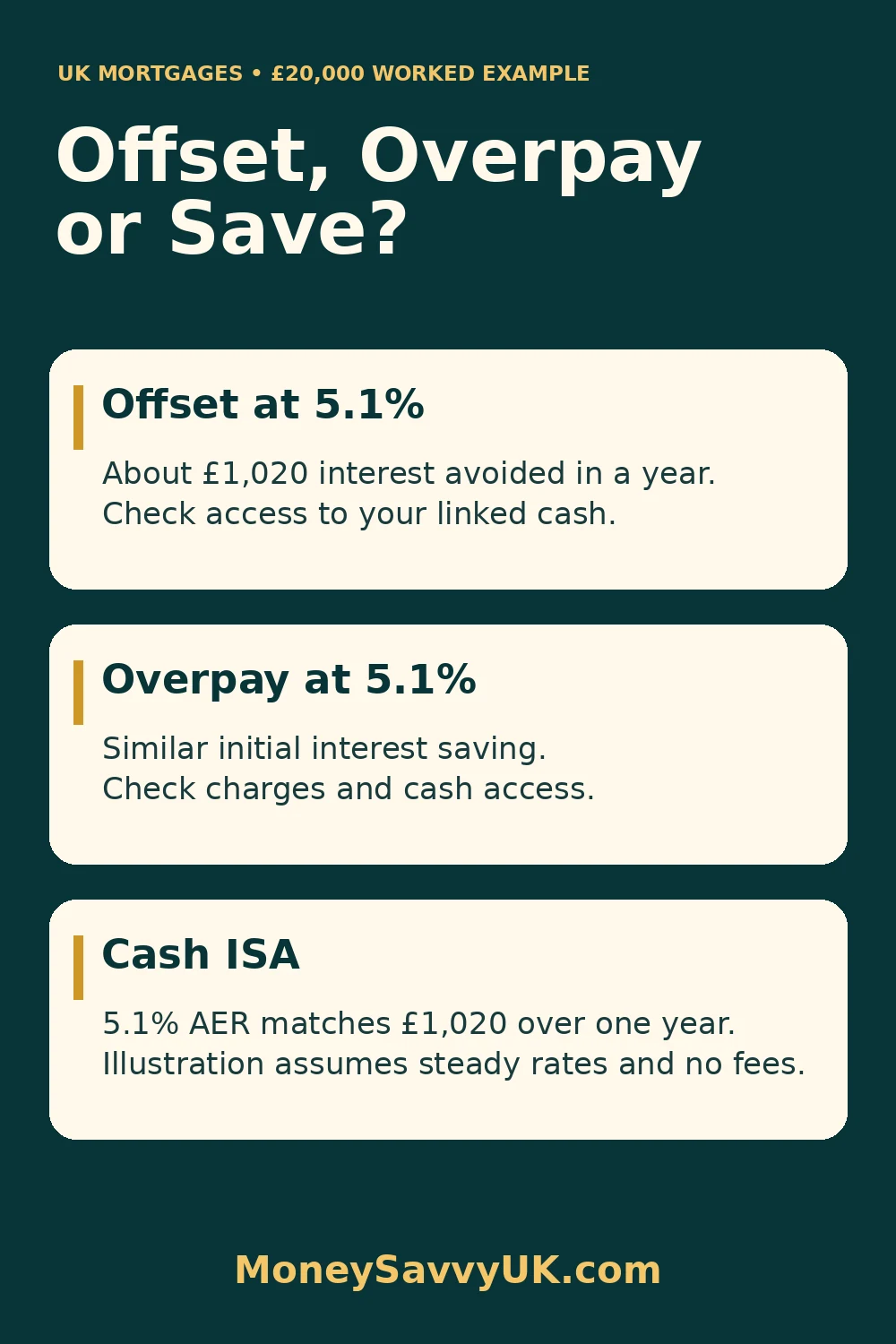
Worked example: £20,000 spare cash on a 5.1% mortgage
At an illustrative 5.1%, £20,000 × 0.051 gives about £1,020 in interest avoided over a year if that full amount reduces the balance charged interest throughout. This is a simple comparison before fees. The actual interest saving depends on timing, changes to the rate and how the lender handles repayments.
| Where the cash goes | Rate needed to match £1,020 over one year | Assumption |
|---|---|---|
| Cash ISA | 5.10% AER | The full balance earns that rate for a year. |
| Taxable savings in 2026/27 | 8.50% gross AER | All interest is taxed at 40%. |
| Taxable savings under the announced April 2027 rate | About 9.11% gross AER | All interest is taxed at 44%. |
To get the break-even savings rate, divide 5.1% by the share of interest you keep after tax. If some or all of your interest fits within your Personal Savings Allowance, your break-even rate is lower. Run the figures for your own mortgage and savings with the Offset Mortgage vs Savings Calculator.
3 questions to ask before moving your cash
1. What would I need this money for in a hurry?
Think about an unexpected repair, time off work or several bills arriving at once. If the spare cash is also your emergency money, use the Emergency Fund Calculator to decide how much you want to keep within reach. Check how long it takes to move money out of an offset or savings account.
2. How much can I overpay without a charge?
Many lenders allow penalty-free overpayments of up to 10% a year, but the rules vary. Check what balance they calculate the limit on, when it resets, whether previous overpayments count and how they calculate any early repayment charge. Ask if the overpayment reduces your monthly bill or helps you repay sooner. Compare the effect with the Mortgage Overpayment Calculator.
3. Does the offset rate or fee cost more?
Compare the rate and fees on the whole mortgage. A simple illustration makes the point: on £200,000, a standard mortgage at 5.0% starts at roughly £10,000 in annualised interest. An offset at 5.3% with £20,000 linked starts at roughly £9,540. That’s a £460 difference before fees and repayment effects, assuming those balances and rates stayed the same.
If you expect to dip into the savings, repeat the comparison with a smaller linked balance. Use the Compare Two Mortgages Calculator to compare rates and fees over the same period.
What I’d do first
I’d check how much cash I need for emergencies, then ask the lender for its overpayment rules in writing. I’d compare the cost of the whole mortgage with the savings I realistically expect to keep linked. My free 7-Day Financial Reset Kit and Sinking Funds & Savings Pots planner can help you separate those savings by purpose.
Key takeaways
- Offsetting and overpaying can initially save the same interest when the rate and amount match.
- Keep money you may need soon somewhere you can access on time.
- Compare the whole mortgage cost, including the product fee and any early repayment charge.
- Use the savings rate you keep after tax when comparing taxable savings.
Offset mortgage and overpayment FAQs
Is an offset mortgage worth it in 2026?
It can be worth comparing if you expect to keep enough savings linked and want access to them. Compare the offset rate and fees with a standard deal using a realistic savings balance.
Can I get a mortgage overpayment back?
Usually, an overpayment reduces the debt and you can only access the money again if your lender offers that feature or agrees to further borrowing. Ask about access before paying in money you may need.
Should I overpay my mortgage or save in a Cash ISA?
Compare the interest avoided on the mortgage with the tax-free interest the ISA pays. Factor in access, withdrawal terms and any mortgage early repayment charge.
Sources
- Bank of England November decision
- MoneyHelper overpayments and offset and remortgaging guidance
- Treasury savings rates and HMRC savings allowances
I’m not a financial adviser. This guide shares my own experience and general information and does not constitute regulated financial advice.