

By Dr Kalpana Govindaraasan
Last updated: 20 October 2026 · Autumn/winter checklist during the 2026/27 tax year.
The clocks go back UK-wide on Sunday 25 October 2026, at 2am, returning to 1am. While you are changing the kitchen clock, check the heating timer too. It could still be following the old time.
I’m a PhD scientist and mum behind MoneySavvyUK. When I check household costs, I want to see what a number actually means: the energy used, the price charged, or the payment leaving the bank.
These seven checks help you separate those numbers, review a proposed payment increase and use our energy tariff comparison calculator appropriately.
Date and time: GOV.UK clock-change calendar. Price-cap discussion below applies to Great Britain; Northern Ireland has a separate energy market.
Clocks go back UK: 7 checks for your energy bills
1. Check your heating timer
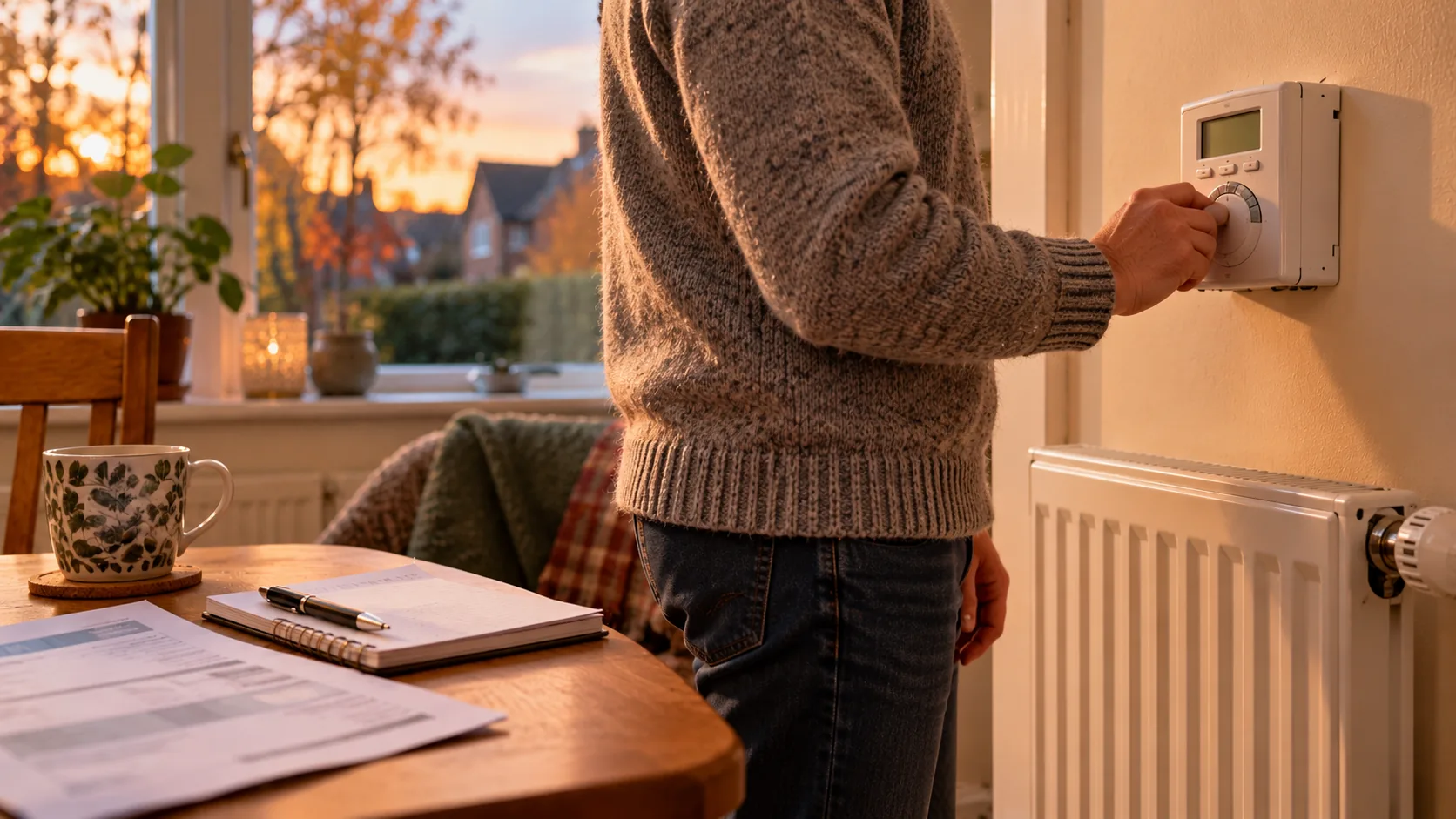
Look at the time displayed on your heating programmer after the clocks change. Some controls update automatically; others need you to reset them. Check the instructions for your model rather than assuming it works like your phone.
Then check the actual programme. Does the heating start when someone needs it? Does the hot water schedule still fit school mornings, shifts or working from home? Energy Saving Trust recommends checking the programmer’s clock before setting heating programmes.
For example, a programme intended to start before breakfast might run at the wrong local time if the controller does not update. Correcting its clock restores the schedule you intended; it does not automatically reduce the length of time the heating runs.
If you use storage heaters or a time-of-use tariff, check your supplier’s instructions before changing charging schedules. The cheaper hours can depend on the meter and tariff. Do not assume every timer should move in the same way.
For your next step, choose relevant ideas from my guide to saving energy at home. Keep your household’s warmth and needs central to any changes.
2. Match the bill to readings
Open your latest statement and find the meter readings used to calculate it. Were they actual readings or estimates? Compare the meter serial number on the bill with the one on your meter if anything looks wrong.
If you have a traditional meter, take a clear photograph and submit the reading through your supplier’s usual route. If you have a smart meter, check that recent readings are appearing in your account. The screen in your kitchen is useful, but check the supplier account as well.
Citizens Advice lists incorrect estimates and wrong-meter billing among possible explanations for an unexpectedly high bill. Follow its country-specific advice where relevant.
You do not need to take a reading at 2am. The October clock change is a useful reminder to check your account, not a special price-cap deadline. If your tariff changes, follow the supplier’s instructions for that separate change.
3. Separate costs from payments
Your monthly direct debit and the cost of energy used that month are different things. A fixed monthly payment can spread expected costs across the year, while actual consumption varies.
| Number | What it tells you | What to check |
|---|---|---|
| Energy charges | Cost of consumption and standing charges for the bill period | Readings, dates and tariff rates |
| Direct debit | Money collected from your bank | How the supplier calculated the payment |
| Account balance | Credit or debt after charges and payments | Whether recent usage has been billed |
A larger payment does not, by itself, prove that your unit rate has risen. Equally, being in credit does not automatically mean you can safely reduce the payment.
Ofgem explains that summer credit can help meet higher winter costs. Check the balance against an up-to-date bill before deciding what it means for your household.
4. Ask for the payment calculation
If your supplier proposes an increase, ask which information changed. Was it annual consumption, the tariff, an outstanding balance or a previous estimate that proved too low?
Citizens Advice explains that direct debits commonly use estimated annual consumption. A review should therefore start with the assumptions behind the payment.
A message you can adapt: “Please show me how you calculated my proposed direct debit, including the annual electricity and gas consumption, tariff rates, latest meter readings, account balance and any debt repayment. Please explain the review period and recalculate it if any information is wrong.”
Keep the reply with your bill and meter photographs. If you still disagree, use the supplier’s complaints process. If affordability is the problem, say that clearly and ask about support rather than treating it only as a calculation dispute.
My free money help guide is a starting point for wider support. You can also use MoneyHelper’s energy-bill guidance to work through your options.
5. Compare tariffs using consumption
If you compare tariffs, find annual electricity and gas consumption in kWh on your statement or supplier account. Use your household’s figures rather than somebody else’s monthly payment.
Then collect the unit rates, standing charges, tariff length and exit fees from the quote. Ofgem’s price cap limits charges on covered tariffs, not a household’s total bill. The headline typical-household figure is not a personal spending limit.
Check the tool’s rate date and compare its benchmark with Ofgem’s applicable regional and payment-method rates. Its displayed national average is not necessarily your tariff.
A fixed tariff can make rates more predictable, but bills still depend on usage. Read my energy price cap forecast guide for the distinction between an announced cap and a forecast. Neither a forecast nor this checklist is a promise about your next bill.
6. Update your household budget
Once you understand the payment, put the agreed amount into your budget. Record the next review date beside it so you know when to check again.
If that leaves a shortfall, work out its size before making cuts. A budget is more useful when it reflects your actual commitments than when it follows a percentage rule your circumstances cannot support.
My 50/30/20 budgeting guide explains a flexible starting point. For practical places to investigate, review subscriptions you no longer need and use the subscription cost calculator to total them.
If you are also reviewing food spending, try the grocery savings calculator with realistic changes. These tools help you organise decisions; they do not make essential spending disappear.
If you prefer a printable record, my paid Bills & Renewal Dashboard is designed for tracking household bills and review dates. A notebook works too.
7. Keep a record for winter
Create one folder, paper or digital, for your latest statement, meter photographs, tariff quote and supplier messages. Write down what you changed and why.
At your next review, compare like-for-like periods where possible. A cold winter month and a mild autumn month are not a clean test of whether one small change worked.
My suggested review sheet is simple: reading date, billed usage, account balance, monthly payment, action taken and next check. You can see whether a problem was resolved without relying on memory.
If you have savings available, the emergency fund calculator can help you consider your wider buffer. For other household decisions, browse the free UK money calculators.
What I’d do first this weekend
I would start with three small tasks: check the heating programmer shows the correct local time; match the latest bill to meter readings; and ask for the calculation behind any unexplained direct debit increase.
I would compare tariffs after gathering the actual usage and rates. Otherwise it is too easy to compare two payment amounts that were calculated using different assumptions.
Clocks go back UK: your questions answered
When do the clocks go back in October 2026?
The clocks go back on Sunday 25 October 2026, at 2am, returning to 1am. GOV.UK confirms the date and timing. Check household controls individually afterwards: a phone updating automatically does not tell you whether your heating programmer has also updated.
Do I need to read my meter at 2am?
No special 2am reading is required because the clocks change. Use the weekend as a convenient reminder to check your readings and account. If your tariff is changing separately, follow your supplier’s instructions for that change rather than treating the clock change as a billing deadline.
Will changing my heating timer save money?
Correcting the clock helps the system follow your intended schedule. Savings depend on whether that changes energy consumption. Check the programme as well as the displayed time, and follow the instructions for your heating system. A clock adjustment alone does not guarantee lower bills.
Is my energy direct debit too high if I’m in credit?
Not necessarily. Ofgem explains that credit built up in warmer months can help cover winter usage. First check that recent consumption has been billed. Then ask the supplier to explain its payment calculation using your readings, forecast consumption, tariff and balance.
Can a calculator tell me my exact winter payment?
A tariff comparison calculator cannot determine your supplier’s exact payment calculation. It can help compare costs under stated assumptions. Your payment may also reflect account credit, debt and the review period. Ask the supplier for those details and check the calculator’s limitations before relying on it.
Clocks go back UK: summary
- Check the heating programmer’s clock and programme after Sunday’s change.
- Match bills to readings and keep charges, payments and balances separate.
- Ask for the assumptions behind a proposed direct debit increase.
- Compare tariffs using consumption, rates and contract terms.
Which part is hardest to untangle in your account: the readings, balance or monthly payment? Share the question without posting account numbers or personal details.
Sources checked for this guide
- GOV.UK: clock-change dates and times
- Energy Saving Trust: using central heating controls
- Ofgem: bills, tariffs and credit
- Ofgem: price-cap scope
- Ofgem: current rates
- Citizens Advice: unexpectedly high bills
- Citizens Advice: direct debit increases
- MoneyHelper: help with energy bills
I’m not a financial adviser; this is general information. Read the financial disclaimer. Heating systems, tariffs and household needs vary.