

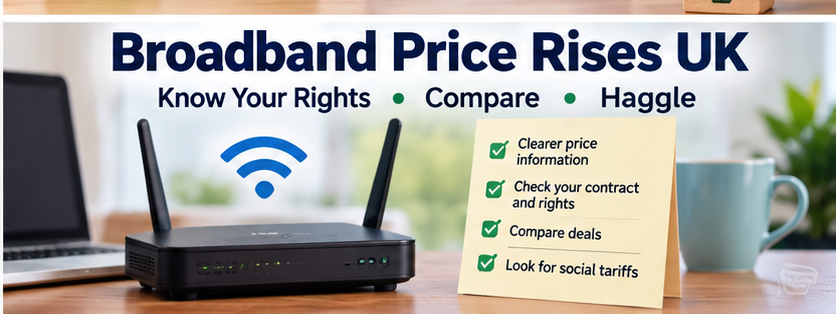
Last updated: October 2026. Provider prices and terms change; always check your own contract before switching.
The useful question now is: what are your rights when a broadband provider raises its prices, and how can you reduce the bill?
Current Ofcom rule on scheduled price rises
For new contracts since January 2025, providers cannot use inflation-linked or percentage-based formulas for scheduled in-contract rises. If a provider plans a specified increase, it must tell you clearly before you sign up what the rise will be in pounds and pence and when it will happen.
If the increase was part of the contract you agreed to, you do not automatically gain a penalty-free right to leave when it arrives. If a provider raises the price beyond what you agreed, Ofcom says it generally must give at least one month’s notice and a right to exit without penalty. Read Ofcom’s current guidance.
1. Check your contract
Find your latest bill or online account and note your monthly price, minimum-term end date, broadband speed, package extras and any scheduled price rise.
2. Compare what you actually need
A cheaper package is not a saving if it cannot support your household. Equally, paying for very high speeds or TV/phone services you rarely use can waste money. Compare speed, setup fees, equipment charges, contract length, scheduled rises and bundles.
3. Haggle if you want to stay
Use competitor prices as evidence when asking your provider for a better deal. Compare the total cost over the contract rather than assuming a retention offer is automatically cheapest.
For a real MoneySavvyUK example, see how I cut my Sky broadband bill.
4. Check social tariffs if money is tight
Ofcom says people receiving Universal Credit, Pension Credit or certain other benefits may qualify for a social tariff. These are lower-cost packages for eligible households, and Ofcom notes that they do not have mid-contract price rises. Use Ofcom’s current money-saving guidance rather than an old provider table.
MoneySavvyUK takeaway
The strongest broadband strategy is no longer a one-off “beat the April hike” trick. Put a reminder around your contract end date, review the package when your provider announces a change and compare the full cost before renewing.
Mobile customer? See our updated O2 April 2027 price-rise guide.
Your broadband price rise checklist
- Find your contract start date and the price-rise terms in your welcome email or online account.
- Check your current speed and whether you really need it. A slower, cheaper package may be fine for your household.
- Note your contract end date. Once you are out of contract, you are free to switch without exit fees.
- Compare deals for your postcode, including smaller providers, not just the big names.
- Call your provider’s retention team, be polite and ask what they can offer before you switch.
How to haggle your broadband bill
Have a competing price ready before you call. Explain that you are happy with the service but the price no longer works for you, and ask if they can match or beat the deal you have found. If the first offer is not good enough, it is fine to say you will think about it. Providers often come back with a better offer. Write down the new price, contract length and any setup fees before you agree.
Broadband is one of those bills we set up once and then forget about, until the price goes up. I’ve haggled our own broadband bill down before, and the biggest lesson was simple: providers rarely offer their best price unless you ask. Here’s what your rights are when prices rise, how switching works now and how to make sure you’re not overpaying.
Switching is easier than it used to be
Since 2024, most home broadband switches in the UK use One Touch Switch. You simply contact the provider you want to move to, and they arrange the switch and the end of your old contract, even if the two providers use different networks. You don’t need to call your old provider to cancel. Check whether you’re still in your minimum term first, because early termination charges may apply. Ofcom explains how switching works.
What broadband speed does your household need?
Paying for speed you don’t use is an easy way to overspend. As a rough guide:
| Household | Typical needs | Speed to consider |
|---|---|---|
| 1–2 people, light use | Browsing, email, some streaming | Standard fibre is often enough |
| Family of 3–4 | Several devices streaming at once, video calls, homework | Mid-range fibre |
| Busy home or home workers | 4K streaming, gaming, large uploads, lots of devices | Faster full-fibre packages |
Check the speeds actually available at your address, because the same package can perform very differently from street to street.
Providers worth comparing
When you compare, look at the total cost over the contract, setup fees, equipment and any scheduled price rises. Providers to check include BT, Sky, Virgin Media, TalkTalk, Vodafone, Plusnet, EE and NOW Broadband. Smaller full-fibre providers may also be available in your area.
If you decide to stay, use a competitor’s price when you call your provider. I share the exact words I used in how I cut my Sky broadband bill.
Broadband price rises: your questions answered
Can I leave my broadband contract if the price goes up?
It depends on your contract. If the price rise was clearly set out in pounds and pence when you signed up, you usually can’t leave penalty-free when it happens. If your provider raises the price beyond what you agreed, Ofcom says you should get at least a month’s notice and the right to leave without penalty.
What is a broadband social tariff?
A social tariff is a cheaper broadband package for households getting certain benefits, such as Universal Credit or Pension Credit. Ofcom notes they don’t have mid-contract price rises. Check Ofcom’s list of social tariffs to see what’s available.
How do I switch broadband provider?
Contact the provider you want to join. Under One Touch Switch, they arrange the move and the end of your old contract. Check your minimum term first, as early exit fees may apply.
Will I lose my internet when I switch?
Usually only briefly, if at all. Your new provider will give you a switch date, and most changeovers happen on that day. Keep your old router until the new service is working.
What broadband speed does a family need?
Most families of three or four are well served by mid-range fibre. If several people stream in 4K, game or work from home, a faster package may be worth it. Check the speeds available at your address before paying for more.
Is it worth haggling with my broadband provider?
Often, yes, especially near the end of your contract. Have a cheaper quote ready, be polite and compare the total cost of any offer before you accept it.
A quick review once a year, around your contract end date, can save you a surprising amount. Put a reminder in your phone now, and check the rest of your bills with my money makeover guide. Mobile customer too? See the O2 price increase guide.