
MONEYSAVVYUK · FREE HOUSEHOLD TOOLS
Browse all calculators · Share or embed this tool
Updated 5 October 2026: See how much of a pay rise you may keep after estimated Income Tax and employee National Insurance, and whether the increase crosses a frozen tax threshold. This 2026/27 calculator is for employees in England, Wales and Northern Ireland with a standard tax position.
⚙️ Fiscal Drag & Pay Rise Calculator 2026/27
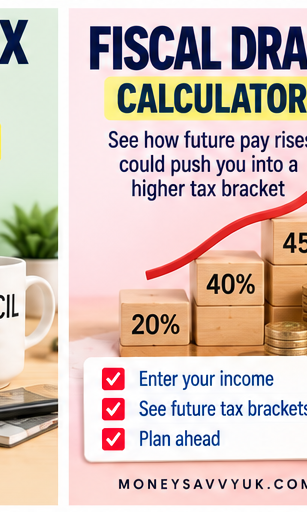
Estimate what happens to your pay rise after Income Tax and employee National Insurance — and see when frozen thresholds pull some of the increase into a higher tax band.
Your estimated pay-rise impact
This tool estimates the extra Income Tax and employee National Insurance caused by a salary increase. It also flags when the rise crosses key frozen thresholds. That helps illustrate fiscal drag, but it does not claim that every pound of tax on your raise was caused by threshold freezes. Measuring the full fiscal-drag effect requires a comparison with an alternative set of inflation-linked thresholds.
Figures checked: 5 October 2026 • 2026/27 tax year
Frozen tax thresholds: why your pay rise may feel smaller
Checked 1 November 2026. If you have had a pay rise but still feel squeezed at the supermarket checkout, your payslip can help explain why. The standard Personal Allowance remains £12,570 and the higher-rate threshold remains £50,270 for employment income in England, Wales and Northern Ireland. The threshold freeze runs to 5 April 2031. When your salary rises while these limits stay still, more of your earnings can fall into a higher tax band.
Does the £5,000 tax-hit headline mean everyone pays £5,000 more?
No. GB News, in an article by Temie Laleye carried on MSN, reports modelling attributed to Tax Adviser magazine. It compares a future income-tax bill under frozen thresholds with a hypothetical bill under inflation-linked thresholds, assuming annual wage growth of 4%. That is a scenario, not a flat £5,000 charge or a prediction of your own bill. Its reported examples exclude National Insurance and Scottish employment-income tax. The original modelling has not been independently reproduced here.
A £2,000 pay rise: how much could you actually keep?
Take someone earning £50,000 who receives a 4% rise to £52,000. Using the standard allowance and current England, Wales and Northern Ireland employment-income bands, the first £270 of that rise attracts 20% Income Tax; the remaining £1,730 attracts 40%. Extra Income Tax is £746. With standard employee National Insurance of 8% below £50,270 and 2% above it, extra NI is approximately £56.20.
That leaves approximately £1,197.80 a year, or £99.82 a month, from the £2,000 gross rise. This is a simplified annual calculation before pension contributions, student loans, benefits or other adjustments. It shows the deductions on a pay rise; it does not measure the whole cost of the threshold freeze against an inflation-linked alternative. Your entire salary does not suddenly become taxable at 40%.
What to check before spending the extra pay
- Enter your salary and proposed rise in the calculator above, then compare the estimate with your first new payslip.
- Base new monthly commitments on the amount arriving in your account.
- Include student loan and pension deductions when checking what is available for household bills.
- If considering extra pension contributions, check access restrictions, allowances and your need for accessible savings before committing money.
Sources: HMRC Income Tax rates and allowances; HMRC threshold-freeze policy; Budget 2026 rates and allowances. Read the GB News report on MSN for the reported long-term scenarios. General information, not personalised financial advice.
What is fiscal drag?
Fiscal drag happens when tax thresholds do not rise as quickly as wages and prices. Even if tax rates stay unchanged, nominal pay growth can move more of someone’s income above a tax-free allowance or into a higher tax band. The result is that the tax system collects a larger share of income over time.
What are the main 2026/27 thresholds?
For England, Wales and Northern Ireland, the standard Personal Allowance is £12,570. With the standard allowance, the 20% basic-rate band takes total income to £50,270, after which the 40% higher rate normally applies. The standard Personal Allowance starts to reduce once adjusted net income exceeds £100,000 and reaches zero at £125,140. The 45% additional rate applies above the relevant threshold.
What about National Insurance?
For a standard employee in 2026/27, Class 1 employee National Insurance is generally 8% on earnings between the Primary Threshold and Upper Earnings Limit and 2% above the Upper Earnings Limit. This calculator combines a simplified annual employee NI estimate with Income Tax to show how much of the pay rise may remain.
Example: £45,000 salary with a 5% pay rise
A 5% rise on £45,000 adds £2,250, taking gross salary to £47,250. In this simplified annual model, the extra earnings remain below the £50,270 higher-rate threshold, so they are generally subject to 20% Income Tax and 8% employee NI. That leaves an estimated £1,620 of the £2,250 increase, or about £135 a month, before any other deductions.
What happens if a pay rise crosses £50,270?
Only the portion that moves into the higher-rate band is taxed at 40%; your whole salary does not suddenly become subject to 40% Income Tax. Employee NI also changes above the Upper Earnings Limit, where the standard employee rate is generally 2% rather than 8%.
What happens above £100,000?
The Personal Allowance taper creates an additional effect. For every £2 of adjusted net income above £100,000, £1 of the standard Personal Allowance is lost until it reaches zero at £125,140. Salary alone is not always the same as adjusted net income, so use the separate MoneySavvyUK 60% Tax Trap Calculator for a more focused explanation of this rule.
Does this calculator cover Scotland?
No. Scottish taxpayers have different Income Tax bands and rates for employment income. The calculator is deliberately limited to England, Wales and Northern Ireland rather than labelling one set of bands as universal across the UK.
Related MoneySavvyUK calculators
Company Car Tax Calculator — estimate the BIK tax cost of a company car.
Important information
This is an educational estimate rather than a payslip calculator or personalised tax advice. PAYE operates by pay period and real deductions can differ because of tax codes, pension contributions, salary sacrifice, student loans, bonuses and other circumstances. Check your own tax code and HMRC information before making financial decisions.
Created by Dr Kalpana Govindaraasan at MoneySavvyUK. General information and planning estimates, not personal financial advice. Report a problem with this calculator.