

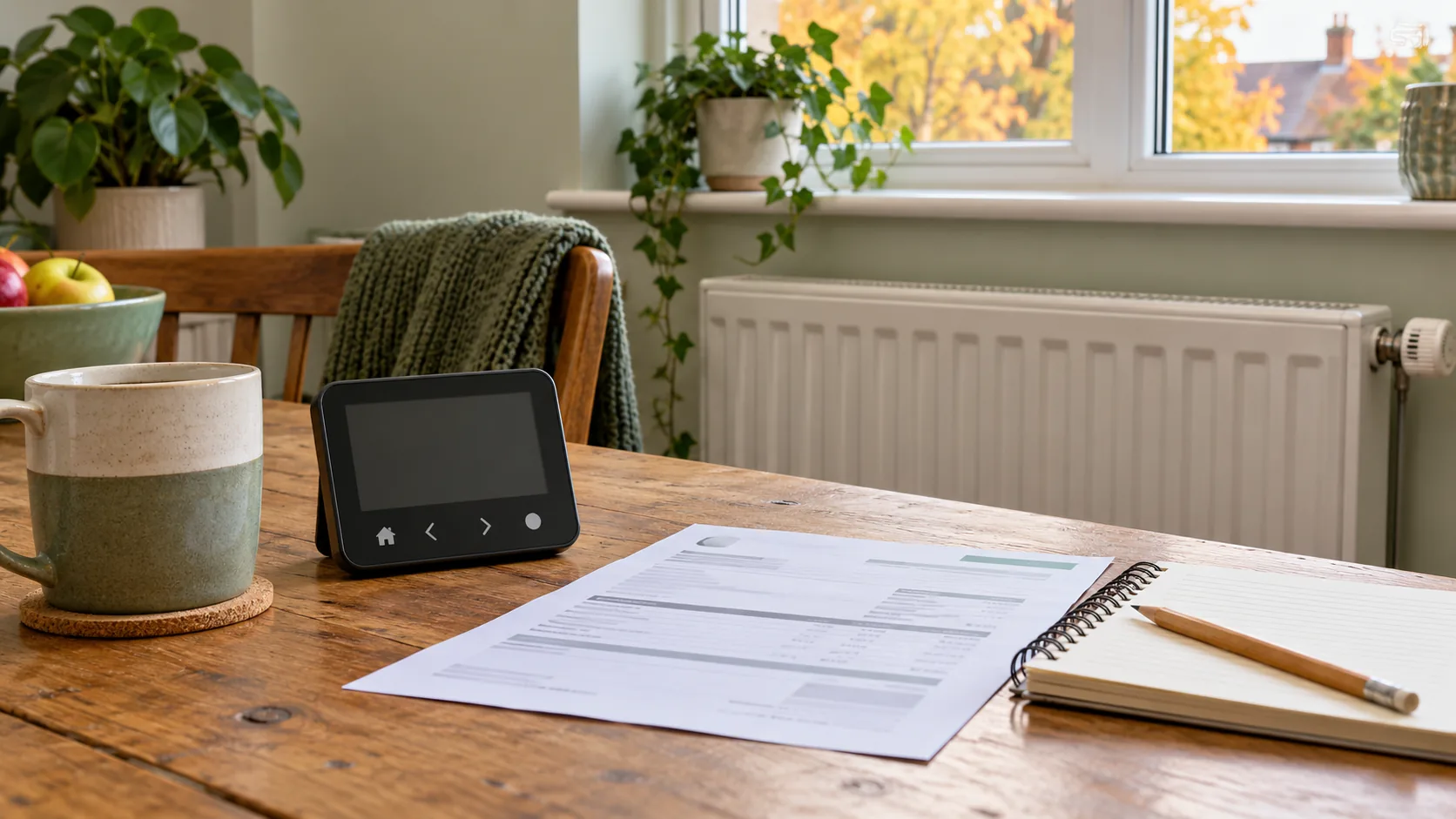
Featured image: original AI-generated illustration.
By Dr Kalpana Govindaraasan
Last updated: 20 October 2026 · Prepared during the 2026/27 tax year.
Is your energy direct debit too high, or has your supplier spotted a genuine gap between your payments and expected use? The answer needs more than a look at this month’s bank statement.
I check my paper statements each month and look for increases in regular payments, including energy. A change is a prompt to ask how the figure was calculated.
These eight checks help you prepare a useful conversation. They apply to domestic energy accounts in Great Britain; Northern Ireland has a separate market. The energy tariff calculator can compare tariff costs, but it cannot audit your supplier’s account balance.
Energy Direct Debit Too High? 8 Checks Before You Call
1. Identify which payment you have
Check whether you pay a fixed monthly amount, a variable Direct Debit based on bills, or through another arrangement. A fixed payment is intended to spread costs rather than copy that month’s consumption. A variable payment will behave differently, so establish which system you are reviewing.
Open the latest statement and the message announcing the change. Record the old payment, new payment, effective date and explanation. Check whether the change affects gas, electricity or a combined account. Save the message so you can refer to the same figures when speaking to the supplier.
Separate a tariff price change from a payment change. Your tariff sets the charges; the Direct Debit is a way of collecting money towards the account. A lower collection amount does not itself reduce the cost of the energy you use.
2. Update the readings first
Look at the readings used on the bill. Are they actual readings, customer readings, smart readings or estimates? Check dates as well as numbers. A corrected estimate can change the balance, so it makes sense to address an obvious reading problem before arguing about a forecast.
If safe and accessible, take the readings your supplier requests and photograph the meter display for your records. Follow the supplier’s instructions for your meter type. A gas meter reading is not necessarily expressed in the same units as the billed energy, so avoid treating a raw meter difference as a completed bill calculation.
If you have a smart meter, check whether the supplier is receiving readings. An in-home display showing information does not prove every bill is using up-to-date readings. Ask what dates the account system actually holds. Use the autumn energy checklist for the separate heating-timer and seasonal checks.
3. Inspect a full year of use
Find the annual consumption figures in kWh for each fuel, where available. Compare the supplier’s forecast with a representative recent year. A household that has changed size, moved, installed different heating or started working at home may need a different estimate.
Note those changes before calling. “One person moved out in June” gives the supplier something specific to consider. So does a period when the property was empty. Do not reduce the forecast merely because the most recent mild month used less energy than winter.
For a tariff comparison, enter annual kWh, the relevant unit rates and standing charges in the energy calculator. Check its assumptions and whether it supports your tariff structure. Multi-rate or specialist tariffs may need a more detailed calculation. Use it as a comparison aid rather than a guarantee of your future bill.
4. Separate energy costs from account debt
Ask how much of the proposed payment is for future use and how much is intended to clear an existing debit balance. A household can have reasonable current usage and still face a larger payment because earlier collections were insufficient.
For planning, write the components on separate lines: expected energy cost, any agreed debt repayment and any allowance for existing credit. Ask what period the supplier used for each component and when it plans to review the payment. This is more informative than comparing a single total with a neighbour’s bill.
Prepare an affordability budget if the proposed amount does not fit your income. The budgeting guide can help organise spending, but essential energy needs should not be forced into an arbitrary percentage. If you need wider support, start with free money help.
5. Review credit in its seasonal context
A credit balance is not automatically an overcharge. Ofgem explains that fixed payments can build credit during lower-use months to help cover winter. Check when the account was last billed and whether recent consumption has already been deducted before deciding the balance is spare money.
You can contact your supplier about a refund. Ask it to explain how a refund would affect future payments and expected winter costs. If it proposes keeping credit, request the reasoning and calculations. The useful question is whether the retained balance is justified by your circumstances.
Keep a note of the answer and any promised review. If a refund arrives, update your records so you do not also treat that money as still available on the energy account. The Emergency Fund Calculator can help with the separate question of accessible household savings.
6. Use a focused supplier script
Have your account number ready, but keep it private when sharing examples online. You can adapt this wording:
“Please review my proposed Direct Debit using my latest readings. Can you show the annual kWh forecast, tariff rates, standing charges, current billed balance and any debt repayment included? Please explain the period used to recover any shortfall and how my existing credit affects the calculation. My household circumstances have changed as follows: [describe the change]. Please confirm the result and next review date in writing.”
If the proposed payment is unaffordable, say that clearly and ask what support and payment arrangements are available. A conversation about accuracy and a conversation about affordability may require different actions. Keep the case number, date and agreed next step.
For other recurring payments, use the subscription audit guide and Subscription Cost Calculator. Treat energy separately because cancelling a collection does not cancel the charges you owe.
7. Check the tariff without guessing the cap
The energy price cap limits relevant charges on covered tariffs; it is not a maximum household bill. Your use still matters. Ofgem’s price-cap explanation is the starting source for understanding what is covered.
When comparing offers, use your own consumption and check the whole tariff: unit rates, standing charges, term, exit fees where applicable and any special conditions. Compare like with like rather than assuming a lower monthly quotation means a cheaper tariff.
Our price-cap forecast guide separates future estimates from confirmed information. A forecast is not a reason to treat an unknown future bill as fixed. For practical changes you can control now, choose suitable ideas from ways to save energy at home.
8. Record the outcome and escalate properly
After the review, check the next statement and bank collection against what was agreed. Save the written explanation and make a diary note for the review date. A promised change is not complete until the account reflects it.
If you still dispute the calculation, use the supplier’s formal complaints process and keep a clear timeline. Ofgem directs unresolved consumer issues towards the Energy Ombudsman; check the Ombudsman’s current process and eligibility before submitting a dispute. Ofgem is the regulator, rather than the handler of individual billing complaints.
Do not simply cancel a payment to force a response. Contact the supplier about the disputed amount and your ability to pay. Keep providing relevant readings and evidence. If bills are becoming unmanageable, seek support promptly rather than waiting for the next payment review.
What I’d do first
I’d update the readings, check the billed balance and ask for the forecast and any debt repayment to be shown separately. Then I’d request a written payment review. Those steps give the conversation evidence rather than a guessed monthly target.
Frequently asked questions
Does being in credit mean my payment is wrong?
Not necessarily. Fixed monthly payments can build credit in summer for higher winter use. Check whether the balance includes all recent consumption and ask how it fits the supplier’s forecast. A large unexplained balance deserves a review, but the season and household circumstances matter.
Can the price-cap headline tell me my Direct Debit?
No. A typical-household headline is not your personal payment limit. Your usage, rates, standing charges, account balance and any repayment arrangement all affect the collection. Use current tariff information and your own kWh figures, then ask the supplier to explain the account calculation.
Should I cancel my Direct Debit while disputing it?
Contact the supplier first rather than assuming cancellation solves the dispute. Charges can continue and payment-method terms may differ. Ask for an explanation, an affordability discussion where needed and a written outcome. Keep the billing issue and the payment arrangement clearly documented.
What if the supplier does not solve the problem?
Make a formal complaint and retain statements, readings and correspondence. Check the Energy Ombudsman’s current escalation conditions and whether your supplier participates. If paying for essential energy is difficult, ask for support at the same time rather than waiting for the complaint to finish.
energy direct debit too high: summary
- Check readings and annual usage.
- Separate future costs, credit and debt.
- Ask for the calculation in writing.
- Verify the next collection and review date.
Did your supplier explain the forecast clearly when your payment changed?
Sources and further checks
- Ofgem: how energy bills and credit balances work
- Ofgem: price cap and standing charges
- Ofgem: Direct Debit compliance review
- Energy Ombudsman: raise a dispute
- UK Parliament: challenging Direct Debit calculations
Sources checked on 20 October 2026. Follow the linked official pages for current rules and charges.
I’m not a financial adviser; this is general information. Read the financial disclaimer.