

Updated 15 October 2026. Prices and operating rules checked against the official sources linked in this guide. Recheck your airport before travelling.
Airport drop-off charges are one of those little travel costs that can catch you before your holiday has even started. You follow the signs, unload a suitcase and head home. Then you discover there was a fee to pay online—or a letter arrives because you missed it.
The good news? Many UK airports have an official free option. The important part is choosing the right entrance, allowing enough transfer time and knowing whether you need to pay afterwards.
I have used a free shuttle when dropping my husband at Heathrow, and I have also learnt that paying for airport parking does not protect you from a separate bus-lane fine. Here is what I would check before another airport run.
Airport drop-off charges UK: the three things to check first
A free drop-off area, a paid terminal forecourt and a short-stay car park can be close together but have completely different rules. A postcode may bring you to the airport without putting you in the correct lane.
There is nothing wrong with paying for a closer drop-off when it makes a journey easier. The aim is to choose the cost knowingly, rather than pay extra because the signs or payment arrangements caught you out.
My airport lessons: the free shuttle and the wrong turn
When I dropped my husband at Heathrow in May 2026, car park works meant we were diverted to Park & Ride. We used the free shuttle bus from there to the terminal for his drop-off. It reminded me to check the alternatives instead of assuming I had to drive to the terminal doors.
For your journey today, use Heathrow’s published current allowance: the standard Park & Ride tariff has 0–29 minutes free. The arrangement we encountered during the May works should not be used as today’s parking entitlement. Check Heathrow’s current Park & Ride rules.
That is the distinction I want this guide to make clear: avoiding a drop-off fee, paying for parking and avoiding a traffic penalty are three different tasks. You can get one right and still be caught by another.
UK airport drop-off charges: a quick price comparison
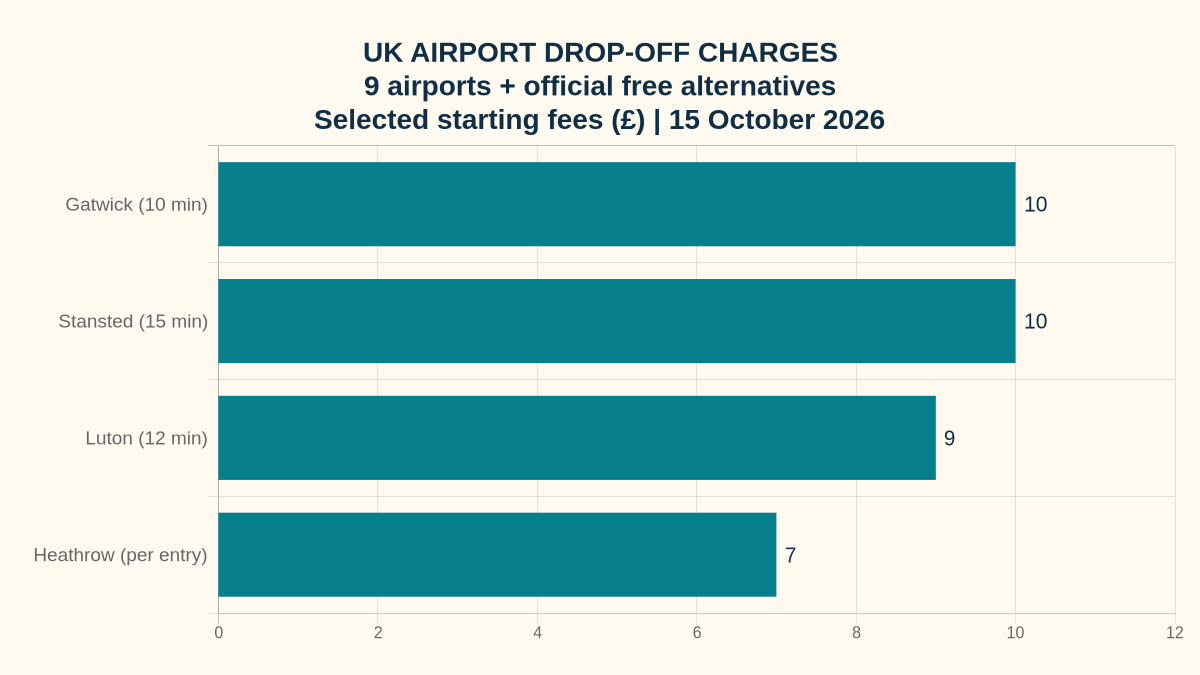
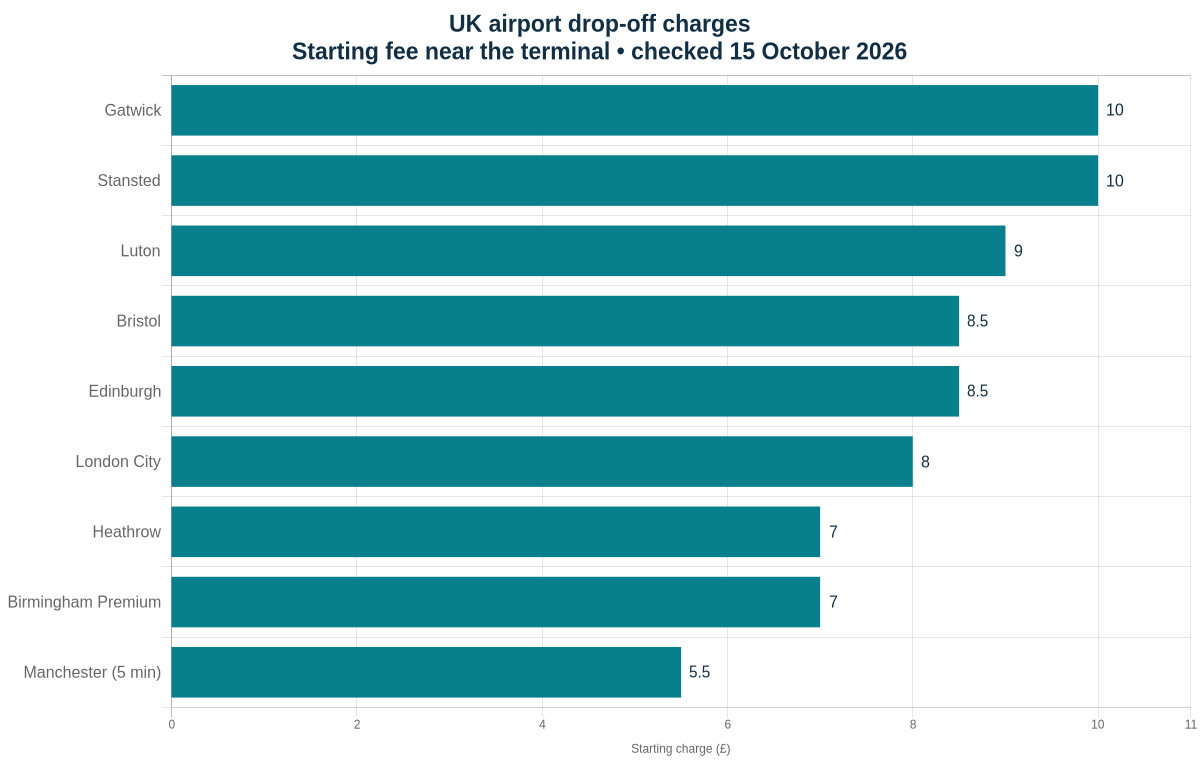
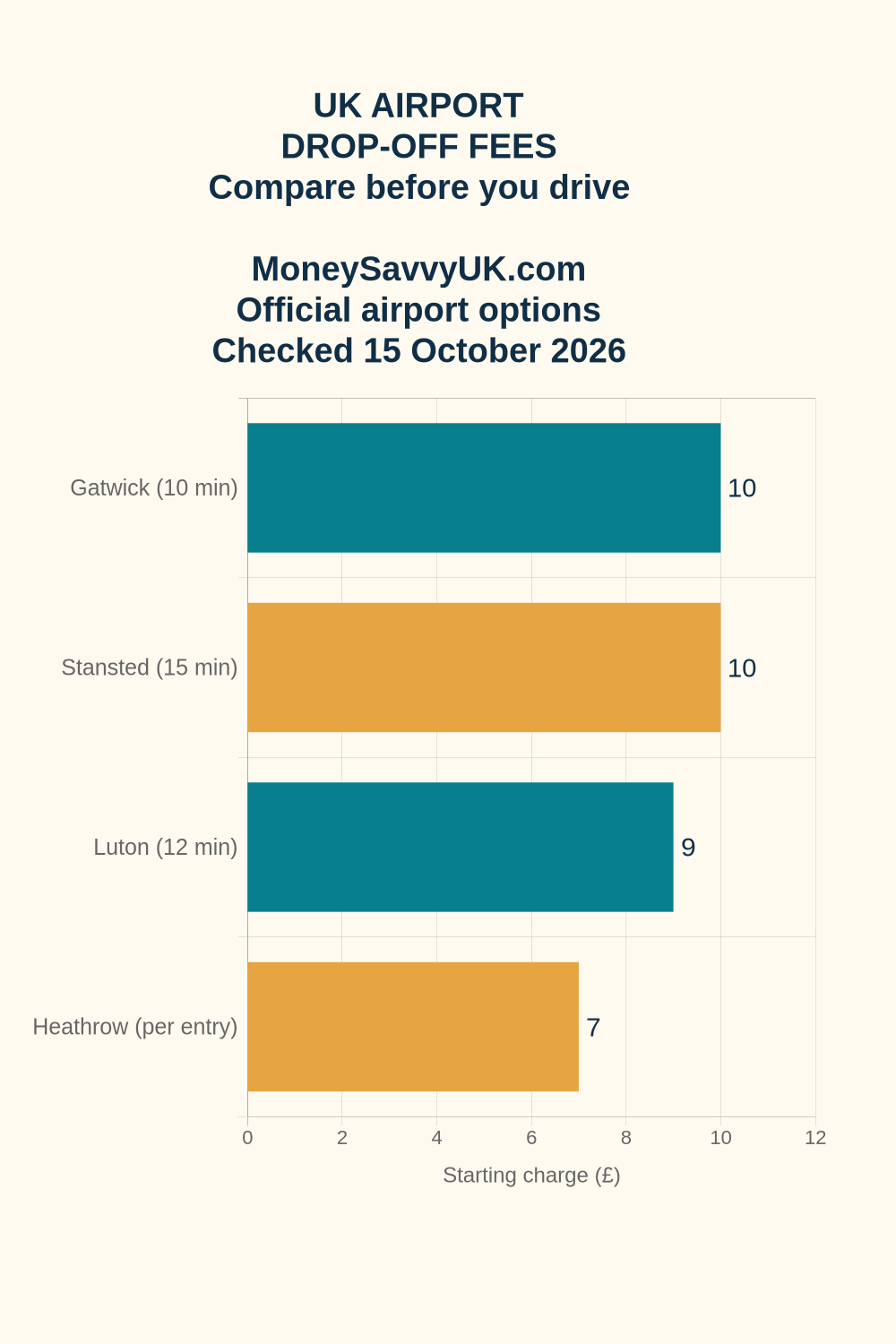
These are selected paid drop-off products, not hourly parking rates. I have kept the free options and payment deadlines in separate tables so you can find the detail you need without squeezing everything into one wide table.
| Airport / paid product | Starting charge | Included stay |
|---|---|---|
| Heathrow forecourt | £7 | Per entry |
| Gatwick forecourt | £10 | 10 minutes |
| Stansted Express Set Down | £10 | Up to 15 minutes |
| Luton Drop Off & Pick Up | £9 | 12 minutes |
| Manchester terminal drop-off | £5.50 / £6.50 | 5 / 10 minutes |
| Edinburgh charged zone | £8.50 | Up to 10 minutes |
| Bristol Drop Off & Pick Up | From £8.50 | 10 minutes |
| Birmingham Premium Set Down | £7 | First 15 minutes |
| London City forecourt | £8 | First 5 minutes |
For example, London City’s £8 starting charge covers only five minutes. Gatwick’s £10 covers ten. Comparing only the headline price misses how quickly a longer goodbye can move you into another charge band.
I would not turn these into a claimed “price per minute” without that explanation: they are minimum charges for a visit, not a meter that necessarily bills each minute at an equal rate.
Check the maximum stay as well as the starting price. Heathrow’s published 2026 decision introduced a ten-minute forecourt maximum. London City also publishes a ten-minute maximum; Gatwick, Luton and Manchester’s named paid drop-off zones publish 30-minute limits. Stansted’s Express Set Down terms also specify a 30-minute maximum. Paying the starting fee does not buy unlimited waiting time. Follow current signs, and use suitable parking if you need longer.
Where can you drop someone off for free?
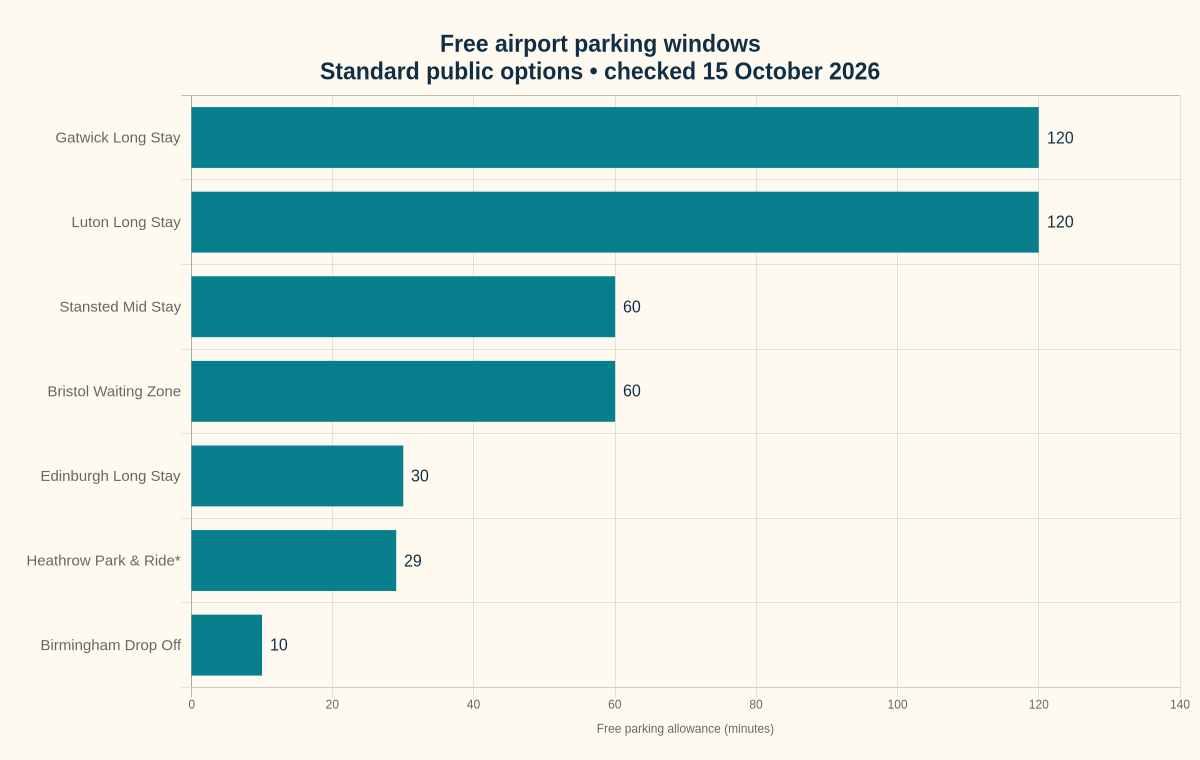
| Airport | Official free option | Free parking window |
|---|---|---|
| Heathrow | Park & Ride | Standard: 0–29 min* |
| Gatwick | Long Stay | Up to 2 hours |
| Stansted | Mid Stay | Up to 60 min |
| Luton | Long Stay | Up to 2 hours |
| Manchester | JetParks 1 drop-off | Max 60 min for general users |
| Edinburgh | Long Stay | 30 min |
| Bristol | Waiting Zone | Up to 1 hour |
| Birmingham | Separate Drop Off car park | Up to 10 min |
| London City | No general free car option verified | Check transport / concessions |
*Heathrow’s travel FAQs describe a separate two-hour free arrangement in Terminal 4 Park & Ride Zone A. Do not apply that to Terminals 2, 3 or 5, or assume it covers every zone.
9 airport-by-airport plans for a less stressful drop-off
1. Heathrow: let the passenger take the shuttle
For a quick free goodbye, choose the official Park & Ride for the passenger’s terminal, unload in a permitted space and let the passenger continue by shuttle while the driver leaves within the standard free window.
Heathrow lists buses every 15 minutes, with transfers to Terminals 2 and 3 taking 10–20 minutes. Waiting comes on top. A driver cannot sensibly plan two bus journeys and a visit to check-in within 29 minutes.
If you want to walk in together, compare paid parking designed for a longer stay. For Terminals 2 and 3, the official Park & Ride address uses TW6 2SB; still follow the final signs for the correct facility. Heathrow parking and transfer details.
2. Gatwick: use the correct terminal’s Long Stay
Gatwick’s Long Stay alternative gives you up to two hours free with a shuttle. Check whether your passenger needs North or South Terminal, then send the driver the correct Long Stay location before setting off.
Two hours gives more room for a goodbye, but it is still an exit deadline. Allow for waiting, travelling back and finding the car. If you use the paid forecourt instead, its £10 starting charge rises after the first ten minutes. Do not leave payment until you have forgotten which car was used.
3. Stansted: follow the Mid Stay free option
Look for the official Mid Stay free drop-off option rather than Express Set Down. The airport’s parking FAQs confirm up to 60 minutes free, with a shuttle available to reach the terminal.
The paid Express Set Down tariff is £10 for up to 15 minutes and £28 for longer stays. Decide before the approach road which product you want. If you need to accompany someone inside, leave a comfortable margin for the return shuttle and exit; an hour is not an hour inside the terminal.
4. Luton: build in the bus wait
Use the Long Stay car park for up to two hours free, rather than the paid Drop Off and Pick Up Zone. The airport lists a shuttle about every 20 minutes, taking roughly ten minutes to the terminal, operating 24 hours a day.
The useful planning question is not just “How long is the bus ride?” It is “What if we arrive just after one leaves?” Add waiting and unloading to the plan. The paid zone is £9 for 12 minutes and has a 30-minute maximum stay. Its payment deadline is separate from Long Stay’s free parking allowance.
5. Manchester: the free shuttle is one-way
Manchester’s free drop-off facility is in JetParks 1. The airport lists a 24/7 shuttle taking around six minutes to the terminal. It is one-way to the terminal. The driver should stay with the vehicle rather than board expecting a ride back.
This is a drop-off facility, not a free pick-up car park. Its terms give general users a maximum 60-minute stay. No-recirculation policy: you must not re-enter the free drop-off facility within 30 minutes of leaving; the published recirculation fee is £25. A separate £25 overstay charge applies after 60 minutes. If helping at check-in matters, choose suitable paid parking instead.
6. Edinburgh: allow for the walk
Edinburgh’s free option is Long Stay, with 30 minutes free. There is no shuttle bus. The airport asks passengers to allow about a ten-minute walk to the terminal.
A driver walking there and back has already used much of that allowance before spending any time inside. With children, heavy bags or difficult weather, the £8.50 paid starting option may be the more comfortable choice. Make that decision at home rather than while everyone is unloading.
7. Bristol: check the temporary Waiting Zone map
The Waiting Zone gives up to one hour free, with access to the Car Rental Centre bus serving the Transport Interchange. From there, follow the pedestrian route towards the terminal. Its no-return rule is 30 minutes.
Travel update: the airport says the Waiting Zone moves temporarily from 19 October to 18 December 2026 during refurbishment. The Car Rental Centre bus continues. Save the current official map, not an older screenshot. After the free hour, the published Waiting Zone tariff is £20 for one-to-two hours, then £20 for each additional hour or part. The free window is worth watching.
8. Birmingham: choose Drop Off, not Premium Set Down
Birmingham has a separate Drop Off car park with up to ten minutes free. The terminal is about five-to-ten minutes away on foot via a covered walkway; the airport also describes a free bus service.
That short allowance suits unloading and leaving. It does not give the driver ten minutes inside departures. Premium Set Down is the closer paid product, starting at £7 for 15 minutes. The separate free Drop Off facility has a one-hour no-return rule; check its current tariff before entering.
9. London City: compare the DLR instead
I have not verified a general free official car drop-off alternative at London City. The forecourt tariff starts at £8 for five minutes, then £1 per minute, with a maximum stay of ten minutes.
The London City Airport DLR station is connected to the airport. Compare the full fare and journey with a car trip, especially if the passenger is comfortable taking the final leg by public transport. Do not assume an unrelated retail car park or residential road is a permitted free alternative.
How and when do you pay airport drop-off charges?
This is the table I would save before travelling. “Midnight tomorrow” and “within 24 hours” are not the same deadline. Nor does every airport let you drive away and pay later.
| Paid zone | Payment deadline / method |
|---|---|
| Heathrow | By midnight the following day; online / phone / valid AutoPay |
| Gatwick | By midnight the following day; online / phone / valid AutoPay |
| Stansted Express Set Down | By midnight the following day; online / phone / valid AutoPay |
| Luton paid zone | By midnight the following day; follow official payment instructions |
| Manchester terminal drop-off | By midnight the following day; official online payment / valid AutoPay |
| Bristol Drop Off & Pick Up | Pay at exit; cashless |
| Edinburgh charged zone | Card / digital wallet at exit barrier; pay stations also described |
| Birmingham Premium Set Down / Drop Off | Pay onsite, valid pre-set AutoPay, or Post Pay within 24 hours of exit |
| London City | By midnight the following day; official payment options |
A simple example: if you leave a Birmingham chargeable car park at 10am on Monday, “within 24 hours” means by 10am on Tuesday. Waiting until Tuesday night could be too late. For a zone with a midnight-the-following-day deadline, a Monday visit is due by Tuesday midnight. This example assumes the standard rules above and no separate notice.
My five-minute payment check
- Start on the airport’s own website. Follow its payment link instead of choosing an advert or unfamiliar payment service.
- Check the registration and visit date. Be especially careful with a hire car or a borrowed vehicle.
- Check the product. Paying for a nearby car park does not necessarily settle a forecourt entry.
- Keep the confirmation. Save the receipt, date, time and registration. A bank transaction alone may not identify the correct visit.
- Set a reminder while parked safely. Do not try to make the payment while driving.
AutoPay is useful when it is already correctly set up. Do not assume registering after a visit clears that earlier charge. Birmingham’s payment FAQs explicitly say an account set up after entry will not cover that stay; use Post Pay for it. Check any separate earlier visit yourself.
I drove through the drop-off zone by mistake. Do I still need to pay?
Do not assume “I did not stop” means no charge. Heathrow’s terms make its charge payable on each entry to a terminal drop-off zone, unless an exemption applies. The cameras can record entry even when nobody gets out.
A mistaken entry and an unpaid charge are separate issues. If you have just taken the wrong turn, keep driving safely, follow the exit signs and make a note of the location and time once you are parked. Check that airport’s exact terms and contact the operator promptly if you are unsure whether the entry was chargeable.
Do not reverse, make an unsafe turn or stop in a restricted lane to avoid a camera. If the published terms require payment, do not let the payment deadline pass because you assume a mistake automatically cancels the fee. If you want to dispute it, ask the operator about the correct route and the effect payment would have on that dispute.
Re-entering can also create another charge or break a no-return rule. A quick loop around the airport is not always a cost-free way to try again.
Forgot to pay Heathrow? Check this time-sensitive option
This is not a new seven-day payment deadline, and it is not a promise that a normal late online payment will resolve the case. The usual deadline remains midnight the following day. Follow the operator’s specific process promptly and keep its written response. Do not assume another airport offers the same arrangement.
If more than seven days have passed or a notice has arrived, read the notice and the operator’s current guidance. Do not pay only the original £7 and assume an issued Parking Charge has disappeared.
Blue Badge drop-off exemptions: check before travelling
Please do not put yourself through an unsuitable shuttle journey just to save a fee. Some airports offer a closer free or discounted option for eligible passengers, but the registration rules matter as much as the badge.
- Heathrow: its terminal concession requires the Blue Badge process. The official page asks for account applications at least seven days before a visit; check how to register each concession trip as well. Telephone applications have a longer lead time.
- Gatwick: the airport’s FAQs describe advance registration for an eligible 30-minute session, from three months before travel up to the day before. Keep the approval email.
- Birmingham: current FAQs describe 30 minutes free in Premium Set Down, validated at the NCP Customer Service Cabin with the badge and registration when ready to leave.
- Stansted: its Express Set Down guidance says Blue Badge holders still need to pay; do not assume another airport’s exemption applies.
Check the current instructions for the actual airport, vehicle and passenger. Displaying a badge in the windscreen alone may not register an exemption with an ANPR system. Airport passenger assistance and parking-concession registration are separate arrangements.
Received an airport PCN? Start with the issuer, not a template
A letter headed “PCN” can describe different things. A private Parking Charge Notice is not the same as a council Penalty Charge Notice for a bus lane. The appeal route, deadlines and legal rules can differ. Identify the issuer and exact notice type before deciding what to do.
| What arrived? | Where to start |
|---|---|
| Private Parking Charge Notice | Follow the operator’s challenge instructions. If rejected, check the named independent service, such as POPLA or IAS. |
| Council bus-lane / moving-traffic Penalty Charge Notice | Make representations to the authority first, following the notice. A tribunal appeal comes after a rejection. |
| Byelaw, railway, police or another statutory notice | Use the process on that notice. Do not substitute a private-parking appeal template. |
1. Write down both deadlines
Record the challenge deadline and any discounted-payment deadline separately. Read what the issuer says happens to the discount if you challenge. Do not assume an appeal freezes it. There is no universal rule that every airport notice gives the same number of days or the same reduction.
For perspective, Heathrow publishes an £80 Parking Charge reduced to £40 within 14 days; Stansted publishes £100 reduced to £60 within 14 days. Those examples are not the rules for every bus-lane penalty. Use the dates and instructions on your own notice.
2. Save evidence that relates to the allegation
- The notice, envelope and date it arrived.
- Payment receipts, confirmation emails and the registration entered.
- The operator’s photographs, timestamps or video, where available.
- Dashcam footage and a short factual timeline while you remember it.
- Relevant signage or roadworks evidence, collected safely—not by stopping on a restricted road.
- Any applicable exemption confirmation or breakdown evidence.
Match the evidence to the alleged problem. A parking receipt may help with an allegation of unpaid parking. It does not, by itself, disprove driving through a restricted bus lane. Citizens Advice explains evidence for parking challenges.
3. Explain the facts to the issuer
Use the challenge method on the notice and keep proof of submission. Say what you dispute, when it happened and which evidence supports it. Avoid copying a long legal template that does not match your location or notice.
Keep the explanation factual, and check that any receipt matches the registration and visit date. If the issue is a genuine payment error, describe that accurately and ask the operator to consider the evidence and any discretion available. No outcome is guaranteed.
4. Use the correct next stage if rejected
For private parking, GOV.UK distinguishes POPLA for relevant BPA operators from IAS for IPC operators. POPLA’s own FAQs explain which notices it can consider. Use the service and deadline given with your rejection, not whichever appeal site appears first in a search.
For POPLA, its current FAQs give 28 days from the operator’s rejection to submit your appeal, using the ten-digit verification code. Submit the evidence you want considered with the appeal. POPLA says enforcement is put on hold while it considers an appeal, but the discounted rate does not have to be preserved. A hold on enforcement and a hold on the discount are different things.
For council penalties in England and Wales, GOV.UK’s tribunal guide says you must first make formal representations. If rejected, the Notice of Rejection explains the next appeal; London Tribunals and the Traffic Penalty Tribunal cover different areas. Scotland and Northern Ireland have different processes. Airport byelaws can add further differences, so seek suitable advice if you cannot identify the route.
Two appeal myths I would not rely on
“You are allowed 20 metres in a bus lane.” There is no universal legal allowance of that kind. Kent County Council’s enforcement guide explicitly says there is no 20-metre rule. A short accidental entry is something to explain with evidence, not an automatic cancellation entitlement.
“Every car park gives you five or ten minutes to leave free.” Do not treat that as permission to enter a charged airport zone or stop on a prohibited road. The rules depend on the site, activity and legal scheme. Check the actual terms rather than importing a rule from a supermarket car park.
If you are weighing payment against an appeal, check the consequences first. Payment normally settles a notice and can close the ordinary challenge route. If the amount or process is unclear, use Citizens Advice or the relevant local advice service before the stated deadline. Do not ignore court papers or enforcement correspondence.
What is happening with the government airport drop-off review?
The Department for Transport’s airport drop-off review is the news behind this guide. The RAC’s 14 October 2026 response confirms the government review announcement and reports that its latest analysis found fee increases at 16 of the 20 busiest UK airports, with the average rising by a third to £7.
In the RAC’s July 2026 comparison of the 20 busiest UK airports, London Gatwick and London Stansted had the highest starting drop-off charges: £10, covering ten minutes at Gatwick and fifteen at Stansted. Their free Long Stay and Mid Stay alternatives are worth checking before you choose the terminal forecourt.
For drivers, the practical point is straightforward: a review does not remove today’s charges. There is no general permission to stop paying while it takes place. I will use confirmed changes to airport rules rather than treat an investigation as a promised ban or refund.
My airport-run checklist: what I would do next time
- Choose the exact product. Free drop-off, terminal forecourt or parking that lets me go inside?
- Open the official map. Check terminal, car park name, final approach and any roadworks notice.
- Agree who stays with the car. Check a shuttle’s return route before boarding it.
- Allow time for the whole transfer. Walking, unloading, waiting and returning all count.
- Check the payment deadline. Save the official page, then pay and keep the receipt.
- Check the return journey separately. A free drop-off is not automatically a free collection.
The fee is only one part of the decision. Add the driver’s return mileage and fuel when comparing a lift with public transport. My fuel cost calculator can help you estimate the driving cost. If walking or a bus change makes the journey difficult, budget for the closer option without feeling bad about it.
For the rest of the trip, check baggage and check-in fees before booking. You can also compare cashback sites for eligible travel purchases, but compare the final price first and never rely on a cashback payment arriving.
If a holiday is stretching the household budget, start with my budget calculator and flexible budgeting guide. Keeping an emergency buffer separate is more useful than finding a small travel saving and then needing it for an essential bill.
Airport drop-off charges FAQs
Can I avoid airport drop-off charges legally?
Yes, many UK airports provide an official free alternative with a parking limit and a shuttle or walking route. Choose the correct facility and follow its conditions. London City is an exception in this guide: I have not verified a general free official car drop-off alternative there.
Do I have to pay if I drove through the drop-off area without stopping?
Do not assume a drive-through is exempt. Heathrow’s terms charge each entry unless an exemption applies. Check the rules for the exact airport and zone, note your visit time and contact the operator promptly if unclear. A mistaken turn does not automatically cancel a charge.
What should I do if I forgot to pay Heathrow’s drop-off charge?
Check APCOA’s current late-payment help immediately. Its published process asks you to contact the team within seven days with your registration and visit date. This is not a seven-day extension to the usual deadline, and it does not apply automatically at other airports. Follow the operator’s instructions.
Does paying for airport parking cover a bus-lane fine?
No. Paying for parking covers that parking product; it does not authorise driving in a restricted bus lane or settle a separate traffic penalty. Read the allegation and issuer on any notice. Keep the parking receipt, but match your challenge evidence to the restriction you are accused of breaching.
Can the driver use the free shuttle to go into departures?
Check the return service and parking allowance first. Manchester’s JetParks 1 free drop-off shuttle is one-way to the terminal. At other airports, waiting and two journeys can exceed the free parking time. Choose suitable longer-stay parking if you want to accompany a passenger to check-in.
Will appealing an airport PCN keep the discounted amount available?
Not necessarily. Check the notice and issuer’s policy before deciding. Challenge deadlines, discount periods and independent appeal routes vary. A council bus-lane Penalty Charge Notice and a private Parking Charge Notice follow different processes. Do not assume every appeal pauses a deadline or that payment leaves the ordinary appeal route open.
Airport drop-off charges: choose the right entrance, then check the deadline
The biggest saving is not always the free drop-off. Sometimes it is avoiding a wrong turn, leaving a car park before its free window ends, or remembering an online payment after an otherwise uneventful journey.
My first step would be to send the driver the exact official car park page. Then I would agree whether they are staying with the car and set a payment reminder if needed. Those small jobs are easier before a busy airport approach.
Have you used one of these free options, or been caught by an unexpected airport charge? Let me know which airport and when you travelled. Your experience can help other readers plan, while the official live rules remain the place to check before driving.
Sources, checks and author
Prices and operating details were checked on 15 October 2026 using official airport and operator pages. Appeal guidance links to GOV.UK, Citizens Advice, POPLA and a council enforcement guide; it is general route-finding help, not an assessment of an individual case. My personal experiences are identified separately and are not evidence of a current parking concession.
- Heathrow: drop-off charges and Blue Badge instructions
- Heathrow: Park & Ride tariff and transfers
- Heathrow: Terminal 4 and travel FAQs
- Heathrow: entry and payment terms
- APCOA Heathrow: late-payment help
- Gatwick: drop-off charges and Long Stay
- Gatwick: Blue Badge and parking FAQs
- Stansted: paid tariff notice
- Stansted: free Mid Stay allowance
- Stansted: payment and concession rules
- Luton: paid and free drop-off options
- Manchester: tariffs and one-way shuttle
- Manchester: free drop-off conditions
- Edinburgh: free Long Stay area
- Edinburgh: paid zone and payment methods
- Bristol: Waiting Zone tariff and temporary map
- Bristol: paid zone payment at exit
- Birmingham: free and paid options
- Birmingham: AutoPay and Post Pay
- Birmingham: Blue Badge and payment FAQs
- London City: drop-off rules
- TfL: London City Airport DLR station
- GOV.UK: challenging parking notices
- GOV.UK: penalty notice tribunal routes
- Citizens Advice: parking challenges and evidence
- POPLA: scope and appeal FAQs
- Kent County Council: bus-lane enforcement guide
- RAC: government review response, 14 October 2026
No affiliate links appear in this article. I am not a financial adviser or legal adviser. If a notice is unclear, seek suitable advice before its stated deadline. See the MoneySavvyUK disclaimer.