

Updated 12 October 2026. General information, not personal tax or career advice. Earnings calculations are illustrations, not advertised jobs or promised income.
Want to know how to make money on Audible as a narrator? UK beginners can explore audiobook production through ACX, but the paid work involves preparation, performance, editing and finished audio, rather than simply reading a book into a phone.
You do not have to sound like a radio presenter. You do need clear storytelling, a suitable recording space and enough time to deliver consistently. Here is how the opportunity works, how to compare payment offers and how to test your setup before spending money on equipment.
How to make money on Audible as a narrator: the UK route
Audible is where listeners buy or access audiobooks. ACX, the Audiobook Creation Exchange, connects rights holders with producers such as narrators and studios. An ACX opportunity is generally a production project, not a salaried job with Audible.
You create a profile, upload samples, audition for suitable projects and assess offers. Winning an audition is not the end: you must complete the agreed production, receive approval and meet the audio requirements. The responsibilities matter when comparing a fee with the hours you can realistically work.
For parents fitting work around school hours, recording conditions can be a bigger constraint than enthusiasm. A quiet afternoon can disappear when roadworks start outside. Try the recording process during the hours you actually have available before committing to a deadline.
If you prefer employment with set duties and pay, compare our Amazon work-from-home guide. Audiobook freelancing and remote employment involve different risks.
Can UK residents use ACX?
ACX’s account guidance currently includes residents of the UK, US, Canada and Ireland, with a qualifying mailing address, local tax identification and banking details. Check eligibility before preparing an entire portfolio.
Choose the narrator or studio producer role that matches your work. Complete required tax and payment information through the official platform, and use your own accurate details. Never pay a third party to unlock a supposedly guaranteed narrator account or contract.
There is no need to invent professional experience. Describe your actual accent, languages, performance background and production capabilities. If you are new, say so and let clear samples demonstrate what you can deliver.
Read the terms attached to each offer. They govern payment, rights, delivery and other obligations. Do not assume that every project uses the same contract simply because you found it on the same platform.
How do audiobook narrators get paid?
The main choice is whether you receive a production fee, a share of future royalties, or both. More attractive-looking percentages can hide a long wait and uncertain sales. A fixed fee still needs a sensible scope and a client who pays.
| Model | Payment structure | Main advantage | Main risk |
|---|---|---|---|
| Per finished hour / pay for production | Agreed fee multiplied by completed audiobook duration | A defined production fee | Underestimating work or payment problems |
| Royalty Share | Future royalties shared with the rights holder | Potential continuing income | No upfront production fee; low sales may mean little income |
| Royalty Share Plus | An upfront PFH component plus shared royalties | Some payment alongside future potential | The upfront amount may not cover your work |
1. Understand per finished hour before comparing rates
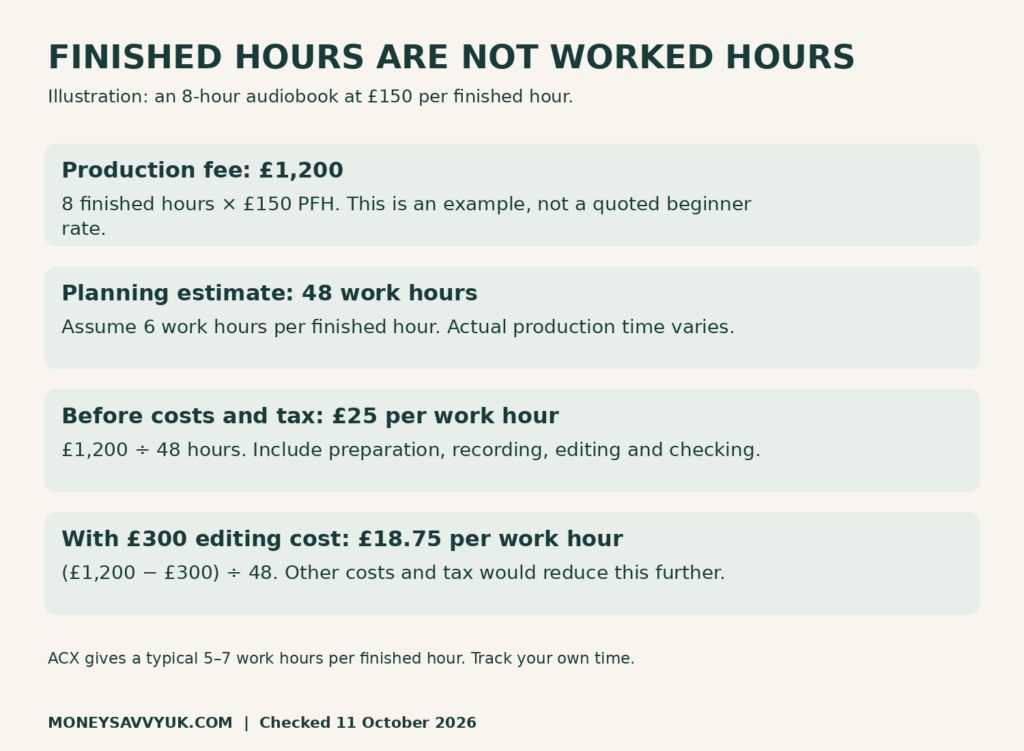
A finished hour means an hour of the completed audiobook. It is not an hour spent recording. If the book runs for eight hours and your agreed rate is £150 per finished hour, the production fee is £1,200.
That is a hypothetical calculation, not a market-rate recommendation. It also does not mean you can earn £150 for every hour you work. The same finished hour may require several hours of preparation, recording, editing and checking.
Ask what the fee includes: narration only, editing, mastering, corrections or complete production. A higher headline rate can be a worse offer if the extra duties and revision expectations are much larger.
2. Treat Royalty Share as a business risk
A royalty-only project asks you to invest work before you know the return. Consider the book’s existing audience, whether the rights holder controls the audiobook rights and their realistic promotion plan.
Reviews and a published book can help your assessment, but neither guarantees audiobook sales. Ask specific questions: who will promote it, what audience do they reach and what previous releases have they handled? Vague promises about going viral are not a payment plan.
Do not plan essential bills around royalties that have not arrived. Our emergency fund calculator can help you assess your buffer before choosing uncertain work.
3. Check the current royalty model, rather than copying old percentages
ACX’s July 2026 royalty guidance describes a new model with a 50% exclusive distribution rate, compared with 40% under the legacy model. For human-narrated Royalty Share, it describes an equal split: 25% each under the new model, or 20% each under the legacy model.
These are contractual royalty rates, not a promise to receive that percentage of the displayed retail price on every listen. Membership calculations depend on the applicable model. Check your title’s contract and statements.
ACX describes a seven-year producer royalty period for Royalty Share. Under pay-for-production, the rights holder pays the producer directly after approval; royalties come from Audible for royalty-based deals. Understand who owes you money before accepting.
How long does an audiobook take to produce?
ACX’s offer guidance says one finished hour typically corresponds to five to seven hours of actual work. This is a planning reference, not a promise about your personal speed. New narrators may take longer, particularly while learning editing.
At that ratio, an eight-hour audiobook represents around 40 to 56 production hours. You also need to allow for auditioning, messages, booking work and business administration. A complex nonfiction manuscript may require pronunciation research; fiction may require character preparation.
With ten available hours each week, a 48-hour project already represents nearly five weeks of working time before scheduling disruptions. Set a deadline from your real calendar, including school holidays and other commitments.
4. Calculate your effective hourly return
Use this planning formula: (production fee minus direct project costs) divided by total working hours. Include all production time, not only the time the microphone is recording.
| Illustrative eight-hour project | Total production fee | 48 hours of work, before costs and tax |
|---|---|---|
| £100 PFH | £800 | £16.67 an hour |
| £150 PFH | £1,200 | £25 an hour |
| £200 PFH | £1,600 | £33.33 an hour |
These figures show the maths, not typical beginner offers. At £150 PFH, paying £300 for editing would reduce the remaining £1,200 fee to £900. Spread over 48 hours, that is £18.75 an hour before other costs and tax.
Track your own time on a practice passage. You will learn more from that measurement than from someone else’s social-media income screenshot. If another home-based route fits better, explore transcription work or the broader make-money hub.
What equipment do you need?
Start by assessing the room. Listen for traffic, a refrigerator, computer fans, a boiler and reflections from bare walls. An expensive microphone can capture those problems in greater detail rather than solve them.
5. Test a quiet space before buying a microphone
Record the same short passage in two possible locations, using the equipment you already have for this initial comparison. Listen through headphones. Does the voice sound hollow or echoing? Can you hear background hum between sentences?
Soft furnishings may reduce reflections, but they do not provide full sound isolation. Choose a ventilated, safe space where you can work comfortably. Do not build an enclosed improvised booth that overheats or blocks your exit.
Repeat the test at your intended working time. You need conditions you can reproduce across chapters and on another day. A one-off quiet recording at midnight does not prove the space works during school hours.
6. Choose a workable recording setup
A practical setup includes a suitable microphone, a stable stand, a pop filter, headphones, recording software and a computer that can run it reliably. A USB microphone is simpler to connect; an XLR microphone normally requires an audio interface.
Microphone choice depends on your room, voice and recording method. There is no universal rule that every beginner must buy a condenser microphone. Compare recordings and return terms before spending, rather than buying solely from a “best microphone” list.
Audacity is one software option to explore; other workflows may suit you. Learning reliable recording and editing matters more than collecting tools. Keep copies of your original recordings and final exports in separate folders.
Set a setup budget. If equipment costs £250 and a project leaves £200 after its direct costs, you have not recovered the initial spend yet. Consider your household priorities using the budget calculator.
ACX audio requirements: a plain-English checklist
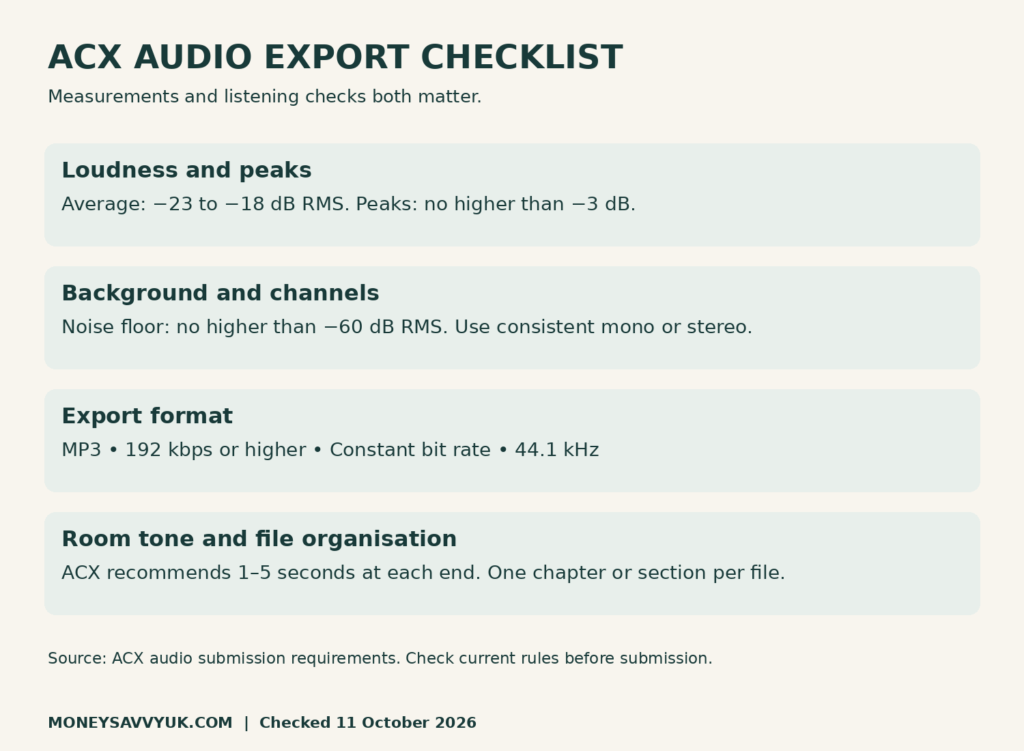
Check the current ACX submission requirements before exporting. Technical compliance and a good performance are separate: acceptable measurements do not fix distracting delivery.
| Check | Current requirement or guidance |
|---|---|
| Average loudness | −23 dB to −18 dB RMS |
| Peaks | No higher than −3 dB |
| Noise floor | No higher than −60 dB RMS |
| Export | MP3, 192 kbps or higher, constant bit rate, 44.1 kHz |
| Channels | Consistent mono or consistent stereo throughout |
| Room tone | ACX recommends 1–5 seconds at the beginning and end; spacing must not exceed 5 seconds |
| Organisation | One chapter or section per file; opening and closing credits separately |
| Duration | No file longer than 120 minutes |
| Retail sample | Five minutes or less, drawn from the audiobook |
Audio must also be consistent and free of distracting noises and outtakes. ACX prohibits unauthorised text-to-speech or automated narration. Its analysis tool can check a finished file before you submit the entire book.
7. Diagnose the recording before applying effects
If you hear a steady hum, identify its source. If you hear sharp bursts on “p” sounds, adjust microphone positioning and your pop filter. If the voice sounds distant, examine the room and microphone distance before amplifying everything.
Heavy noise reduction can leave unnatural sounds. A limiter can control peaks but cannot restore a badly distorted recording. Save a clean original, make changes on a working copy and listen to the whole result.
Test several paragraphs with different delivery levels. A whispered passage and an energetic line can expose problems a steady sentence misses. Aim for a repeatable process that supports the performance.
How to find and submit suitable auditions
8. Build samples that show your actual strengths
Prepare a small selection of contrasting samples using text you have permission to record and share. Demonstrate clear nonfiction explanation or a short fictional scene if those suit your voice. Label samples accurately.
Do not upload a full copyrighted chapter simply because you bought the book. For auditions, use the material supplied by the rights holder and follow their instructions. For a public portfolio, confirm the permission covers public sharing.
Your samples should represent the production standard you can deliver repeatedly. A heavily repaired sample that takes an entire weekend may be difficult to reproduce across an eight-hour book.
9. Choose books you can perform and finish
Read the brief for language, accent, tone, payment model and expected duration. Consider whether you can handle the content and vocabulary. A specialist title may require research you cannot fit into the quoted fee.
Follow the requested audition length rather than applying a universal two-minute rule. Prepare the passage, decide the emphasis and practise unfamiliar names. Record a clean performance, then listen as if you were choosing the narrator.
Keep the accompanying message brief and factual. State why the project suits your capabilities, any relevant scheduling information and a sensible question if something important is unclear. Do not promise delivery before you know the manuscript length and scope.
10. Read the offer before accepting
Confirm the complete manuscript, responsibilities, payment currency, production rate, deadlines and correction process. Ask how manuscript changes will be handled. A pronunciation correction and a rewritten chapter are different kinds of work.
Discuss the platform’s early approval stage so the rights holder can confirm the sound and performance before you record everything. Keep decisions in writing. Clarify who approves final files and how payment will be made.
Do not mark a production fee as received until it has actually arrived. Be cautious about overpayments followed by requests to return money, requests to buy equipment from a named unknown supplier, or links asking for bank-login credentials.
Is the ACX bounty programme extra narrator income?
There is an ACX referral bounty programme, but it is not guaranteed pay for sending someone to a free trial. Eligibility depends on the audiobook, contract, tagged link and a qualifying new member’s purchase and membership duration.
The published guidance describes a $25 producer share for qualifying Royalty Share referrals, alongside $50 for the rights holder. The member must remain for at least 61 days. Read the current bounty terms and your account’s applicable conditions.
Use the platform’s own tagged links and any required disclosure. Do not confuse these with general Amazon Associates links. Treat eligible bounties as additional income when received, rather than money you rely on to cover production costs.
Can you use AI voices instead of doing the narration?
Do not upload an AI reading and assume it is accepted because the audio measurements pass. ACX’s submission guidance requires human narration unless otherwise authorised.
ACX has described an authorised voice-replica beta, initially involving invited US narrators. That announcement does not establish general access for a UK beginner or permission to clone another person’s voice.
Check current account eligibility and written permissions for any authorised programme. If a contract covers voice replication, understand consent, approved uses, payment and future rights before agreeing. Traditional narration also remains performance work; do not misrepresent automated output to a client.
UK tax, records and money you actually keep
A production fee is not automatically your take-home income. Keep records of payments, platform statements, equipment, editing costs and relevant expenses. Record currency conversions where needed rather than relying solely on the final bank deposit.
GOV.UK says sole traders with more than £1,000 income before tax relief generally need Self Assessment. The trading allowance has conditions and applies across relevant activities. Royalty arrangements and overseas payments may require additional attention.
Read our side-hustle tax guide and sole-trader registration guide. Use the self-employed tax calculator as a planning estimate, and get advice if your circumstances fall outside its assumptions.
ACX also requires a tax information profile relevant to payment and withholding. Completing platform paperwork does not replace UK reporting. Do not guess answers about treaty benefits or assume every payment arrives without deductions.
If you receive means-tested benefits, check the reporting rules for your actual income and work situation. The trading allowance is not a universal benefits exemption. Our Universal Credit calculator is only a simplified estimate.
A low-cost first-week test
Day one: confirm eligibility and read the production and audio requirements. Decide whether you want complete production responsibility or need to learn more first.
Day two: compare two recording spaces during your available hours. Record a short passage and room tone. Note the problems you can hear.
Days three and four: practise recording, corrections and editing. Time every stage. Keep the untouched original and a checked export.
Day five: test the finished audio against the specifications. Listen on headphones and check consistency rather than judging only the waveform.
Days six and seven: review suitable projects and calculate whether their scope fits your time. Prepare a truthful sample profile only when you can show a repeatable standard.
If the room is unsuitable or production takes much longer than expected, pause equipment spending. You can practise, arrange a better recording location or choose a different side hustle. Learning this before accepting a contract protects both your time and the client.
Frequently asked questions
Can beginners become Audible narrators in the UK?
UK residents meeting ACX’s account requirements can explore producer profiles and auditions. Beginners still need suitable samples, a reliable recording process and the ability to complete the agreed production. Acceptance and paid work are not guaranteed.
How much do Audible narrators earn per hour?
Offers may use per finished hour, which is the completed audiobook’s duration rather than time worked. Your effective hourly return depends on the negotiated fee, production time and costs. There is no fixed beginner wage.
Do all Audible narrators receive royalties?
No. Pay-for-production normally provides the agreed production fee. Royalty Share and Royalty Share Plus include royalties subject to the relevant contract. Check the current model rather than assuming an old percentage applies.
Can I record an audiobook on my phone?
A phone can help you practise or compare rooms, but that does not demonstrate production-ready audio. Final files must meet the platform’s technical and performance requirements. Test the actual recording and export process before offering the service.
Is audiobook narration passive income?
The production itself is active work. A royalty contract may generate later payments, but sales and income are uncertain. Do not treat unpaid production time as guaranteed future earnings.
Save this guide for later
Make a sample before making a large investment
Your first goal is a short, clear recording you can reproduce, alongside an honest measure of the time it takes. Once you have that, suitable auditions and realistic pricing become easier to assess.
Protect essential bills while you experiment. Our MoneySavvyUK budgeting printables can help organise spending; they are optional, and you can also start with a simple notebook. Would you enjoy the editing and checking as much as the reading?
About the author: Dr Kalpana Govindaraasan is a UK mum, former science teacher and PhD scientist behind MoneySavvyUK. This guide uses primary-source research and illustrative calculations; it does not claim personal audiobook-narration earnings. Read our financial disclaimer.