
To secure the 7% energy price drop, you do not need to take any action if you are on a Standard Variable Tariff (SVT); your rates will automatically fall on 1 April 2026 from £1,758 to £1,641 for a typical household. However, the “smart move” is to switch now, as market-leading fixed-rate deals are currently 14–19% cheaper than today’s rates, potentially saving you over £260 a year by locking in lower prices before the summer rush.
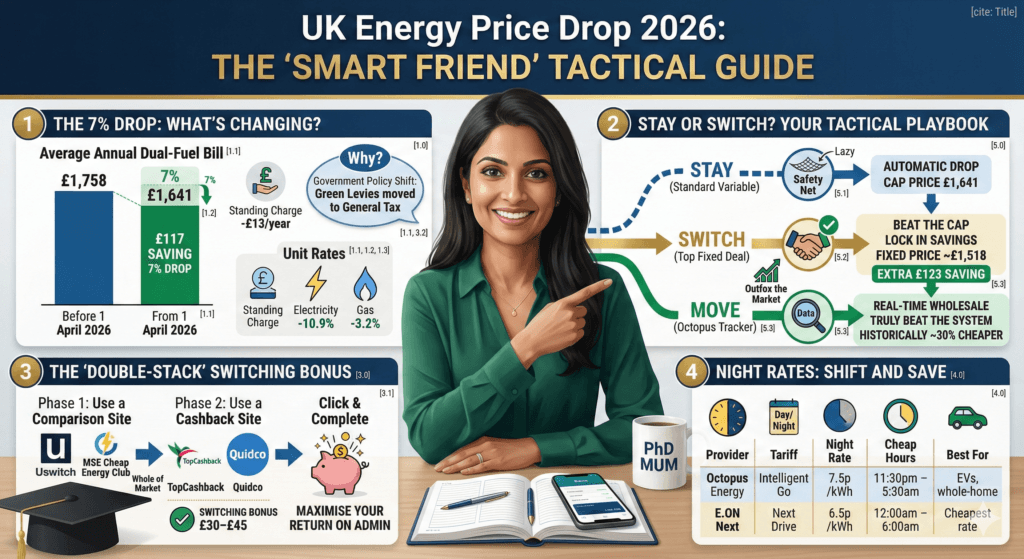
On 25 February 2026, Ofgem officially announced that the energy price cap will fall by 7% for the second quarter of the year. This change, which comes into effect on 1 April 2026, brings the typical annual bill down by £117.
As a PhD researcher, I look past the headlines. This “drop” isn’t just about market fluctuations; it is the direct result of a major government policy shift from the 2025 Autumn Budget. If you simply wait for April, you are settling for the “safety net” price—which is almost always the most expensive way to buy energy.
The 2026 Price Cap Cheat Sheet
- Announcement Date: 25 February 2026
- Effective Dates: 1 April 2026 – 30 June 2026
- New Typical Annual Bill: £1,641 (Down from £1,758)
- Monthly Saving: Approximately £10 per month for the average home.
1. Decoding Your Energy Bill: Layman’s Terms
If you’ve ever looked at your energy bill and felt like you were reading a different language, you aren’t alone. Most people focus on the total amount, but understanding the “why” is how you save the “how much.”
A. The Standing Charge (The “Daily Connection Fee”)
- What it is: Think of this as the “line rental” for your energy. It is a fixed daily cost you pay just to be connected to the grid, even if you turn off every light.
- What it covers: Maintenance of the physical pipes, wires, and cables.
- The 1 April 2026 Update: Standing charges are shifting. Costs for the Warm Home Discount are moving from the standing charge into the unit rate. For the average home, the daily fee will drop by about £13 a year (roughly 4p a day).
B. The Unit Rate (The “Usage Fee”)
- What it is: The price you pay for every kilowatt-hour (kWh) of energy you actually use.
- The 7% Win: This is where your savings live. From April, unit rates are falling because the government moved “green levies” (like the Renewables Obligation) off your bill and into general taxation.
C. The MPAN and MPRN (The “Identity Tags”)
- These are unique numbers for your house. MPAN (Electricity) and MPRN (Gas) are your “Supply IDs.” You’ll need these to switch, but they stay with the property even if you move.
2. Provider Spotlight: 2026 Loyalty Perks & “Hidden” Value
Beyond the 7% price cut, the “Big Six” are fighting for your custom with high-value rewards. For a mum trying to save, these perks can add an extra £100–£200 of value to your household annually.
British Gas: PeakSave Sundays
- The Perk: Half-price electricity every Sunday from 11 am to 4 pm.
- The ROI: If you save heavy laundry and dishwashing for this window, you aren’t just saving 7%—you are saving 50% on your most intensive hours.
Octopus Energy: Saving Sessions & Octoplus
- The Perk: Earn “Octopoints” for reducing usage during peak times (4 pm–7 pm).
- The 2026 Bonus: Octoplus rewards now include monthly perks like National Trust passes and free cinema codes.
E.ON Next: Next Smart Saver
- The Perk: Exclusive access to “Energise” offers, including £200 off solar panels and a £50 referral bonus for you and a friend.
3. The “Double-Stack”: Comparison Sites & Cashback
In 2026, the savviest way to switch is to get paid for doing it. By “double-stacking” a comparison site with a cashback site, you can effectively earn a Switching Bonus that the suppliers don’t advertise on their own homepages.
Phase 1: Use a Comparison Site (Uswitch or MSE)
Before clicking anything, you need to know which deal is actually the cheapest for your specific postcode.
- Uswitch: Excellent for a quick mobile-friendly comparison.
- MoneySavingExpert (Cheap Energy Club): This is the gold standard for tracking the market. Sign up for their alerts so they can email you the second a new deal launches that beats your current one.
Phase 2: The Cashback Hack (TopCashback & Quidco)
Once you know which supplier you want to move to (e.g., E.ON Next or EDF), don’t switch yet.
- Log into TopCashback or Quidco.
- Search for the supplier or a comparison tool like “Uswitch” within the cashback site.
- Click the link and complete your switch.
- The ROI: In 2026, you can often earn £30 to £45 cashback just for this 30-second extra step. It’s free money for a task you were already going to do.
4. Night Rates: The 2026 “Shift and Save” Strategy
The “cheap energy at night” you’ve heard about has evolved into Smart Time-of-Use (ToU) tariffs. While the 7% price cap drop helps everyone, these specialist night rates allow you to pay as little as 7.5p per kWh overnight, compared to the capped daytime rate of 24.67p.
As a researcher, I look for “Peak Shifting”—moving your energy-heavy chores to these low-demand hours to maximize your household ROI.
| Provider | Tariff Name | Night Rate | Cheap Hours | Best For |
| Octopus Energy | Intelligent Octopus Go | 7.5p /kWh | 11:30pm – 5:30am | EVs and whole-home savings. |
| E.ON Next | Next Drive | 6.5p /kWh | 12:00am – 6:00am | Cheapest unit rate in 2026. |
5. Stay or Switch? The Comprehensive Tactical Playbook
As a researcher, I look for the asymmetric upside: a small amount of effort for a significant, guaranteed return. In the current 2026 energy landscape, the decision to “Stay or Switch” is no longer just about price—it’s about Lifestyle ROI.
Strategy 1: The “Stay” (Standard Variable Tariff)
If you choose to do nothing, your supplier will automatically move you to the new, lower rates on 1 April 2026.
- Who it’s for: People planning to move house in the next 6 months, renters on short-term contracts, or those who simply value the “safety net” of Ofgem’s maximum prices.
- The Reality: You are paying the maximum legal price for your energy. In the world of finance, this is equivalent to leaving your savings in a 0% interest account. It is safe, but it is the least efficient use of your money.
Strategy 2: The “Switch” (Fixed-Rate Tariff)
This is currently the most popular move for 2026. By locking in a fixed rate, you protect your household from potential wholesale price spikes later in the year.
- Who it’s for: Families who need budget certainty. If you have children and your energy usage is high, a “fixed” cost allows for much better monthly planning.
- The Math: The market-leading Outfox the Market (Fix’d Dual Feb26) deal is currently priced at £1,518/year.
- The Saving: You aren’t just getting the 7% drop—you are locking in a price that is £123 cheaper than the upcoming April cap. That’s nearly two months of “free” electricity compared to the standard cap.
Strategy 3: The “Tracker” (Wholesale Tariffs)
For the “Smart Friend” who doesn’t mind a bit of data, the Octopus Tracker is the 2026 champion.
- Who it’s for: Tech-savvy households with a smart meter who want to pay the “real” price of energy.
- How it works: Your price changes every day based on the wholesale cost of gas and electricity.
- The ROI: Historically, the Tracker has undercut the price cap by 30% or more. While it carries the risk of prices spiking if there is a global crisis, it has consistently been the cheapest way to buy energy for the last three years.
6. Extensive Expert FAQ (20 Questions Answered)
1. Why exactly is the price cap falling on 1 April?
The primary driver is the 2025 Autumn Budget intervention. The government scrapped the Energy Company Obligation (ECO) levy and moved 75% of Renewables Obligation costs into general taxation.
2. Does “Price Cap” mean my bill can’t go above £1,641?
No. The “cap” is on the unit rate and standing charge, not your total bill. Use more, pay more.
3. I’m on a fixed-rate deal—do I get the 7% discount?
Yes. Suppliers are passing the “policy cost” savings to fixed-rate customers mid-contract.
4. What if my bill says “Estimated”?
Submit a meter reading on 31 March 2026 to ensure you aren’t overcharged at the winter rates.
5. Why did my standing charge increase while the cap fell?
Rising network costs (grid repairs) increased by £66, which slightly offset the savings.
6. Can I switch if I am in debt?
Yes, usually if the debt is under £500 per fuel for prepayment customers.
7. Is electricity more expensive than gas?
Yes, electricity unit rates are roughly 4.3x higher than gas.
8. What is “Levelisation”?
A policy ensuring prepayment and direct debit customers pay the same standing charge.
9. How long does a switch take in 2026?
It takes just 5 working days.
10. Do I need a Smart Meter to get the 7% drop?
No, but you do need one for night rates and rewards.
11. What is the “Warm Home Discount” change?
Ofgem moved these costs from the standing charge to the unit rate to help low-energy users.
12. Is VAT included in the quoted prices?
Yes, all “Price Cap” figures include the 5% domestic VAT.
13. What is a kWh?
Enough energy to run a laptop for a full day or boil a kettle 10 times.
14. Are business rates falling too?
Yes, but they are not protected by this domestic cap.
15. Can I get a £40 compensation boost?
Yes, if your supplier fails to fix a smart meter within Ofgem’s timeframes.
16. Will the cap fall again in July?
Analysts predict a small further drop of about £41 in July 2026.
17. What are “Green Flex” events?
Windows when renewable energy is high and suppliers offer half-price power.
18. Does my region affect my price?
Yes. Unit rates vary based on local infrastructure costs.
19. What is a “Tracker” tariff?
A tariff that moves daily based on wholesale costs.
20. Should I wait until April to switch?
No. Fixed deals today are already cheaper than the predicted April rates.
Disclaimer
This guide is for informational purposes only and does not constitute professional financial advice. Energy prices are volatile, and while forecasts for 2026 are stable, they are subject to change based on global events. Always check the specific Terms & Conditions and exit fees of a tariff before switching. MoneySavvyUK may earn a commission from some links on this page at no extra cost to you.
Sources
- Ofgem: Energy price cap will fall by 7% from April
- Ofgem: Changes to energy price cap between 1 April and 30 June 2026
- GOV.UK: Your energy bill from April: what’s changing
- Uswitch: Energy bills to fall with Ofgem’s February 2026 price cap set at £1,641
- TopCashback: Gas & Electricity Cashback Deals and Voucher Codes
- Quidco: Compare Energy Deals & Get Up to £40 Cashback
- MoneySavingExpert: Energy supplier rewards and referral schemes